

In addition to all the great content we bring cheer professionals in our quarterly print issue, you’ll find plenty of original exclusive content right here at TheCheerProfessional.com.
Keep checking back for all the latest and greatest news, updates, debates and more!
Candid Coach: Kelly Helton of Cheer Extreme
jen : August 11, 2016 1:28 am : In the Industry| Web ExclusivesAnyone who knows Kelly Smith Helton of the popular Cheer Extreme franchise knows that she is blessed with a creative mind. As owner of the gym’s Raleigh location, Helton believes in positive reinforcement and has an innate talent for coming up with fun ideas to get her athletes involved and reaching their full potential. (In fact, Helton is so good at inspiring loyalty that more than 200 of her athletes and gym parents attended her wedding ceremony.) Learn more about Helton’s offbeat approach and why it works:
 Talk about the creative activities you do with your athletes.
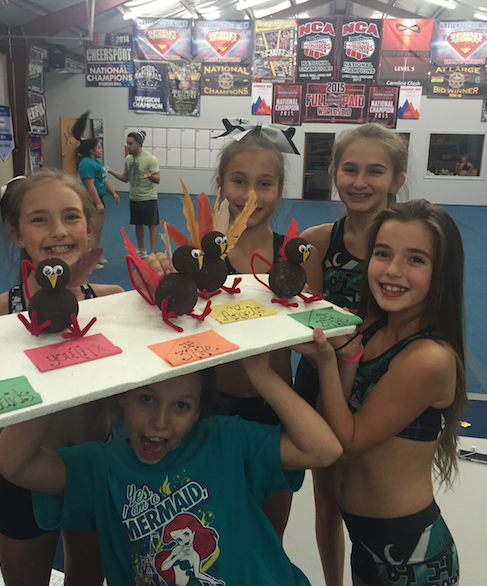
Helton: We do all kinds of crazy stuff—every month, we’ll do a craft kind of thing. We made Styrofoam turkeys for Thanksgiving. [Athletes who] hit a routine with three deductions got a feather for the turkey, and the kid who did the best in that routine then got to actually attach it to the turkey. For the last 30 minutes of their practice, we ushered everybody out of the lobby, put a tablecloth down and had a legitimate turkey dinner at the gym. We all shared what we were thankful for.
For Leap Day, we did a leapfrog thing, and we did bouquets for February. The way it worked was that if you had a routine with one deduction, we put the kid’s name or the stunt name on a rose that went into the vase of fake flowers. We teach accountability in our gym, and nobody wants to be the deduction. Routines with timing issues or bobbles that weren’t actual deductions were worth two points, and the team that hit fullouts perfectly got red roses in a vase. Every rose was worth a different amount of points, and the team with the most points got to skip out on the last 30 minutes of practice and go with me to Starbucks. We actually ended up with some of the best routines we’d ever done in February.
Are they all team activities?
Helton: Most are on a team basis, but we have some individual ways to get attention. We have incentive charts all across the gym, and every kid’s name is on their team’s chart. If you hit a fullout individually, you put a sticker under your name. Once you get to 25 hits, you get a sticker that says “Gold Star Club” to wear around the gym. Eighteen-year-olds will wear it around the gym because they’re proud they did 25 fullouts in practice.
 Why do you think these activities are important?
Helton: I think when kids look back, they’re going to remember things like this. That’s what I remember from cheerleading and what made it fun and still kid-oriented. These days, competitive cheer is so stressful and causes a lot of anxiety for kids, so if we can pair it with something that’s fun and kind of elementary school-esque, they tend to revert back to their childish ways and have a little more fun with it. It makes it less stressful. They’re not doing it to burn calories or do exercise; they’re doing it to [win a prize]. I think positive motivation gets you further in the sport than cursing and yelling. And it entertains the coaching staff too, because when you watch 40,000 hours a week, we can use that change of pace.
How do the kids respond?
Helton: They get really committed. A lot of times, they roll their eyes like, “Oh, man, again?” But then they get into it. The crazy thing is it works for all ages. Even our international team [members], some of whom are out of college, get really excited, too.
–Renee Camus
As a gym owner, Kim Braasch of Cheer Tyme gets plenty of requests from athletes and parents alike. But when a talented young athlete named Paul asked to wear the girls’ uniform, it was a situation she hadn’t navigated before—yet one that’s becoming increasingly common.
 Like many young athletes who identify as transgender, Paul planned to change his gender and his name, becoming “Crystal.” Not only was Braasch supportive, but so was Crystal’s father, who inspired everyone at the Fairfax, VA-based gym with his incredible support.
“You never know how you’re going to feel as a parent, but you hope you would be accepting,” explains Braasch. “I thought it was so brave and honorable and courageous of [Crystal’s] dad to stand up for his child. He inspired us as parents to be able to be that strong and that loving. It just was amazing.”
But what happens when a parent isn’t supportive of an athlete? “In that case, you become the parent role model,” Braasch says.
She also expresses the importance of getting everyone at the gym on board, while still being mindful of the athlete’s privacy. “We sent a letter to our coaches, including the office staff—but not to the entire gym, so we didn’t make it everybody’s business,” Braasch explains. “It was presented in such a positive light, [stating] that we are in support of this athlete, everybody deserves to cheer at Cheer Tyme, and we welcome everybody with open arms. In return, I feel like all the parents and the kids have been extremely supportive.”
It’s all part of Braasch’s philosophy that an inclusive gym environment “starts from the top. If you set the example that this makes this child happy, who are we to judge and try to make them feel inferior? Our attitude trickles down and makes for a more comfortable situation for everybody.”
Jade Faletto, a transgender athlete and coach, had a similar experience when Leeann Teasdale of Elite Cheer Sensation invited Faletto to join her Newport News, VA-based team. “They embraced me with open arms and were very welcoming,” Faletto says. “They knew I was trans, [but] it was never an issue. [Their attitude was], ‘You’re just another athlete, and we’re happy that you’re here. Thank you for bringing what you can bring to our gym.’”
Teasdale sees it the same way, though she believes Jade’s positivity and confidence helped set the tone for helping everyone feel comfortable. “I think you have to take the lead of the person that’s actually going through it,” Teasdale says, adding that “[you] set a precedent by not making something out of nothing. She came to the program, she cheered. That was it. I think that sent a strong enough message where I didn’t really have to say anything else.”
 Tannaz Emamjomeh of California All-Stars is also grateful to be able to offer her transgender athlete Sophia a safe space. Though Sophia is now home-schooled, she was bullied during her days of traditional schooling, so the gym has provided a safe haven both then and now. “Cheer is her happy place,” Emamjomeh says. “She’s safe at California All-Stars.”
And how do the teammates respond?
“I’m sure in the beginning there were questions,” Emamjomeh says, “but the kids asked the coaches. The coaches had a couple of private, outside conversations with them, and they understand. There’s really no judgment, at least that I can see. We all care for her deeply, and we know how hard this has been for her, so I think everyone makes a concerted effort to make her feel like she’s just like everybody else.”
Jeanine Russell, floor director at Core Athletix in the Finger Lakes, NY, feels it’s important for the athlete, not the gym, to share what they wish with the gym and its members.
“The goal would be to obviously respect the family’s wishes—the gym has to be concerned regarding how much information it divulges,” says Russell. “If the family doesn’t care who knows, then they need to be the ones sharing the information, so that it doesn’t come back on any privacy breach. Just as we wouldn’t share medical information, it’s the same thing.”
Of course, the more gym staff that are in the know, the more who can ensure that “nobody’s being inappropriate, there’s no bullying, and no discrimination is occurring,” Russell continues.
USASF has also responded to the needs of transgender athletes by developing a “Gender Inclusive Policy” (with the assistance of a third-party organization and doctors trained and experienced in creating policy for transgender athletes).
“Our transgender policy was created out of a need at several events where transgender athletes were competing,” shares USASF’s Senior Regional Director Karen Wilson, who facilitated research and development of the policy. “The policy allows participation by all athletes and follows a self-declaration and prior verification model that the Regional Directors facilitate under the direction of a professional from a third-party advisor.”
The policy has proved timely, as the past year has shone a spotlight on gender identity, thanks in part to high-profile stories like Caitlyn Jenner. Braasch suspects that Jenner’s reveal may have affected new transgender athletes, at least in Crystal’s case: “She’s known for a long time [that she wanted to transition], and when the whole Caitlyn Jenner thing came out, I feel like that helped elevate people’s desire to come forward and do it.”
But as much as Faletto appreciates Jenner’s story, she says it adversely affects people’s understanding of what transgender means.
“She kind of became our leader and our icon, and everybody thought, ‘Oh, this is what a trans person is—trans is surgery and enhancements,’” Faletto says. “People see me and [assume I] had all this stuff done, but no.”
But Faletto knows how important it is to be confident and true to yourself—and how that manifests itself on the mat when you have a supportive community. “If you’re happy with who you are, that will show, and people will respect that,” Faletto says. “Your [own] self-acceptance is the best thing to have; I found that and I’m very happy.”
–Renee Camus
More Power To You: Power Tumbling & Trampoline
jen : July 18, 2016 6:55 pm : Down to Business| Web ExclusivesPower tumbling and trampoline have long been part of the gymnastics world, and in recent years, gained major traction in the all-star cheerleading world as well. Many cheer gym owners are now incorporating trampoline and tumbling into their programs with amazing results. Like any new endeavor, it takes patience, time and discipline to get the program up and running, but the results are often well worth it.
 In a nutshell, power tumbling is a specialized discipline that involves trampolines, rod floors and double minis. Like gymnastics and cheer, it’s divided into different skill passes or levels, from beginner to advanced. Kellie Alvarez, Tennessee state chair for USTA (United States Trampoline and Tumbling Association), says that power tumbling and trampoline can build a cheerleader’s existing skillset and give athletes a new sense of aerial awareness. There’s a reason the discipline is becoming a growing trend.
Just ask Heather Dean, owner of Orrville, OH-based Heather’s Studio/Ohio Star Power, who says, “Power tumbling is my passion.” Since its founding in 1997, her gym has played home to more than 50 state and national champions in power tumbling and trampoline. Athletes compete in USTA competitions, and Dean believes that her gym’s power tumbling and trampoline programs have also contributed to her success on the cheerleading front.
Her advice to other gym owners who want to expand into these areas? Start small. Gyms that want to ease into offering these programs can use their existing floors and start with black bed trampolines to test the waters. “[These disciplines] are very easy programs to add,” says Dean. “The only necessary purchase is a double mini.” She adds that once gym owners know they want to continue, the next investment should be a rod floor and a yellow or white bed trampoline.
As Collinsville, IL-based Pride of Illinois’ tumbling and class director, David Briggs was given carte blanche to develop the gym’s power tumbling and trampoline program a few years ago. The main facility, nicknamed The Lion’s Den, is 14,400 square feet and holds two tumble tracks and two trampolines (in addition to all the other cheer and gymnastics equipment needed for their programs). Briggs says they started small and built from there, working to keep the budget “well within the parents’ comfort zone.”
 One way the gym does that is to keep the power tumbling and trampoline program affordable. Currently, they charge $99/month in tuition, which is $30 to 50 less than their all-star prep and competitive cheer programs. Competition fees, coach fees and team T-shirts are added up and divided into block fees for the season.
“Being affordable has been a great asset to our power tumbling program and is definitely one of our number-one selling points,” explains Briggs. “Our power tumbling parents only pay about $800 in block fees for the whole year, and the uniform is significantly less than a fully blinged-out cheer uniform, regardless of company.”
In just one year, Pride of Illinois has doubled the size of their trampoline and power tumbling program. Of the 550 total athletes at Briggs’ gym, 50 compete in power tumbling (five of those are cheer crossovers). The new programs also help with retention of all-star athletes, Briggs says. If they get burned out with cheer or just want a change of pace, it’s something different for them to put their energies into for the long haul or for just a short period of time.
However, transitioning and teaching those athletes who do crossover can sometimes be a challenge. There are major differences in how athletes are judged at competitions, so it’s an adjustment for some at first. “In cheerleading, the judges are far away from where you perform and [there are] often multiple athletes tumbling at the same time,” explains Briggs. “In power tumbling, the judges are right there looking at you. This was a struggle because it unnerved some of our athletes to know they were being looked at that closely.” With solid coaching and a little bit of time, though, those nerves were soothed, and the athletes adjusted.
Both Dean and Briggs say that another common challenge is coordinating practices and managing athletes’ and coaches’ time. “Every team and coach wants the entire gym to themselves,” Briggs says. “Sharing a space with other teams at the same time is always a challenge. But it forces you as coaches to better plan your practices.” As a workaround, they added Saturday practices in addition to their one weekday practice.
As far as hiring new coaches for power tumbling and/or trampoline, Briggs suggests that you can train cheer coaches in those disciplines if they’re interested, but that “the most important investment is to have a coach or director who is passionate about building this type of program. You cannot have a part-time coach who wants to be doing other things within your program in charge of [power tumbling and trampoline]. It will never get off the ground.”
Ideally, hires should have a power tumbling or gymnastic background or at least be highly motivated to learn and embrace the disciplines. “It cannot be someone who is just taking the position for a few extra dollars in their check per month,” Briggs cautions. “The coach must be willing to listen, to learn, to train and to adapt in order to be successful. They also must know how to set reasonable goals.”
And speaking of goal-setting, Briggs says that’s the key to creating success with power tumbling and trampoline. “If you set measurable and attainable goals, it can be one of the best additions to your program that you will ever make,” Briggs says. “Go slow, but go sure.”
–Dina Gachman
The Last Chapter: Angel Phyre All Stars
jen : June 21, 2016 2:19 am : Down to Business| Web Exclusives Whether due to changes in the industry or changes in their own lives, some gym owners are making the difficult decision to close their doors. CheerProfessional talked to three of those gym owners, and asked them to share what they learned in the process. See the first installment of this series below:
After running Angel Phyre All Stars in Larkspur, Colorado, for three seasons, owner Jessica Maynard was focused on the future. She moved into a huge new facility, bought an $18,000 spring floor—and then took a good, hard look at her financials and decided it was more practical to close the gym than to start a new season. See what Maynard had to say about how everything changed so fast, and what she learned along the way.
Why did you decide to close Angel Phyre?
Maynard: I started Angel Phyre with $5,000. I didn’t go into debt at all, and we started out really tiny. We did really well, and things started progressing. But for a cheer gym, you need a lot of space—at least 4,000 square feet of open space with no poles—which is hard to find since we’re located in a small town. We ended up moving last December, and I made that move knowing it was going to be difficult. We needed to bring more kids in, because the rent went from $2,500 to $4,600. At the time, I was still debt-free, and that’s how I wanted to stay.
We did really well this last season, before we closed; we got a lot of first [place wins]. We were just getting into our groove of knowing what we needed to win and molding our kids into the way they needed to be. Then we hit a block, and I looked at my significant other and said, “I’m so stressed out about making bills and because I want to make sure my coaches get paid.” I was paying myself maybe $500 a month and working 60 hours a week. I really wasn’t coaching anymore; instead, I was doing paperwork and email and dealing with parents and all these things. Our new facility was so pretty—everything was about angels—but I just kind of hit that point where it was like, “I’m not going to go into debt for this. I can sell all of my equipment and make money, and then I can be done.”
I thought Angel Phyre was a forever thing, but it was the right business move to make. I was so stressed out and putting my family in a state of financial insecurity, and I didn’t want to do that. It was a really horrible weekend; I cried pretty much the whole time. We went over the pros and cons about 3,000 times. We closed the gym on a Monday. The next Monday, I had sold all of my equipment and was completely out of the building. It was really quick. It was a big life change, and it’s very sad. I miss it so much, but I don’t miss the stress of it at all.
How did you tell your athletes?
Maynard: I sent my coaches an email and text first, so they weren’t blindsided. Then we sent an email out to everyone else, and my phone blew up.
How did you deal with parents who were stressed out about the gym closing?
Maynard: When I sent the email out to everybody, I didn’t tell them exactly what had happened. I just said that it was a choice that we made based on some situations and where the gym was going. I said, “If you have more questions, you can personally call me.” I didn’t feel like it was important for all of them to know. Parents called me crying, like, “Oh my god, are you okay?” The majority of the parents were very sweet and understanding. I know some of the parents are mad, but other than that, it was easy, because I had a set idea in my mind that this was what I was doing, and I was fully committed to this decision.
How did you sell the equipment so fast?
Maynard: I used the ASGA Facebook page. I put up the spring floor and sold it in like four hours. The people came from New Mexico in a 26-foot U-Haul, and we pulled it apart, put it in there and they were gone.
Were you able to help anyone who worked at the gym find a new job?
Maynard: One of my coaches was planning on moving at the end of the season anyway, so I knew she was going to be fine. I heard one coach was mad, but she got another job and I gave her a reference. I did anything I could do, but they also weren’t making enough money that it was going to be significant. I paid them $8/hour for four or five hours a week; they all had other jobs. Emotionally, it was more upsetting for everybody. One of my coaches is one of my good friends, and she’s not coaching at all now, and for her, it’s been devastating. I probably should’ve given them more of a heads up, but I didn’t really know until the day before.
What are you doing now?
Maynard: I decided not to work for a couple months. I coach high school, which is not a lot of money, but I love it. I’m not sure what I want to do next. The owner of WSA, Darren, contacted me and asked me to apply to be a judge. So I did that, because I would love to travel and get to judge cheer. At this point, I’m just kind of enjoying life and figuring it out.
What advice would you give other gym owners in your situation?
Maynard: The biggest thing is to make sure that you’re able to live with the decision you make. If you’re okay with having some hard years and going into debt, that’s going to be a life change just as much as closing. Also, look at your financials and be really realistic. How much money is going out every month? How much money is really coming in every month? Where is that money going? Be honest about what the numbers actually are.
–Lisa Beebe
Owner’s Manual: Carlos Onofre of West Coast Rush
jen : June 14, 2016 1:51 am : Down to Business| Web ExclusivesWest Coast Rush owner Carlos Onofre started coaching overseas more than 10 years ago. To date, he’s been to countries including Mexico, Canada, Chile, Ecuador, Switzerland and Costa Rica. Says Onofre, “I just put my name out there and, through connections, I started traveling and coaching in other countries.”
 Vital Stats
Name: Carlos Onofre, Owner and Coach
Gym: West Coast Rush Cheerleading All Stars
Location: Chatsworth, California
Founded: 2005
Size: 72 athletes on five teams
Gym size: 8,000 square feet
The Dish: “Early on, I started coaching and judging in Mexico—that’s how it all started for me. Now the events have grown so big it’s hard for me to attend all of them, so I have gotten a lot of people to go judge over there. The places making the biggest progress with cheer are Mexico and Canada, and in many cases, they’ll pay what you are worth in the U.S. In some instances, you can actually make a fair amount of money.
Overseas, they’re usually a little bit behind [cheer-wise] because they have gotten a lot of their information from videos or YouTube. They’re getting a lot better, but oddly enough, because they get so much from watching videos, they don’t understand that they’re mirroring. For instance, they’ll stand on their left leg instead of the right or pull their right heel stretch instead of their left, which is the opposite of what we do.
Overall, you’re able to make money on opportunities abroad, but initially, there isn’t much. The exchange rate can definitely hinder that. Besides money, a lot of it is paid off in different ways with flights and hotels. For the most part, they really take care of you and go out of their way to make you feel at home. Because of that, there have been places where I’ve been able to bring my wife and my child to visit and I’ll work for the weekend and then we’ll stay a few extra days. It varies.
Usually, you just need a passport to be able to work outside the U.S. I’ve never been to a country where you need a special visa, as long as you’re not working there long-term. That’s been my experience.
One of the biggest things I would stress is to make sure you go over the details before you agree to anything. Only once did I actually not get what I was owed. There are huge differences in the culture sometimes, so you need to be very upfront about what you need, what you’re going to get and how you’re going to get it. You don’t want to go to a country like Mexico and, all of a sudden, you’re getting paid in pesos. It has happened. I’ve gone somewhere and gotten the money in their currency, so that’s a big one—to make sure it’s all clear before you go.
The language barrier can also be an issue. I’m about to go to Switzerland—initially I was going to work with their Level 6 teams, but now it turns out that I’m also working with their Level 5 athletes. You just have to be clear about what you’re doing and what you’re not doing.
Most of the time, I’ve gotten these opportunities through someone I know directly or someone who knows that person. I’ve also gotten jobs just because I’ve coached so many athletes. They spread their wings and go somewhere and then I might get an opportunity that way.
The experience is very rewarding. I’ve never gone anywhere where they’re not eager and ready to work for you—they’re just so ready to go. I’ve worked with teams in the U.S. where they don’t want to do what you’re asking; overseas, you can say, “We’re going to flip you upside down, and someone is going to catch you by your pinkie toe,” and they’ll go, “Okay!” They trust you, because you’re coming from the States. They make the unfortunate assumption that everybody from the U.S. knows what they’re talking about.
I would do my homework online about the people you’ll be working for, regardless of who it is. You don’t want to go somewhere for the first time without knowing anything at all. If you’ve never been outside the country, it can be overwhelming. Colombia is one of the countries where cheer is growing rapidly, but it can be intimidating to someone who isn’t used to it. Some people can get culture shock. And definitely watch what you eat!
The bottom line: Just be clear about what you’re going over there to do and how many hours you’re working. Be firm, honest and straightforward—they don’t get insulted by that.”
–Dina Gachman


