

In addition to all the great content we bring cheer professionals in our quarterly print issue, you’ll find plenty of original exclusive content right here at TheCheerProfessional.com.
Keep checking back for all the latest and greatest news, updates, debates and more!
Kathy Penree still vividly remembers the life-changing conversation she and her longtime friend Elaine Pascale had back in 1996. Both former cheerleaders, she and Pascale were chatting about the business of all-star cheerleading, as well as their love of coaching. World Cup All Stars owner Pascale saw the writing on the wall—and suggested that Penree take advantage of the emerging sport by hanging out her own shingle. At first Penree was hesitant, but “Elaine pushed me out of my comfort zone. I started CNY Storm and it took off.”
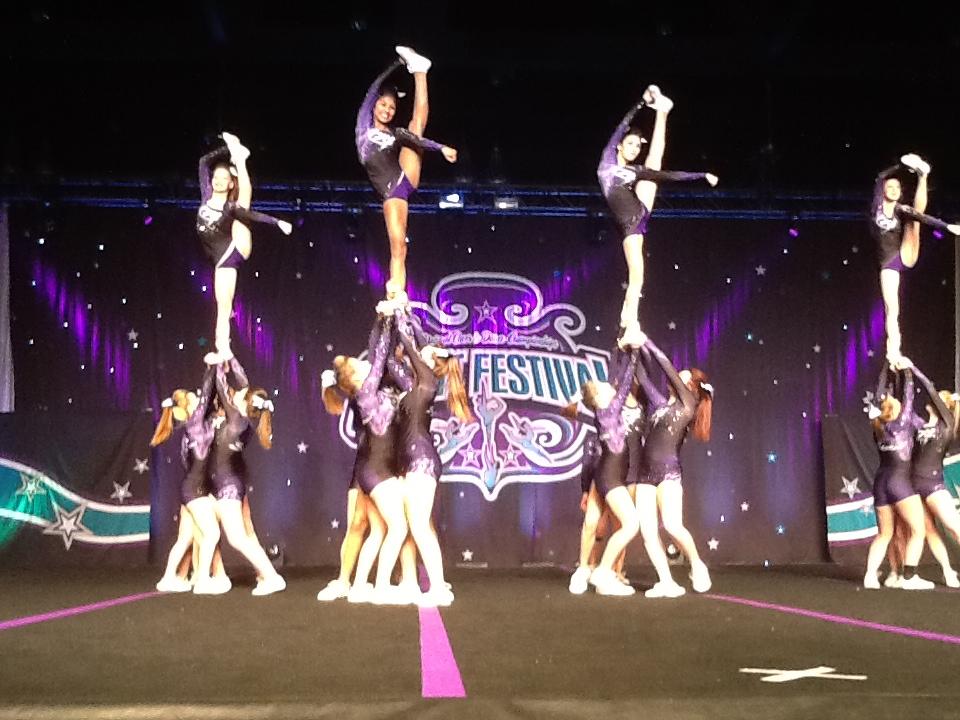 That might be an understatement. Today, CNY Storm includes three gyms, 375 athletes and a staff of 35. And Penree’s modesty doesn’t end there—she was named 2014 Program Owner of the Year by the USASF, led efforts to fundraise for fellow program owners affected by Hurricane Sandy and is regularly tapped by her peers for advice on running a successful franchise operation.
But it all began with a flagship shop in Utica, New York. There was one team, 16 kids flip-flopping around a 10,000 sq.-ft. gym just one night a week with Penree acting as coach. Yet Penree wanted her program to be different. She wanted to build one that was, in her words, “more than just a place for parents to drop off their kids.” So she made sure her athletes performed community service and that the coaches incorporated lessons about character building and leadership.
Gradually over the years, CNY Storm became more of a lifestyle for the girls and boys. Penree wanted to offer the same opportunity to more kids—so when two nearby programs wanted to increase their resources and collaborate, it all clicked. “It made more sense to combine our athletes, our coaches and all that we, as a [unified] team, can bring to the table,” says Penree.
As a result, CNY Storm now operates three New York locations: Watertown, Albany and Syracuse, with Penree “overseeing quality control and consistency in the brand over all three locations.” Her daughter, Jenn, 31, manages the Syracuse location, while the Watertown and Albany owners manage their own daily business operations, oversee dealings with parents and coach their athletes. “I want all the programs to be successful,” says Penree, who ensures that all of the owners talk every day and attend frequent staff training and education.
 In her management role, Penree no longer has daily personal contact with the kids and parents—a big change for Penree, who admits, with a laugh, to being, “a bit of a controlling person.” “I miss spending time with the girls and boys,” says Penree. But to make up for abdicating much of the precious face time with parents and athletes, Penree often hires Storm alumni who can bring professionalism and dedication to their role as part muse and part mother hen. The familiarity is especially helpful when it comes to rookie parents, adds Penree: “You are at your client’s disposal, and my staff is so great at handling the rather large learning curve when it comes to this all encompassing sport.”
The sport has been good to Penree. Storm teams have won Cheersport Nationals, Battle at the Capitol Nationals and several US Finals Championships. Dance teams also play a large role at CNY Storm, with four competitive hip-hop teams—and because dance isn’t Penree’s strong suit, she hires only the best. But that doesn’t stop her from getting on the dance floor occasionally to boogie, especially, she says, “when the kids need a chuckle.”
Beyond just giving them a laugh every now and then, Penree is hyper-aware of the influence she has on her gym’s youth as a female business owner and community leader. She tasks her athletes with service projects like promoting the iPromise Athlete Code of Conduct and volunteering to teach the two Storm special needs teams (whose members range in age from 6 to 19 and run the spectrum from cerebral palsy to autism). Penree also admits to checking up on her girls, making sure they are using good sense when it comes to things like social media and personal safety. “There are so many whole life skills to be learned,” says Penree.
When she does need to boost her own resolve, Penree often reaches for a file called “good things” where, over the years, she’s tucked scads of thank you notes and accolades from former athletes and parents.
“It helps me to keep pushing,” says Penree. “These kids are counting on me.”
–Molly Blake
Often Imitated, Never Equaled: Dealing with Trademark Infringement
jen : April 28, 2015 11:18 am : Down to Business| Web ExclusivesWhen CheerForce owner, Becky Herrera, logged onto the ASGA Facebook page this fall, she discovered a plethora of posts about a company that was using existing cheer logos to make doll clothes without the gyms’ permissions. This was familiar territory for Herrera, who’d previously discovered the CheerForce logo being used on bows and other apparel—without her consent.
“There was even a gym in Texas that took our logo, changed its color, and was using it as the primary logo on their Facebook page,” recalls Herrera. “It’s frustrating because we work hard to develop our brand and make it recognizable in our industry. It’s our own intellectual property, and other people do not have the right to use it or make money off of it.”
Herrera wasn’t about to let it happen again. “Fortunately, I was given a heads up by my colleagues and was able to reach out to the company [that ASGA members were complaining about] and tell them that they did not have my permission to use our logo before they attempted to do so,” she explains.
 But more gym owners may need to be following in Herrera’s proactive footsteps. As parents and external vendors look to make side income, trademark infringement continues to plague the professional cheer industry—a reality Randy Dickey of ACX Cheer knows all too well.
“I was at a competition, and there was a vendor selling bows with the logos of the gyms that were at the event,” he explains. In order to stop the merchant, Dickey and his colleagues had to approach the competition director. “It got really ugly, but she eventually pulled the product,” he adds.
Many gyms owners have found that it’s often a case of not-so-blissful ignorance on the part of the vendors, shares Tara Wieland of Michigan Storm. While larger corporations outfitted with legal departments may be aware of the concept of trademark infringement, the offenders are often smaller stores or cheer parents looking to accrue additional income by piecing together gym-themed apparel from their homes. In addition, many of these bootleg products are created when cheer moms and athletes contact vendors directly, sending a photo of their gym’s logo and asking for custom clothing.
“What these [people] do not realize is that they do not have permission to use our personal logos without our say,” says Wieland, adding that it is a company’s responsibility to get permission to replicate a logo before proceeding to duplicate it on a T-shirt.
Gym owners who have fallen victim to copyright infringement have not taken the experience lightly. To avoid running into the same issue, incorporate their suggestions on how to ensure that your logo is not replicated without your permission.
Buy your own logo. “If you don’t have it registered, anybody can go and buy your logo and make it their own—and if they purchase it, they can charge you to use it,” warns Wieland. The best way to ensure that you have the rights to your own logo is to have it legally copyrighted. This process is fairly inexpensive (typically around $35 – $55) and gives gym owners the power to stand up for their own branding images. For more information on how to copyright, visit www.copyright.gov.
Be proactive. According to Dickey, the best way to avoid trademark infringement is to keep tabs on the apparel circulating around your gym. “When you go to competitions, that’s often when parents are going to wear the stuff that has the gym logo on it, [and] you’ll know if it’s yours. If it’s not, that’s when you look around and say, ‘Hey, where did you get that?’”
Put it in your contract. “We have a stipulation in our handbook that states that you are not allowed to use our logo to make anything,” says Wieland. “You can’t make sweatshirts for your kids for Christmas using our logo without our permission. If the T-shirt place up the street is going to sell our logo, they need to compensate our brand.”
But, as Dickey points out, there will occasionally be times where one of these vendors will slip through the cracks. So what happens if you find your logo has been replicated without your permission? “The best thing you can do is to reach out to the company directly,” he suggests. “Pick up the phone and say, “You are using this logo without my permission,’ and ask them to remove the products from their inventory.” If that doesn’t work, the next step would be to involve an attorney.
Another resolution is to approach the offenders and offer them a contract to sell their products under consignment. “Would you walk into Chick-Fil-A with your George Foreman grill and start cooking chicken breasts on one of the tables and selling them for 50 cents inside? No, you wouldn’t. They would kick you out in a minute,” says Dickey. “The only transaction for apparel that is going to happen with my logo is inside our facilities and through our pro shop.”
–Nicole Pajer
When Midwest Cheer Elite owner Tanya Roesel calls a pizza place near her Ohio gym, chances are, it’s not to order a pizza—it’s to make a deal. She regularly contacts local pizza places, including franchises like Pizza Hut and Domino’s, and asks the general manager to consider doing a cross-promotion. If they’re willing, Roesel drops off a stack of flyers to be distributed on pizza boxes, and picks up a stack of pizza coupons to hand out at her gym.
Roesel and other gym owners are discovering that partnering with local businesses can be a great way to reach new customers. “We try to coordinate it with something going on. Football season is big, so we’ll contact them and say, ‘We have these great flyers. Do you mind putting them on the pizza boxes delivered in the month of September?’ The other one we do is Superbowl Sunday, because it’s the number one pizza delivery day of the entire year. We contact them in September to get permission for [that month], and then we’ll say, ‘Hey, on Superbowl Sunday, is it possible for us to bring up 2000 flyers that you’ll put on the boxes?’”
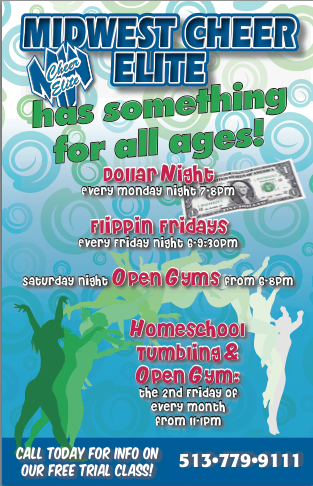 As for the flyer itself, Roesel said pizza places typically want a 5”x 7” size. According to Roesel, the September flyers typically focus on two specific aspects: a special half-season team promotion (since the timing coincides with registration), and a coupon for a free open gym. She tracks the coupons coming in and also puts a message out on social media saying, “If you order a pizza and get a flyer, take a picture and post it!”
So far, Roesel has been impressed by the results. “We give them a year on the coupon. If we give out 1,000 coupons, we’ll probably see 100 of them coming back, but we also get a lot of phone calls.” She recommends that other gyms give this kind of marketing a shot, because “it’s easy and it’s cheap.”
In a similar program at Twisters Sports in Warrensburg, Missouri, Danielle Johnston reaches potential customers by connecting with local charities. She says, “We do a charity of the month, where we offer the opportunity for families to come in and donate things. We did a blanket drive for the United Way, we did a canned food drive, and we did one for Survival House, which is a women’s abuse shelter in our town.” She asks other businesses to help promote the drives, which encourages people to stop by the gym and donate.
Getting new people into the gym—even just to drop off a donation—is a big deal to Johnston. “We’re located in a weird spot, in the back of a strip mall. Our goal is not just to raise the resources for charity, but to get our name out there and make sure people know where we are.”
In addition to building the gym’s brand, Johnston sees tremendous benefits from the charity drives. “We have 550 families coming into the gym every week, and even if they bring one can, that’s 550 cans that go to the local pantry. If even half of the people have a gently used blanket, then we bring in almost 300 blankets. It gives the kids a chance to see that there’s more out there than just what they’re accustomed to.”
Whether you’re handing out flyers or giving kids a fresh perspective, connecting with other local businesses and charities can build your customer base—and give people a great first impression of your gym.
 2014 was a big one for Spirit of Texas—at the Summit, the gym placed third in Youth 3 and first in Senior 3. In addition, they snagged three silver medals at Worlds, and their coach Krista Godbee was appointed Coach of the Year by USASF. As this season shapes up to follow suit, Spirit of Texas looks poised to continue as one of the cheer world’s powerhouse organizations.
Now celebrating its 20th season, the Dallas-based program was founded by Brett Allen Hansen and Brad Vaughan. Prior to joining forces, Hansen worked with Southwest Spirit, while Vaughan spent his days building choreography routines for Rebel Cheer Company. Realizing they both possessed a desire to run their own program, the duo teamed up to open their first location in Arlington, Texas in 1995.
According to Hansen, the partnership wasn’t instant. “We actually competed against each other for a couple of years before Brett and I merged,” he jokes.
But the result of the merger was a successful fusion of the co-owners’ varied skillsets. “Brad is very creative and he’s a really good choreographer,” says Hansen. “He also tackles things like the monthly newsletters and he’s the one that keeps the organizational side of the business running.” Hansen spends his days directing staff, prepping curriculum and coaching at the facilities.
The partnership has proven fruitful, with Spirit of Texas earning a reputation for polished routines and pristine choreography. Their secret? Old-school values. “We still embrace the things that were popular when we cheered: strong jump techniques, motion techniques, the fundamentals of cheerleading,” says Hansen. “I think that is probably something that people [associate with] our program—keeping everything clean and not sacrificing form for a new skill or trying to do something that’s not perfected.”
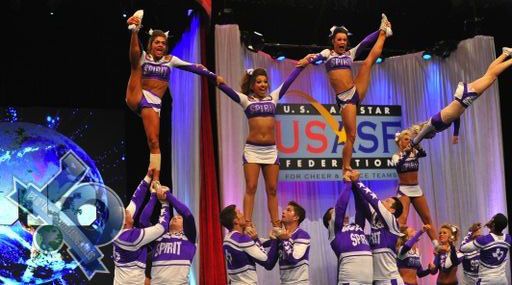 As leaders, Hansen and Vaughan encourage their athletes to focus less on winning and more on development. “I tell them all the time, ‘I don’t care if you win, but what I care about is you doing a perfect routine,’” says Hansen. “If my teams go out and do a perfect routine, they are going to win. We don’t talk about winning. We just want them to go out there and hit a beautifully well-executed routine.”
Over the years, Spirit of Texas has continued to expand, opening a new location in Coppell, Texas in 2011. The additional practice space has made room for the organization’s increasing enrollment. “Just in all-star teams themselves, we’ve increased our enrollment by 25 percent each year since 2011,” Hansen explains, adding that the number of teams has increased from 12 to 15 since last season.
Hansen attributes much of the program’s growth to with the boom in the Dallas-Fort Worth market, which he says is “now the fourth largest metro area in the United States.” While it made sense to add the location further north to accommodate the growing demand, he’s also acutely aware that Texas is one of the most cutthroat markets in competitive cheerleading. However, Hansen doesn’t allow that to psyche himself out: “It takes so much time to focus on what your competitors are doing, and you need all that energy to develop your own athletes—it’s better not to even worry about it.”
Hansen relies on his gym’s reputation to attract athletes. “It’s positive, it’s fun, and the kids do well at competitions. Everybody hopes to be on a winning team.” As such, the owners strive to keep things fun. Adds Hansen, “Cheerleading has gotten so hard; we’re all such perfectionists and want to do well at competitions and sometimes practices aren’t fun. It needs to stay positive so the kids are still interested.”
In addition to top-notch athletes, the gym has been recognized for their effective coaching staff. The organization recruits coaches with strong cheer backgrounds, often from within. “Typically we hire from the inside out. Our own athletes become our own coaches when they age out, or they go to college and come back and want to teach,” explains Hansen.
As the program expands, the biggest challenge that Spirit of Texas is facing is inadequate floor space. And as the teams continue to multiply, the owners are looking to remedy that situation. “We are going to have to find a bigger facility or build one. That is definitely in the future,” says Hansen.
–Nicole Pajer
 There was no time to batten down the hatches. It was business as usual July 8, 2012, at Fredericksburg, VA-based Cheer Fusion. While coach Mandi Spina and her senior Level Four co-ed Dream Team members practiced double downs, the sky turned ominous. The rain pelting the building had shifted sideways, sending a warning through the facility’s garage door.
The room went black. Spina instructed everyone to carefully dismount and head to the middle of the floor. Rain turned to hail, as gale winds shook the building. There were no weather alerts, but to be on the safe side, Spina instructed everyone to head single file to the gym’s steel-enforced dance room.
Within minutes, a loud thunderous noise shook the building and walls around them collapsed as Spina pushed the athletes through the door and crammed them into a corner, using her body to shield as many of the 10- to 18-year-olds as possible. Debris, cinder blocks and glass swirled around them as the gym disintegrated.
In less than 10 minutes, there was almost nothing to show for the six-year-old gym. Two of the cheer parents were found buried under debris outside of the safe room; they both survived but suffered serious injuries. The trauma spared no one.
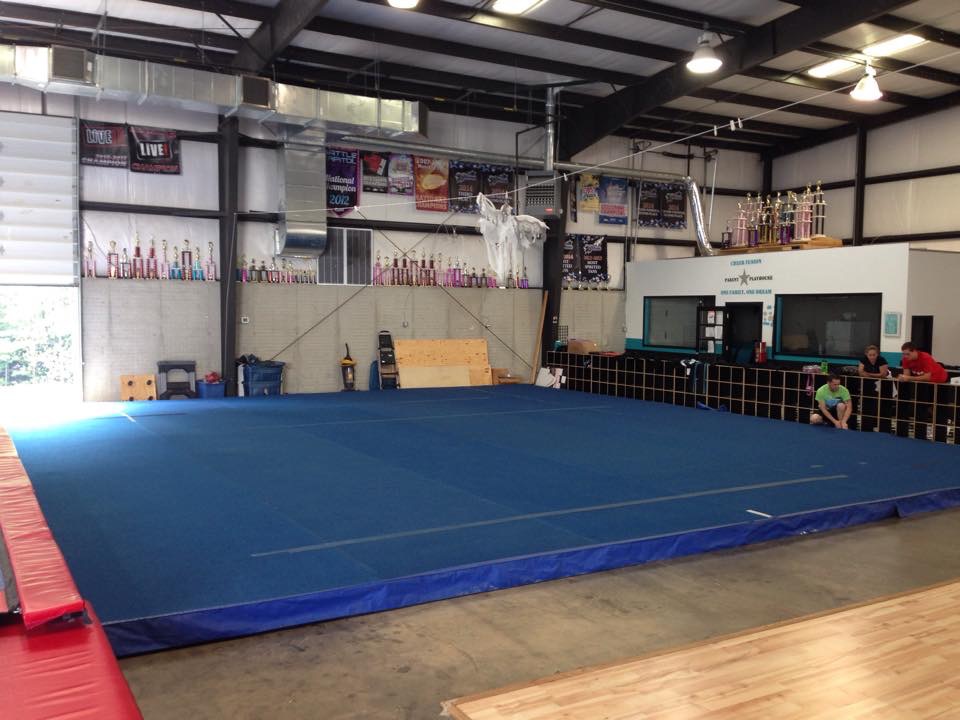 But even Mother Nature cannot shake Cheer Fusion’s spirit and determination. Leaning on their mantra “Faith, Focus, Believe,” Cheer Fusion’s staff and athletes refused to quit. Within a week, Spina and gym owner Connie Allen decided the kids needed the gym rebuilt as part of the healing process to find their strength to move on.
“It wasn’t really our decision,” Allen says. “All I had to do was look at those kids. They were the reason. The kids wanted the rebuild. They needed a place to go.” Many of them were spending seven days a week at the gym at that point, working hard to progress, and Allen and Spina didn’t want to let the athletes down. For some kids, the gym was a second home.
Other facilities in the community opened their doors to the Cheer Fusion teams during the one-and-a-half-year rebuild, including North Stafford High School, Paragon Gymnastics and the Fredericksburg Ballroom. The all-star cheer world rallied, too, from The JAM Brands’ Brandi Sims setting up a fundraising account to other cheer programs holding T-shirt fundraisers and sending care packages. Some gyms donated equipment, and Spring Floor Guys in Delaware pitched in a new hardwood floor.
 The efforts paid off—Cheer Fusion’s new home is nearly twice its original size. The extra space opened a world of possibilities not to just survive but to prosper, particularly by expanding the gym’s tumbling program run by Stephen Young. What started with one or two Saturday classes turned into a three-coaches-strong tumbling program offering up to five classes daily. “It’s been a big surge for the gym,” Spina says.
During the rebuild, a new dance room was also added with full-length mirrors and a hardwood floor. The addition has allowed dance director Diana Hill to add breakdancing and tutting classes to the mix, along with master classes with special guests like dance crew Jungle Boogie and Bonita Lovett from Beat Freaks.
Now the small gym, which has grown from 25 to 130 athletes since its second season when Spina came on board, plans to add a Worlds team by next season. Allen and Spina don’t let Cheer Fusion’s size steer its competition schedule. “We set ourselves apart by going out of our comfort zone so we can see what people are doing in other areas,” Spina says.
The experience and exposure Cheer Fusion gains from expanding its travel schedule pays off on the cheer floor. Case in point: During Cheer Fusion’s most recent and best season yet, they earned 51 first place wins, 12 grand champion titles, paid and at-large bids to Summit, an at-large bid to the Dance Worlds and five US Finals paid bids. Cheer Fusion was also one of three national finalists for USASF Small Program of the Year, and Spina was named the Cheer & Dance Extreme Coach of the Year for the 2013-14 season. Cheer Fusion team parents nominated Spina for her courageous actions during and after the tornado flattened their facility, as well as her top-notch coaching skills.
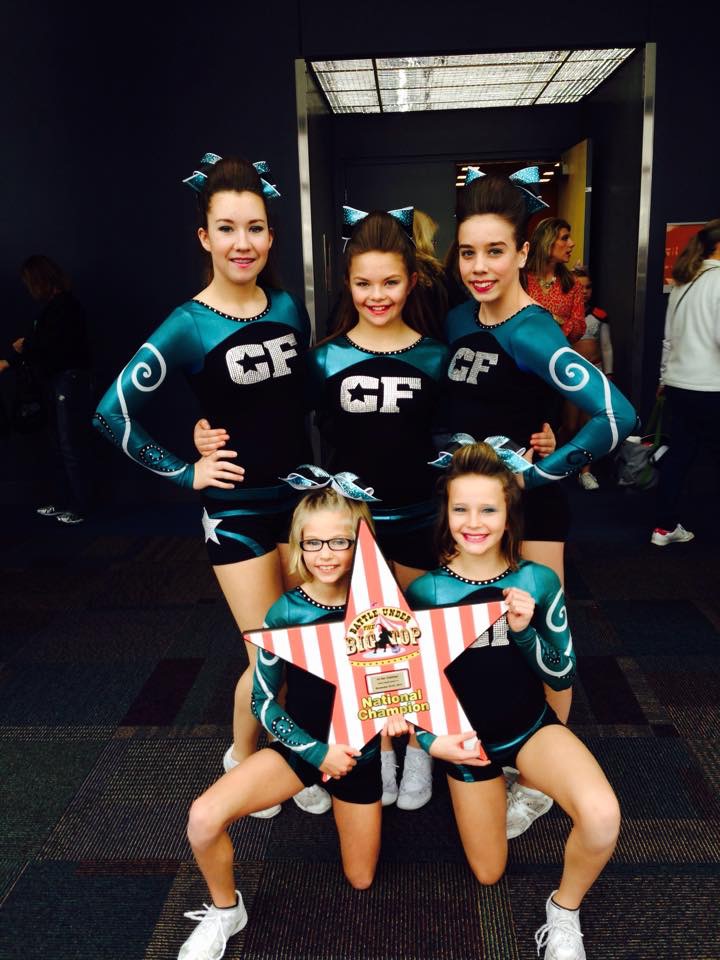
 More recently, in November the teams stormed Battle Under the Big Top in Cincinnati with three teams, winning each of their divisions with deduction-free routines. The Dream Team was named Level 4 grand champs and they earned a Summit bid.
“It’s all about the dedication you put into your team,” Spina says of her coaching style, which pushes the kids to be the best athletes they can be. “I am about effort. You don’t have to be the most talented kid on the team to make an impact. They are like puzzle pieces. Our whole team is a jigsaw of different talents and different personalities. You take those together and find the right way to coach that measures their strengths and weaknesses and then highlight them best you can—that’s my philosophy.”
Spina and staff are good at putting things back together again. And while they are putting much of the past behind them, some of it remains under them. Salvaging a few of the strips from the gym’s old floor ruined in the tornado, they were able to have a six-panel hardwood floor built from the remnants at the front of the facility.
“It was a heartwarming moment to see it all come together finally,” Spina says. “The kids who were in the building when it collapsed wanted to be the first kids to tumble on it, the first ones to jump on it or to do a standing tuck. It was really cool to see everyone come together for that.”
–Arrissia Owen


