

In addition to all the great content we bring cheer professionals in our quarterly print issue, you’ll find plenty of original exclusive content right here at TheCheerProfessional.com.
Keep checking back for all the latest and greatest news, updates, debates and more!
Spotlight: DJ Yeager of Cheer Updates
jen : September 22, 2015 3:56 pm : In the Industry| Web ExclusivesThe wildly popular CheerUPDATES Twitter feed started off simply enough. DJ Yeager, then a coach for the now-shuttered Galaxy program, was traveling to the Majors in 2012, and his athletes wanted play-by-play updates from the competition.
“I didn’t want to send out a ton of text messages,” says Yeager. “I decided to start a Twitter account instead.”
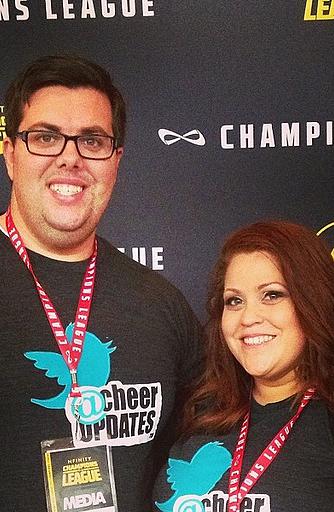 Word spread quickly, and by the end of that first evening, CheerUPDATES accumulated 500 followers. Athletes at gyms around the nation and in Canada, it seemed, were desperate to know about stunts, omissions, pyramid hits, standing fulls and dismounts. Yeager, 29, kept Tweeting and the followers kept reading and re-Tweeting. By the time Worlds rolled around, much to Yeager’s surprise, CheerUPDATES had amassed 11,000 followers who devoured each 140-character Tweet packed with information—in widely understood cheer shorthand—about each team’s performance. The most popular Tweets, of course, included just one word that said it all: HIT.
“Twitter is so immediate and it lends perfectly to the cheer competitions because of the coded system of deduction,” says Yeager.
From the get go, Yeager made sure the CheerUPDATES posts were precise, accurate and, most importantly, unbiased. “I stuck to the facts,” says Yeager, whose deep knowledge of cheerleading began back when his sister first began competing. He’s also coached and consulted with teams about everything from music to stunts.
After Worlds, Yeager began attending competitions when he could, and Tweeting the results live. Followers would re-Tweet and reply, share photos and comment. All the while, however, the account was shrouded in mystery as the man behind the Tweets was as yet unidentified. There were rumors, but Yeager kept his alter ego secret and didn’t emerge as the CheerUPDATES mastermind for some time.
“It was fun,” says Yeager, “to be anonymous but at the same time, we were very careful about maintaining a high level of accuracy when we were calling competitions.”
By the middle of 2012, Yeager’s cover was mostly blown. “They figured it out,” said Yeager. Nothing changed, however, and today CheerUPDATES boasts more than 150,000 followers who, during competition weekends, will hang on every tweet that Yeager or his co-tweeter, Marley Lopez, fire off at a feverish pace—about every 2.5 minutes. Even if there aren’t competitions, the Tweets are energetic and frantic, peppered with contest announcements, giveaways, emojis and cheer-related chatter. The industry has also taken notice of Yeager’s enthusiastic and very targeted social media following, and resulting content sharing and marketing opportunities have enabled Yeager to monetize his efforts.
“It took a season and a half to start making any money but it was worth it,” says Yeager, who, should he have to miss a competition, calls only on a few very trusted sources to run the show. But for the most part, he or Lopez will travel to as many competitions as time allows and park themselves with their gear, a computer and an iPhone in front of the stage until the lights dim and the music cranks up.
During big competition weekends, “it’s insane,” said Yeager. Hundreds of new followers—and hundreds of thousands of re-Tweets and interactions—are the norm. That’s because besides CheerUPDATES, there’s also CheerUPDATES2 (a Twitter feed aimed at the younger, Level 1 cheer crowd) and CheerMEDIA. Their latest endeavor, CheerMEDIA launched in 2014 and serves as a stationary source of video, music and other multimedia that so often get buried in the frenetic CheerUPDATES Twitter feed. “People can seek it out,” said Yeager.
The cheer-obsessed social media doesn’t end there. CheerMedia is on Instagram, too, and averages 45,000-70,000 likes on a given weekend.
Yeager, who studied English and communications at University of Delaware, prides himself on exporting content that benefits the cheer crowd and staying on top of the trends. “We are positive and real, and I want to keep it that way,” said Yeager. “But at the same time, we have to continually evolve with social media.”
He’s already evolved. Yeager sent the first CheerUPDATES Tweets using a Blackberry device; today, Yeager is a one-thumbed master of the iPhone 6. Given the time commitment CheerUPDATES demands, Yeager rarely puts his phone down. When he does, it’s to coach at TriState Athletics in Delaware, go walking or shop. But for the most part, he’s happily connected all the time.
“That might bother some people…but I like it.”
–Molly Blake
Now Hiring: Finding Reliable Staff
jen : September 9, 2015 12:07 pm : Down to Business| Web ExclusivesWhen hiring new staff, Kevin Spencer of Southern Kentucky Athletics follows the same litmus test as Facebook mogul Mark Zuckerberg, asking himself, “Would I work for this person?” If the answer is no, then the coaching candidate doesn’t make the cut.
Pretty cut-and-dried, but hiring isn’t always so simple. Finding coaches that demonstrate proper technique, are responsible and share the same values as your gym can often prove to be a tall task. So how do you go about staffing your facility with top-notch talent? We picked the brains of some of the best in the industry to get their secrets on coach recruitment.

The staff at Southern Kentucky Athletics
For Spencer, it comes down to what he calls the “Four P’s” of hiring: punctuality, professionalism, positivity and productivity. The first three are non-negotiables, but he’s willing to be somewhat flexible on the latter. “When you get to the productivity part of it, you can fix that through teaching them,” says Spencer. “But those other three traits, you either have them—or you don’t.”
Many gym owners require their coaches to come USASF-certified, but Pride Cheerleading’s Matthew Kyser is willing to look past that for the right character traits. “I have never turned a coach down for not having their certifications,” he explains. “I’m a firm believer that everyone must start off somewhere. If I feel that a coach is a strong leader, knowledgeable of the sport and a good fit for our family, I will invite them to take a coaches’ clinic with myself and shadow our staff.”
For Kyser, that philosophy translates to a prospective employee’s level of qualification as well. “I have known some very talented coaches who could coach any level; however, their personalities were not a match for that team,” he explains. “I have learned through the years that experience is not the only criteria to take into consideration.”
As far as where gyms recruit from, smaller programs like Southern Kentucky Athletics wisely focus on promoting and training from within. “Very rarely will we be able to pull people in from other programs, especially since we’re a smaller community and it’s not as appealing to outsiders,” says Spencer. But when he does recruit externally, there is always a background check involved. “You’ve really got to cover your butt nowadays because there are some crazy people out there,” he adds.
Other gyms choose to recruit out-of-state coaches to pump up their staff potential, but it’s important to fully vet a candidate before making the investment. Just ask West Virginia Cheer Academy owner Kayla Wygal, who had a horrible experience recruiting an out-of-state coach who’d answered her Twitter ad. The first red flag? He’d refused to include his past gym as a reference.
“I asked him why, and he said, ‘Well, we just had irreconcilable differences,’” she explains. “He was 21 years old and our kids liked him, so we called his other references and they all gave him a great report.”
But six months into the coach’s employment, things took a negative turn, says Wygal. “He lied to us and to parents. He snuck and did private lessons. We even found out later that he was Snapchatting inappropriately with our girls and made a lot of our seniors feel very uncomfortable.”
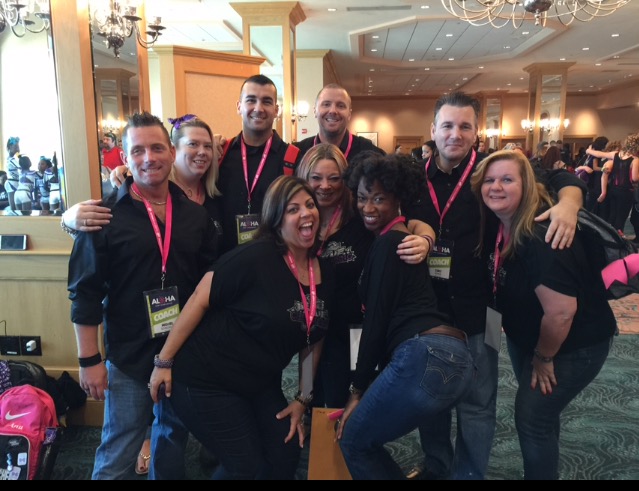
The staff at Pride
In light of such situations, many gym owners, like Spencer, suggest putting coaches on a trial period before handing over a full-time contract. At Southern Kentucky Athletics, all new hires are put on a 90-day trial, during which they can be released at any time. “While on the trial, they will always be working with one of our veteran staff; for 60 days, it’s like being an assistant coach and shadowing,” says Spencer. “Not until those two months are up do they get to teach a class on their own.”
And once new employees are on board, it’s just as crucial to keep sharpening their skills and giving them opportunities to learn from their competitors. Southern Kentucky Athletics sends its staff to yearly seminars such as JAM U, Varsity Coaches Conference and USASF regional meetings; Spencer also swears by the ASGA Facebook group, where he believes cheer professionals can learn best practices.
He also aligns his organization with other gyms to in order to advance his staff’s productivity. “We’re actually taking our entire staff to the Cheer Athletics facility soon to do some training and to see how they run their practices,” he explains. “They have a great program, and we have a lot we can learn from them.”
When it comes to recruiting solid coaches, all gym owners have their own techniques, but finding what works for your gym is the key to upping your staffing game.
–Nicole Pajer
Rallying Your Gym Family After Tragedy
jen : September 2, 2015 12:56 pm : Mind, Body & Soul| Web ExclusivesChesapeake, Ohio is set on the banks of the Ohio River. At last count, less than 1,000 people live in the tiny town, steeped in railway history. Stuck halfway between the two bridges that connect the town to its neighbor Huntington, West Virginia is Jill’s Tumbleworld. Owned by Jill Greenhill, the gym plays home to the Dreams All Stars and more than 350 athletes, some of whom travel two hours to train. When the girls and boys, coaches and trainers head home after a rigorous practice, they can be seen squeezing one another’s hands three times. Later, there will be a flurry of texts and social media posts that read simply, “Sqx3.”

The three shoulder straps signify the “Sqx3” motto at Jill’s TumbleWorld.
Coined by Toni Black, it’s shorthand for “squeeze times three.”
Black was a star athlete at Tumbleworld and an “all-around nice, well-mannered girl,” says Greenhill. “She was soft spoken but somehow managed to make people laugh.” Black was diagnosed with stage 4 brain and lung cancer in March 2011; almost immediately, the aggressive fight against the disease was on. It was during these painful treatments that Sqx3 became much more than just a meaningless series of letters and numbers.
“It was a way to send her our support and love,” says Greenhill. “And it caught on. Girls would send her a text or post on her Facebook page and it just was such a simple way to encourage her.”
While Black battled the cancer with the fierceness of an all-star and the squeezing salvo continued with gusto, Greenhill furthered the momentum both for her gym family and the small town that has rallied around her athletes since the moment she opened her facility in 2001. She started Team Toni Inc., a non-profit organization “designed to strengthen communities and families by offering help where it is needed,” says Greenhill. Through 5K races, motorcycle runs and car washes, funds are raised and donated to Chesapeake locals in need to cover everything from medical expenses to funeral costs and meals. It’s a way, says Greenhill, for the athletes to “reflect on the influence Toni had on us and look at the impact that we can have and the help we can provide to so many others.”
Similarly, Lori Sauers, managing director of the Western New York Outlaw Allstars, is always on the lookout for ways “to pump someone else up.” Her motivation? “The positive vibes you put out always come back.” And with upwards of 220 athletes training at three Outlaw locations, the optimistic energy is abundant. That verve was eventually called to task when, on a four-lane stretch of highway in West Seneca, NY, 14-year old Outlaw cheerleader Alyssa Loschiavo was nearly killed.
“It was such a shock and so abrupt,” says Sauers. As word of the accident spread, athletes, including Alyssa’s sister Gabby, and staff began filtering into the gym. It was there that they comforted one another, cried and talked for long hours about Loschiavo. “The gym was a safe haven where they all felt comfortable sharing their emotions,” says Sauers. “We wanted the girls to know it was okay to feel mad and frustrated.”
Later the gym became ground zero as all-star programs from across the nation flooded the Outlaws with a veritable rainbow of bows that were eventually incorporated into a huge wreath that hung on Loschiavo’s hospital door. The lesson was not lost on Sauers. “That so many gyms participated demonstrated to the athletes how a community comes together,” says Sauers.
Loschiavo eventually recovered enough to leave the hospital but, sadly, her grave injuries left the young lady with severe brain damage. For three years, Loschiavo lived at home with her family; meanwhile, her gym family visited, wore pink and green—Alyssa’s favorite colors—and participated in benefits for the family. After her death in September 2014, the gym hosted a competition and established a scholarship in her name. The recipient, an outstanding all-star, receives tuition and competition fees for an entire year.
Like many gym owners, Sauers and Greenhill bootstrapped their programs from just one or two teams into the strong programs they are today. Despite the growth, both say that knowing each and every athlete on a personal level is paramount—particularly when tragedies hit close to home. That involves checking social media feeds and posts for any sign of stress or sadness. When that happens, both Greenhill and Sauers jump in.
Besides that, the athletes are always encouraged to write personal notes to each other and, in cases like Black and Loschiavo, cards and letters to the families affected. And of course, Sqx3.
The Dreams memorialized Black in other ways too. A giant framed photo of the smiling girl hangs over the front desk of the gym, and this year’s uniforms feature three shoulder straps (a nod to the Sqx3 mantra that buoyed the young patient’s spirits through round after round of agonizing chemotherapy). There’s also a butterfly stitched on the hip. Why a butterfly? When Black passed away on April 9, 2012, at the tender age of 23, the team released 23 butterflies near her graveside. “It was symbolic of life,” says Greenhill.
In October, on the day Black would have turned 26, the team will release 26 butterflies.
“We see things every day that remind us of her,” says Greenhill. “Life is special.”
–Molly Blake
**Feature photo courtesy of @woodleywonderworks via Flickr
The Real Deal Behind Divisions I and II
jen : August 25, 2015 9:56 am : In the Industry| Web ExclusivesThe conversation about redistributing small gym and large gym numbers to level out the playing field of the all-star industry began two years ago at USASF regional meetings. Today, it has become USASF’s newest initiative for the 2015-2016 season.
 USASF will assign gyms in Division I or Division II—previously large gym and small gym, respectively—based on the program’s total number of traditional All Star and All Star Prep athletes. A Division I gym has 126 or more traditional All Star and All Star Prep cheerleaders enrolled in their program, while a Division II gym has 125 or less. (Exhibition teams, crossover athletes, special needs teams and dance teams do not count toward the total.) As with last season, a gym that increases above the cap during the competition season—such as with the addition of prep athletes—will automatically move to Division I.
“This little baby step is the perfect first step,” says USASF board member Morton Bergue, who has been instrumental in this discussion. “The industry has really grown over the years; within five years, the number of gyms in this country has doubled.”
Division I (large gym) and Division II (small gym) isn’t an entirely new idea in the industry. Last season, for example, a small gym was defined as any facility with 75 or less traditional All Star athletes enrolled in a program. Now that cap of 75 will jump to 125 and include all-star prep athletes in the 2015-2016 season. The main reason for the cap increase is the recent rapid industry growth of small gyms and big-name franchises throughout the US.
“We felt the hardship of the Division II teams that felt the pressure of [competing against] the large gyms,” Bergue says. “Mega gyms are moving out of area—they are everywhere. We needed something to protect Division II gyms that want to compete against like gyms with the same economic field and level of teams.”
USASF cannot regulate or limit business owners from running an organization in a certain matter; however, it can implement and enforce policies to ensure event producers and gym owners follow the rules. Under the new USASF age grid rules, event producers are to split “small team” and “large team” divisions by gym size (Division I and Division II) if 10 or more teams are competing in each category.
“They have to follow the rules as given,” Bergue says, explaining that event producers are subject to a compliance review if someone reports them to USASF for a rule violation.
Individuals who own gyms with multiple locations have two options: 1) registering each location with the USASF separately and thus agreeing not to share athletes between locations, or 2) registering all locations with the USASF under one main/umbrella organization and having the option to share athletes between locations.
Mostly, the biggest change is just a matter of semantics—the name change to Division I and Division II—as well as the change on the dividing line between the two. Other than that, many of these policies have already been in place throughout last season. But Bergue is hopeful that these developments will benefit the industry in a big way long-term, and help align our sport with other team sports that use similar terms (like college sports, etc.).
“I think in the long run when it takes hold, and we start fine-tuning it, it will help us grow,” Bergue says. “USASF wants Division I and Division II to thrive, but it takes time. We are looking toward the future to make everyone happy and successful, and to let people get in the business that is a fair business.”
–Christina Hernandez, CEO of Rah Rah Routines
Spotlight: Kansas City Athletic Cheer
jen : August 13, 2015 12:05 pm : In the Industry| Web ExclusivesOff-season can be a slow time, but Kansas City Athletic Cheer has found a way to keep up the competitive momentum: stunt charades. “The athletes come up with stunts and act out a theme, like a movie or a favorite summer activity,” explains KCAC owner Johanna Lucas. (Picture a Frozen theme where one stunt group has an “Ella”-esque flyer freeze the other group with choreographed arm motions, or a Brave Little Toaster-themed basket toss.) Adds Lucas, “This gives our girls the opportunity to show off skills that they’ve worked on throughout the year and to come together as a team to try out new things.”
This is just one of many ways in which Lucas and her staff keep their teams engaged, and it shows—KCAC’s program has doubled in size over the past three years. Also, in 2014, KCAC advanced to Worlds semi-finals for the first time, and the gym was one of three finalists for USASF’s Program of the Year.
 It’s a far cry from the gym’s humble beginnings, says Lucas. “We started with three athletes in 2002 and grew slowly for the first few years; we had no intentions of being a competitive gym back then,” shares Lucas, who launched the program as a platform for her daughter and her friends to try out all-star cheerleading and tumbling without having to commit to the travel. “I was just renting space from a local gymnastics gym.”
Since the original roster of KCAC athletes was composed of competitive soccer players, the girls got their start by performing at local high school soccer games—but after Lucas took her team to a local exhibition, the girls fell in love with competing. However, Lucas stuck to her original vision of keeping it local: “We have only traveled great distances with our [Level] 5’s,” says Lucas. (That’s starting to change though: this coming season, each KCAC senior team is slated to travel to at least one competition.)
Over 13 years, KCAC has grown to consist of 160 full year all-stars, 60 prep team athletes and 27 half-season exhibition athletes, along with 120 recreational athletes. “Our exhibition teams have helped our prep teams grow, and many of our prep kids are feeding into our competitive program,” explains Lucas.
Lucas also credits part of the expansion to the thriving Midwest all-star arena. “With the growing economy, we’re seeing more prep teams [in the region], and everybody is starting to get more competitive,” she explains. “We’re all trying to keep kids in the right brackets and that’s going to make for some exciting competitions.” Lucas has also noticed that gyms have started to focus on fostering relationships with other area gyms, as solid family relationships are key to attracting new parents and athletes.
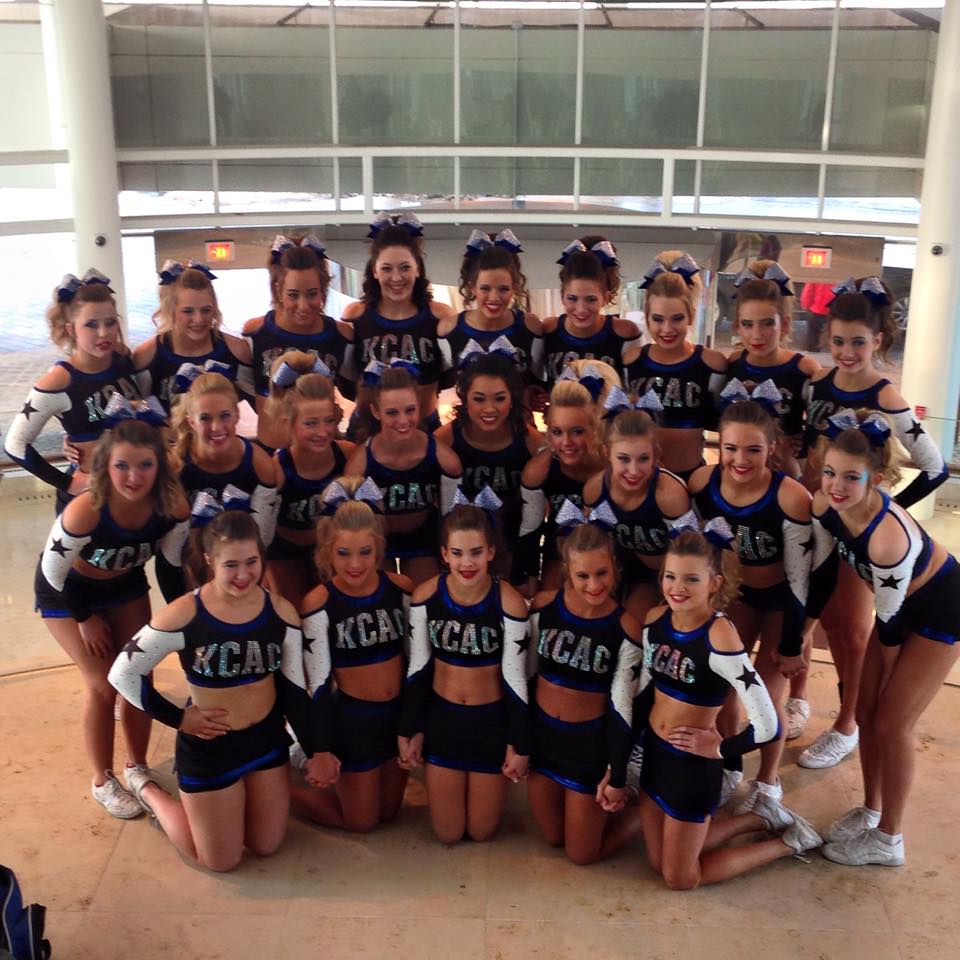 Though competition has become a central focus at the gym, Lucas is quick to distinguish that it’s not about winning. “If you get rid of deductions at a competition, you get a party. If you win, you don’t get a party, you get to celebrate your win,” states Lucas. “At our gym, we celebrate the fact that the athletes did their job.”
In recent years, KCAC has also experienced its share of other types of victories. The program was nominated for the Leadership Through Sportsmanship Award after teaming up with COA to sell T-shirts and bracelets to raise money for a former cheerleader who had passed away from brain cancer. “That’s probably the most prestigious award to give out because it speaks directly to the action of the coaches, athletes and parents,” explains Lucas. “Everyone at our gym understands that we don’t tolerate anyone in our program being unsportsmanlike, and I think that is one of our secrets to success.”
Another secret to success is the staff she has carefully cultivated; Lucas credits them with helping KCAC land the Program of the Year nod, and says that one of her biggest priorities is providing her coaches with continuing education. “Everyone goes every year to USASF training. Everybody gets credentials—we’re all AFTA certified, first aid- and CPR-certified,” says Lucas. “I just don’t think you can get enough education or be safe enough.”
With the support of her staff, Lucas has been able to diversify and host an array of programs, including tumbling classes and high school preparation classes held in January before tryouts. “We do entrances and jumps and teach them different materials. Then, during tryout week, the kids get to come in an hour a night after their clinics and we’ll work with them,” she explains.
Moving forward, Lucas says the gym’s focus is to continue to build athletes from the ground up. “Our goal is to get them as Tinys and keep them as Senior 5’s. Obviously we want to get better and better, and I believe our 5 teams will be great, but we want our Level 1 teams to be as strong as our Level 5 teams,” she explains. “And from there, we hope to naturally become more of a competitive powerhouse.”
–Nicole Pajer


