

In addition to all the great content we bring cheer professionals in our quarterly print issue, you’ll find plenty of original exclusive content right here at TheCheerProfessional.com.
Keep checking back for all the latest and greatest news, updates, debates and more!
Industry Reaction to GrowCheer.org
jen : February 15, 2013 3:36 pm : Blogs| Web Exclusives| webexclusive2 Yesterday’s announcement about GrowCheer.org and the push for an independent USASF sparked a range of reactions throughout the industry. While USASF has declined to comment on the matter, we were able to speak with Varsity’s VP of Public Relations Sheila Noone to learn their company’s stance. “Everything Varsity does is with an eye towards what is best for the young athletes we serve,” says Noone. “No one has more of an interest in growing all disciplines of cheerleading than Varsity, and we feel we have been a strong partner to the USASF and its members.”
Read a sampling of what event producers and gym owners around the industry had to say:
 Independent Event Producers (IEP): The Independent Event Producers, IEP, was not consulted, informed or involved in any formation of this proposal. The IEP fully supports a proposal for a fair and transparent governing body. It is our hope that all constituents of the USASF have equal representation. The mission of IEP remains our focus today. Our main objective is to “collectively influence the cheerleading and dance industry, to promote independence and work to ensure our long-term viability in the industry.”
Dave Sewell (Extreme Spirit): Xtreme Spirit has not renewed USASF membership for the 2012-2013 season due to its Varsity control. We feel the current system is in place to maintain control over the Industy’s growth. We will follow the USASF rules, but with exceptions designed to help struggling gyms retain their higher level athletes and also showcase the advanced tumblers out there that are beyond Level 5.
 Jody Melton (Cheer Athletics): This is a very interesting proposal that could potentially lead to some needed reforms for our sport. I like the group’s willingness to at least try to work with the USASF/Varsity to iron out some of the issues, rather than starting by creating a competing organization.
The USASF has given us many positive changes for our industry, and it simply would not exist without the leadership of Varsity and its employees, money, guidance and support. They should be applauded for their tremendous work over the last decade. However, it is time to take another look at the USASF structure to ensure that the entire industry is fairly represented. It seems obvious that no single individual, gym, program, company or conglomerate should have significant & permanent influence over our governing body.
There are obvious details that would need to be filled in and some questions to be answered, but on its surface – this looks like a potentially great way to help transition the USASF into an even better & more transparent governing body.
Scott “Crasher” Braasch (Cheer Tyme): I am a staunch supporter and critic of the USASF. I believe our industry has been served well by those in leadership and applaud all their efforts. Our governing body for the sport/industry of All Star Cheer is not just important to our continued growth, safety and structure—it is a must. For this reason, I have always supported the USASF and its mission. I have also been a critic of the USASF and its origins from the cheerleading industry’s largest vendor. As a huge supporter of Varsity brands, I respect and appreciate their financial and intellectual contributions to the origins of the USASF; however, I believe we have come to a point where USASF should truly stand and govern our all star industry independently. This letter shows a divide in our industry that has been developing for years. A governing body that is so closely intertwined with the largest vendor in our industry does not insure that all decisions made on behalf of the governing body are in its best interest, but rather implies that they are in the best interest of the vendor. What other format in our world today has a for-profit entity that governs or is perceived to govern a non-profit entity whose decisions reflect and/or could reflect the profitability of the for-profit entity? This proposal sounds fair and seems to alleviate reasons why so many question the relationship of Varsity Brands to the USASF. I look forward to the outcome of this proposal and sense yet another defining moment in our sport/industry ahead.
 Megan and Casey Marlow (Pacific Coast Magic): Awesome concept. Awesome news!!!! Been in this industry for 15 years. So happy to see something truly moving and changing happening!
Chad Mulkey (XPA All-Stars): This is the best news that has been introduced to this industry since its inception. The stronghold has held back a SPORT that has grown tremendously. While Varsity can be thanked for its contributions for the inception, it is clear that this step is crucial as it grows. Excited, excited, excited!
Pam Swope (Storm Elite All-Stars): I totally agree!!! There should be NO company that controls the USASF – no more than the International Olympic Committee (IOC) is! There can’t be a company profiting from the use of a governing body for a sport to grow and thrive. MLB and the NFL are not owned by NIKE – so Varsity should not have control over the governing body of USASF.
BREAKING NEWS: Seven Industry Companies Unite to Urge and Facilitate USASF Independence
jen : February 14, 2013 4:00 pm : Blogs| In the Industry| Web Exclusives| webexclusive1 CheerProfessional has learned that seven industry companies (Cheer Zone, GK Elite, GTM Sportswear, Motionwear, Nfinity, Rebel Athletic and Team Cheer) have united in an effort to facilitate the USASF’s independence from Varsity Brands. Their plan includes assuming the USASF’s loan from Varsity, revising the Board of Directors and moving the USASF office and employees to a neutral location. Read their full proposal and react in the comments section:
GrowCheer.ORG
Proposal to the United States All Star Federation
GrowCheer.ORG is a group of unrelated industry companies with a singular purpose – to grow the sport of cheerleading.
As such, we believe that the first (and most important) step in fostering future growth in our sport is a FREE and INDEPENDENT United States All Star Federation (“USASF”).
How are we going to accomplish this?
Central to our plan is to replace the current loan(s) that the USASF has with Varsity Spirit Corporation and/or affiliated companies (“Varsity”).
It is understood that the reason Varsity controls a majority of the seats on the USASF board and why Varsity owns the trademark of the USASF is to secure repayment of these loans. We firmly believe that in order to have a unified industry, no single organization should be unduly influenced by and/or controlled by another.
We propose to assume the loan with essentially the same financial terms that Varsity has given to the USASF. We are prepared to do this immediately after the 2013 USASF Worlds competition.
Other key provisions relating to our plan are as follows:
1) Require an immediate external audit of the USASF financials by an independent accounting firm that we mutually agree on. We will bear the cost of this audit.
- This firm would determine the amount that remains outstanding to Varsity.
- The firm would examine the relationship between the USASF and the IASF and confirm that all monies paid to the USASF by American gyms would be used for the support of American programming, not international programming.
- The firm would examine the relationship between the USASF and the host site to make sure only the USASF received benefit from the relationship.
2) All USASF property held in lien as security for outstanding loans with Varsity, including but not exclusively intellectual property (i.e., trademarks), would be released to the USASF.
3) Immediate rewriting of the Articles of Incorporation, By Laws, and Operating Agreement to abolish all permanent Board of Directors seats and create a provision for an organized election to be conducted as soon as practical. The new Board of Directors would be composed of equal representation among all segments of our industry – gym owners/coaches, event producers and industry vendors.
4) Future production of USASF World competitions would be granted to a qualified event producer after an open bidding process administered by the Board of Directors.
5) The office and employees of the USASF would be moved to a neutral location in Memphis. If necessary, we would subsidize payment for the office space until it could be supported by the cash flow of the USASF.
6) After the first year, or as soon as practical, the Board of Directors would interview and select a professional management company to assume the day-to-day operations of the USASF.
7) The USASF would be reorganized as a 501(c)(3) non-profit organization that is recognized by the IRS as such.
We believe very much in this industry and recognize Varsity for its past foresight and support, but we have come to a point where we can no longer afford to see our governing body indebted to and controlled by a profit motivated company with a clear conflict of interest. In a time when so many are calling for the industry to break apart into separate factions, we feel that the best solution is to step in and provide a practical way for there to be just one, FREE and INDEPENDENT governing body. And we believe that we have proposed a workable solution to this matter.
Your acceptance of the above terms is expected by March 1, 2013 to GrowCheer@gmail.com so that we can make provisions for a seamless transition.
Respectfully,
Cheer Zone ™
GK Elite Sportswear, L.P.
GTM Sportswear, Inc.
Motionwear, LLC
Nfinity Athletic LLC
Rebel Athletic ™
Team Cheer™
United States All-Star Federation, USASF, ISAF, USASF Worlds, Varsity are all Registered trademarks of the Varsity Spirit Corporation, Memphis, TN.
Web Exclusive: The Parent Trap
jen : February 13, 2013 1:06 pm : Down to Business| Web Exclusives| webexclusive2 You’re a passionate coach and cheer business owner. You work hard to train your athletes and place each one on the best team for his or her ability and the team’s needs. It’s natural to assume everyone will recognize your expertise and respect your decisions.
Unfortunately, there’s always someone who doesn’t see it that way. That someone is usually a parent—a stage mom or stage dad—who seems to want more spotlight shining on their little Ashley. Or perhaps they just don’t understand how progression through the skill levels works. Either way, a parent is second-guessing your decisions. Their tactics can range from gentle suggestions to accusations of favoritism or racism. If you don’t do what they want, some may threaten to quit—and take as many others with them as they can.
Scott Foster, owner of Rockstar Cheer Gym in Greenville, South Carolina, is all too familiar with this conflict. “I have the same things over and over, every year,” he says. “Usually parents want [their children] to move to a different level than the team they’re on. They have a hard time accepting that even if an athlete has Level 4 tumbling skills, they shouldn’t necessarily be on a Level 4 team. There’s more to cheer than tumbling.”
As an example, Foster cites one particular athlete who came into the program with no tumbling experience and progressed to Level 4 tumbling within a year. “The athlete was still too small to be used in Level 4 stunts,” shares Foster. “When it came to flying, the athlete wasn’t experienced enough; since she couldn’t outfly the other athletes, she had to stay in Level 3.”
At Naugatuck, CT-based USA Wildcats, it’s the gym layout that sometimes leads to misunderstandings with parents. The waiting room is blocked off—leaving coach Amanda Daniels and her colleagues open to potentially unfounded criticism. “If something goes wrong on the floor, parents will ask why we were mean to their child or why we picked out their child on this [skill],” says Daniels. “A lot of it is overexaggerated because they’re not on the floor and don’t necessarily know what happened.”
Coaches aren’t the only ones who have to deal with parental drama. Other cheer parents are often acutely aware of conflict and other parents trying to influence gym decisions. “I think there is a disconnect sometimes,” says Nikki Delude, who runs the Cheer Parents Central website. As a parent and parent advocate, Delude sees it from both sides. “You need to understand that if a parent is being demanding, [it’s because] we are trusting you with our children,” she says. “Does that give every parent the right to scream and yell? No.”
As with most relationships, the primary key to managing parental expectations is communication. Lisa Kretschman, owner and coach of Whippany, NJ-based Cheer Pride All-Stars uses several avenues of communication from flyers to motivational texts to regular emails. “I send a major email every two weeks about fundraisers, how the kids are doing, and so on,” says Kretschman. “They know the lines of communication are open.”
To that end, Kretschman says it’s important that gym owners be willing to hold up their end of the bargain; communication must be ongoing and responsive: “If I get an email at 7 in the morning, I’m going to reply immediately. I make sure they know that if they have a problem I will respond. It is a business. You want to make sure that everyone is happy with the services we are providing.”
A big part of successful parent relations is making your program’s expectations crystal clear so that there is no room for interpretation. “We communicate very clearly what we expect from the parents and the kids,” says Kretschman. “We lay out what they can expect from us and make it clear that we’re not going to put athletes out on the floor before they’re ready—and that everyone will be treated fairly.”
Though emails and texts make it easy to keep contact flowing consistently, face-to-face communication is beneficial—especially in the face of conflict or misunderstandings. When problems arise at USA Wildcats, Daniels has a one-on-one conversation with the parent to squash the issue at the outset. “We do our best to make sure that the parent is aware of exactly what happened from step one to step 10,” says Daniels. “There has never been a point where a parent left our gym really upset and less understanding of what really went on. 100 percent of the time, the parent feels better after having a conversation with the coach.”
Group sessions are also effective, especially when it comes to relaying policies and procedures. Foster prefers to discuss levels and progression with large groups of parents. “If you have a parent that is a little more demanding, what better audience than to answer in front of everybody?” he says. “That way, you don’t have to answer it 200 times.”
Holding regular meetings and social gatherings can also play a role in keeping parental competitiveness—the root of many issues—at bay. By fostering a sense of community, gym owners can ensure that everyone feels valued and connected. “I try to really discourage people from comparing their kids to other kids. We try to make everyone feel important, whether they are at Level 1 or Level 4. That’s all part of making sure we don’t have any issues,” says Kretschman.
Over the course of a season, most parents and athletes will learn to trust you and your decisions. To get there, Delude feels there needs to be give and take between parents and coaches. When a coach has to justify her decisions to each of 25 parents, that takes a significant amount of time, and Delude encourages parents to be cognizant of that. “As parents, we need to give a little bit also,” she says. “You have to develop trust over time.”
If a parent is still not happy with your program or with all-star cheerleading in general, sometimes they may need to look elsewhere. It’s better to let one parent and child go than to make everyone unhappy; both sides should be open and honest about whether this is really a good fit.
The need to communicate and deal with parents is an important part of the cheer business that’s never going to go away. Most parents understand and are willing to let you do your job, but a few parents are more demanding. “Just embrace it,” says Foster. “You have to allocate time to educate them and make them understand. I just refuse to let it bring me down—you have to take the good with the bad.”
–Sally Herigstad
What a Powerful Web We Weave
jen : February 11, 2013 1:25 pm : Down to Business| Web Exclusives| webexclusive2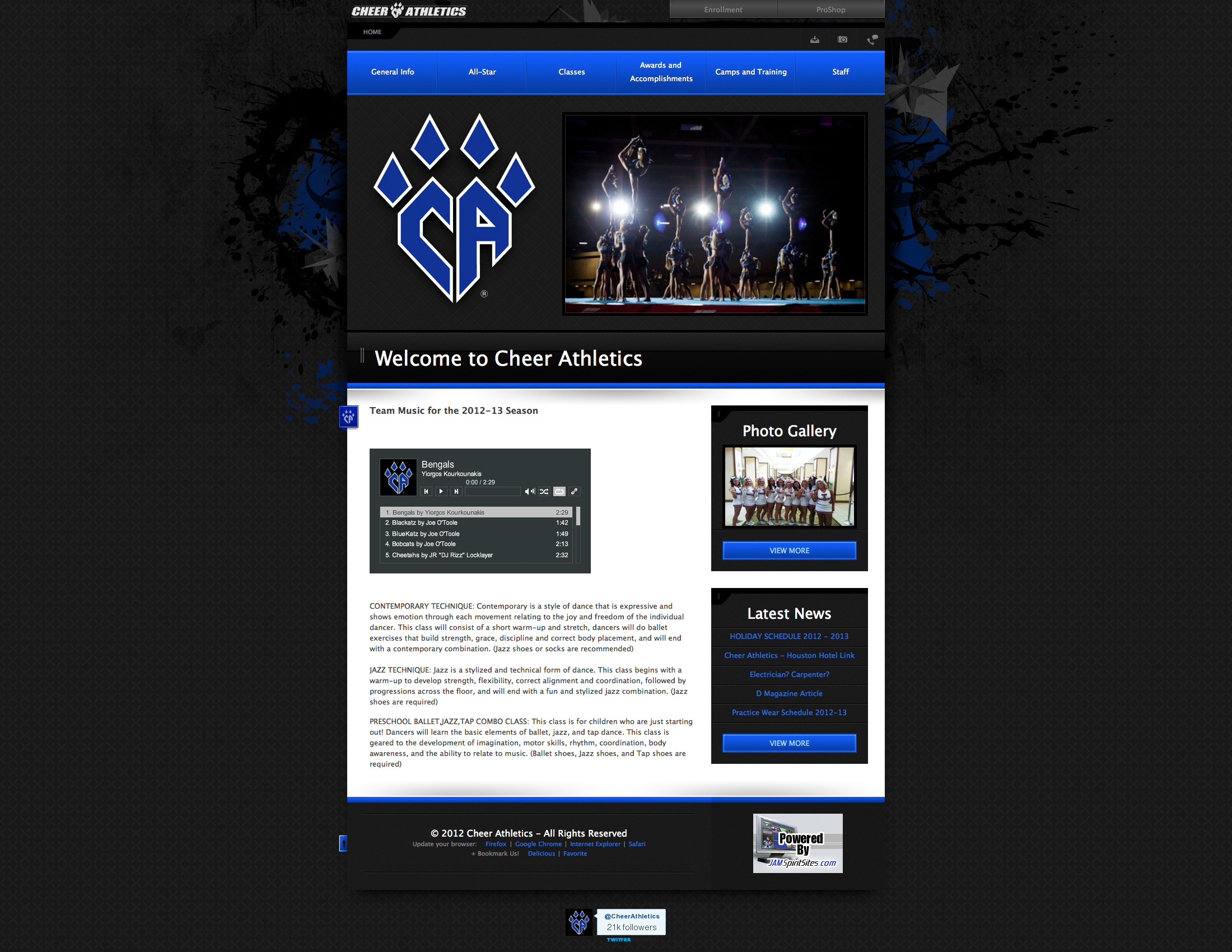 It’s a lot like the proverbial tree falling in the woods: if a cheer gym doesn’t have a website, is anyone going to hear its marketing message? Not in today’s digital world, according to Jason Silverman of AllStarCheerSites.com. He says that having a dynamic online presence is just as pivotal as having a physical gym—and most potential clients and athletes are going to find your virtual doors before they step through your real ones.
“We all know that you only get one chance to make a first impression,” says Silverman, who is also CEO of Powerful Words Character Development. “When your site is easy to find and easily navigable, your prospects will appreciate it and you’ll be rewarded with a higher conversion rate.”
Ready to turn your website into an unstoppable marketing force? Follow these simple five steps:
Get a Professional Involved
As your first point of contact with potential members, your website needs to effectively reflect the professionalism of your program. The best way to accomplish that is to enlist a skilled web professional to create a visually appealing and easy-to-navigate website. As for content, Silverman says the top priority should be sharing information that potential athletes (and their parents) need to make an informed decision about whether your program is right for them—and vice versa.
Hiring a professional doesn’t necessarily have to cost a fortune, either. For gym owners on a tight budget, utilizing a template can be a cost-effective solution. Template-based websites are often easier to update and typically cost much less to set up than something designed from scratch. “One of the biggest benefits is the speed at which you are able to get the site up and running,” says Kim Smith, customer service manager for JAM Web Designs, Inc.
As for concerns about originality, rest assured that you can still achieve a unique look even with a template-based site. “Not only do we work with new clients to ensure their site differs from local competitors, but we also retire popular styles that seem to fly off the shelf,” shares Smith.
If you truly want a one-of-a-kind site but have to be mindful of budget, consider a happy medium. Services like St. Louis-based Vault Media offer a custom-designed, SEO-optimized website and one year of web hosting for a package price of $1299 (a fraction of what many web designers charge for a site designed from scratch). They also teach newbies how to use content management systems like Joomla and Wordpress so that you can update your site on its own once it’s up and running.
Set the Stage for Success
Design is just the first bridge to cross, as your site also needs to be search engine optimized and meet certain keyword criteria. Silverman says that, generally speaking, parents will research activities for their children by Googling a term like “cheerleading for kids Randolph, New Jersey;” Google will then produce a bunch of results that best meet that criteria—and the higher your website shows up, the better.
For those who want to go the DIY route, there are numerous ways you can ensure your own success with search engine optimization (SEO). Silverman says that using a Wordpress site is a “must” for being SEO-friendly, as is installing Yoast’s Wordpress SEO plug-in. It’s important to keep your site active by updating your blog regularly and including strategic keywords in your posts. “Think about what a mom would enter into Google when she sits down at her computer,” advises Silverman. After posting, share the link across your social media channels to give it maximum exposure among your audience.
However, Chris Quarles of Vault Media cautions that professional SEO assistance may still be necessary, especially if you live in a market where the all-star cheer business is competitive. When developing their new program, they reviewed almost 500 gym websites and learned that 80 to 90 percent are not properly set up for search engine optimization. “Working with someone who knows how to code properly on the backend with SEO and proper keyword relevance in mind can really help gyms be on top of their game—and on top of the results for their market,” says Quarles.
Don’t Fall for Common Mistakes
Just as important as what to include is what to avoid when designing your site. A common mistake website gym owners make is choosing design over function. “Many of the sites in the cheer world use overly flashy designs, which actually take away from the job that the website is trying to do—get prospective members interested in your program,” explains Silverman. For instance, Flash sites look pretty, but can’t be viewed on Apple devices—frustrating a significant sector of mobile users.
Another common faux pas is not including some sort of “road map” to help visitors get around your site and find information quickly. “Most people don’t know what to do when they get to your website,” shares Silverman. He recommends creating a helpful welcome video that tells them exactly where to go and what to read first, citing PrideCheerGym.com as a great example of this in practice.
Include the Right Elements
From Smith’s perspective, balance is the key to every website. “When selecting a style, you want to make sure to find one with the right type of cheer flair for your gym, so that it compliments your identity,” she advises. Sticking with a clean color palette is extremely helpful as well; Smith says too many colors outside the realm of your branding doesn’t add “pop,” but is actually disruptive.
Silverman believes a lead generation tool/opt-in box is an essential element in any successful cheer gym website. With this tool, potential clients fill out a form with their name and email address, and in return, they get a special report or other information that parents will find helpful. For instance, Tracy, CA-based Athletic Perfection offers a free PDF on “Building Champions from the Inside Out,” while Macon, GA-based Middle Georgia Cheer Extreme offers a free video on improving jumps.
“We call it a ‘shy yes,’ as it’s a way for a prospect to say yes to an offer you’ve made without having to choose whether or not to join your program,” Silverman says. “The key here is that the opt-in box must be in the right place, have the right offer and ask for the right information, or the effectiveness is worthless.”
Promote Your Site
Even the best website in the world will do nothing for you if people can’t find it. Silverman points out you have to “train people” to visit the site often. “We normally suggest blogging at least one time per week, and optimally, three times per week.” Silverman explains. “Get people used to looking for your blog posts.”
When it comes to getting the word out, social media is key. Posting on Twitter and Facebook regularly will drive people from social media to your website—where they can take the next step to joining your gym. You can also encourage athletes to “check in” to your gym on FourSquare to build further awareness. And after that? Just promote, promote, promote. Smith suggests making your web address visible in every possible aspect of your life: your email addresses, signage, bumper stickers, T-shirts, flyers and any other marketing materials.
Quarles agrees: “Social media is where the most eyeballs are at—use it to drive people to your website that way as much as possible. Your website is the tree trunk of your digital presence, and social media acts as branches and little twigs. It all counts.”
Follow these tips, and your website is sure to “click” with its intended audience.
–Diana Bocco
State of the Union, Part 2
jen : February 6, 2013 6:00 am : In the Industry| Web Exclusives| webexclusive1CheerProfessional tapped four of the industry’s cheer leaders for a spirited panel discussion on our industry and its future. Following part one, read part two of our interview:
Safety is obviously a hot-button topic in the industry. What do you think will be the impact of the American Academy of Pediatrics report and all of the media attention on safety?

Dan Kessler of The Jam Brands
Kessler: Safety and kids’ health is more important than it’s ever been. Five years ago, we never talked about concussions in football—the awareness is much higher. And, as the sport of cheerleading grows, the more kids doing it, the more possibility for injury. Unfortunately, the Pediatrics report include all types of “cheer”—from rec and school to all-star cheer—so until we can define a clear separation between these types of cheer, there will always be that comparison. Going forward, our gym owners have to be [focused on] safety first, using proper progression and keeping kids to the proper level. Event producers rely on the coaches and owners to only put skills on the floor that the athletes can safely execute. The more we make our coaches smarter and more aware of safety issues, the better our industry will be.
Puckett: For the sport’s longevity, I think we have to keep a balance of good safety and good coaching. Some of the current [rule] changes were very necessary to keep the sport safe. In all honesty, if we push the limit too far and increase catastrophic injuries, it will destroy the sport. I’d like to see credentialing taken a step further and made mandatory to more levels.

John Newby, Executive Vice-President and General Manager of Varsity All-Star
Newby: [There are] a lot of gyms doing it the right way—take those examples and have certified tumbling instructors. Education and training progressions and proper technique are paramount to the long-term success of our industry. That’s one of the areas of focus in the near future that we need to ramp up and continue to make the sport safer. The more we talk about ways to increase safety measures, the better off the sport will be in all aspects and disciplines.
There’s a lot of talk about cheerleading becoming a sport and even entering the Olympics. What are your predictions on that front?
Kessler: All-star gym owners need to be educated on the pros or advantages to being an Olympic sport and how it will help their business or create more cheerleaders. Will it change what they do in their four walls? A lot of these questions are not being asked of our all-star market, but are being told to our all-star market. The all-star market should demand more input into the growth of cheerleading, both nationally and internationally. Until we have these answers, there is no way to predict if this would be a good or bad thing for our industry.

Karlette Fettig, Indiana Elite All-Stars
Fettig: I think it’s a long way off. More countries are getting involved, but I don’t know that they’re at the level of competitiveness that the United States is. To me, there is a lot of work to be done before it’s an interesting enough sport to be attractive to the Olympics. They need to know that the U.S. won’t go out there and dominate every time.
Newby: I think it is an exciting thought, but probably years away from being seriously considered. International development of the sport is crucial and will make a difference of how quickly, if ever, this sport will be considered for Olympic competition. Time will tell.
How can our industry thrive in the future?

Pam Puckett, The Cheer Center
Puckett: Coaches are concerned that our routines are so jam-packed that [the sport is] becoming totally skill-based—taking the fun and flash out of routines. I think we might take a turn back toward adding the flair, either by adding time to the routine or cutting back the skills. That will be a tough transition, but it’s possible. Also, I think the types of events will keep evolving with new, fresh ideas like Jam LIVE! and Varsity’s Gameday Championship. It’s important to keep it exciting for kids and parents and keep people wanting more.
Fettig: Gyms are going to need to figure out how to make their programs attractive to more children so they can stay alive. I believe in 10 years, the industry will look different on the gym side. Larger gyms have grown over the last several years because of other small gyms closing. It’s become difficult for gyms to start up and be competitive against very large gyms of 500-600 kids. There will be a big dichotomy between a 700-kid program and 150-kid program. In 10 years, you’ll see a big spread between large and small gyms and not a lot of in-between if people don’t start trying to figure out how to get more kids in their door each and every year. That means focusing on younger, less skilled kids and getting them interested in the sport. I get that Level 4 and 5 is exciting to coach and watch, but you have to get more kids in at Level 1 and Prep in order to keep the sport going.
Kessler: All Star Prep. These divisions are about embracing the simplicity and the fun that got our sport growing to begin with. It’s not the you-have-to-get-your-back-tuck-NOW mentality—it’s more about making it fun, making it exciting and making the kids love what they do. It offers the same athletic appeal but with less commitment and the same performance aspect. That’s kind of what all-stars was at the beginning in the purest sense.
Our industry and the future of all-star cheerleading and dance can thrive if it is a positively regulated sport that is safe, exciting, accessible and competitive for the kids that participate. The kids have to have FUN! The environment must be safe, and the whole purpose of creating an all-star team of any type is to be competitive. In addition, the sport has to be both affordable and wholesome so as to assist parents in raising strong, healthy kids. We have to offer the same (or better) benefits than any other sport out there so that kids and their parents make all-star cheer and dance their sport choice.


