

In addition to all the great content we bring cheer professionals in our quarterly print issue, you’ll find plenty of original exclusive content right here at TheCheerProfessional.com.
Keep checking back for all the latest and greatest news, updates, debates and more!
Candid Coach: Jon Rolle
jen : November 6, 2014 4:14 pm : In the Industry| Web Exclusives| webexclusive2 For Forestville, MD-based gym Crimson Heat, “spirit” has more meanings than one. The faith-based gym builds both moral foundation and athleticism, with Jon Rolle acting as both Travel Cheer Program Director and head coach of its Worlds team. Calling on more than 15 years of experience, Rolle has taken Crimson Heat to Worlds for the past four years—reaching a peak of ninth place in 2012. Recognizing the spirited approach Rolle embodies as a coach and encourages in his athletes, Rolle was nominated by USASF for 2014 Coach of the Year. Find out more about this rising industry star in our candid Q&A.
Since you began heading up the Worlds team, how has the team grown and impacted the growth of the gym as a whole?
Rolle: I think building a Worlds program is something our gym has made a priority, to make the Level 5 team more successful. I’m just kicking up our skills as a coach and seeking the advice of other coaches. One thing that is really unique about our gym is our focus on the child as a whole—we want to show that they are people [as well as athletes]. We seek to find ways to bond together, grow as a team and build a brand.
How does faith play a role both on and off the mat?
Rolle: Crimson Heat has a set of core values and [the name] stands for Christ, Respect, Integrity, Motivation, Success, Opportunity, Noble, Humble, Effort, Academics and Teamwork. [Owner Veronica Burton] focuses on development of the entire child. We are not a gym where faith is something pre-eminent or that we shove down our customers’ throats. It is a way of living—Christ is our focus. The things that we do are competitive, but we are doing the best things we can, where 100% effort is respected and required. Creed, morals and values are what we expect our athletes to uphold.
Are there extra considerations as a faith-based coach?
Rolle: Not necessarily. The major thing about Crimson Heat is that it’s a family organization. It has been around for 15 years, and we are constantly thinking about how to make our business better, but at the end of the day, what we provide to our athletes and families is the idea of an extended family. We always ask ourselves: How do we actually uphold the letters of the Creed in the same ways that we expect of our athletes?
As a member of the NACCC executive committee, what do you view as the industry’s biggest current issues?
Rolle: I’ve had the great pleasure of representing the Northeast region of coaches as one of the people elected to be their voice on major topics. At regional meetings, we’ve discussed a number of different issues, [including] the idea of Worlds Division I and II. What is a large gym and what is a small gym? What constitutes a medium-sized gym? Another really big issue: how do we continue to grow the brand of all-star cheerleading? How do we market and develop all-star cheerleading as a growing sport? How are we being competitive in an economic time where all-star cheerleading costs exceed other sports?
I think as a coach, our responsibility is to provide the best training possible; kids are going to want to stay in an all-star program if they are with coaches who value them and provide structure and guidance. At Crimson Heat, we seek improvement and are on the cutting edge of making the kids and the gym successful.
-Amanda Kennedy
Hot Topic: Stay-to-Play
jen : November 3, 2014 10:57 am : In the Industry| Two Sides| Web Exclusives Ever since The Aloha International Spirit Championships in Honolulu began requiring stay-to-play in 2005, event producers have been following suit. As more competition companies start to shift their policies toward stay-to-play, the industry has reached a heated crossroads. Gym owners are fighting for the right to reserve their own hotel rooms, while event producers maintain that it’s necessary that they require programs to book room blocks at designated hotels. As the new season takes shape, the question remains: how exactly will this growing practice affect the world of all-star cheer?
If Tanya Roesel’s Midwest Cheer Elite is any indication, large programs could change course and leave competitions for which they’ve been long-term customers. “We pulled over 1,100 athletes from CheerSport nationals—all four teams,” shares Roesel, whose final straw came when one of her cheer parents sent her an email explaining that she would be forced to retire her child if the schedule continued to include CheerSport.
“What we saw with stay-to-play was that all the costs were $25-$50 higher a night,” adds Roesel. “Not only do my parents have to pay gas money or flights, but now they have no means of negotiating any hotel rates. They can’t use their reward points. They can’t go on Hotwire and get their own hotel rooms because now they are stuck with stay-to-play—where historically the prices have been higher.”
A growing majority of gym owners say they are also riddled with complaints from cheer parents that stay-to-play hotel rooms have become too costly—and that they’re prevented from using rewards points to book them. Some gym owners also suspect that event producers may be receiving kickbacks from the travel agencies, further driving up the cost.
West Virginia Cheer Academy owner Kayla Wygal says she experienced the difference for herself this year when booking travel for Universal Spirit’s Spirit of Hope competition in Charlotte, North Carolina. “Last year, stay-to-play wasn’t required [for that competition]; I think they were transitioning into it,” she recalls. “This year, I contacted the same hotel we stayed at last year and there was a block tentatively waiting for us at $89/night; of course, [the stay-to-play booking] got us rooms at another hotel for $129/night. It was frustrating because I knew there were cheaper rooms available, but we couldn’t get them because that was not what we were assigned through stay-to-play.”
As the tension continues to build, so do the rumblings that some gym owners are planning to pull their athletes from certain competitions. While not everyone has the guts to follow in Roesel’s footsteps, others have certainly thought about it. “I think if enough small gyms like [mine] felt the same way I did, it probably would affect things big time,” says Wygal.
Spirit Celebration’s Billy Smith, however, sees these threats as idle. “I don’t think people are actually going to stop going; they are just going to be frustrated about it,” says Smith. “I haven’t seen any decrease in registration so far this season. People are going to go where there is competition, and they are going to pay to be there. It’s just one of those things.”
On the Flip Side
 While gym owners are a hard sell, stay-to-play proponents are quick to defend the policy. Liz Rossetti of Americheer maintains that her company’s stay-to-play program provides a benefit to its customers. “We work with a travel company and they are in the cheer industry, so they know how important it is to find a hotel that provides breakfast at a reasonable amount or has the right facilities that fit four or five in a room,” she explains. “The whole idea of stay-to-play is to have the travel company cater to individual needs for teams and their parents as well. It’s really your one-stop shop. It creates an overall experience for each team.”
She adds that in lieu of pinning down just one hotel that coaches have to book from, Americheer’s program provides an array of choices at a variety of price points. For the upcoming Buckeye Open Nationals, for instance, participating programs are able to select from seven different hotels.
Tara Patton Harris, Vice President of Sales with The JAM Brands, says that JAMFest Super Nationals moved to a stay-to-play approach in order to provide hotels that were more closely located near the competition venues. “Prior to moving to stay-to-play, we constantly heard complaints from customers that they couldn’t book rooms in downtown Indianapolis for the weekend,” explains Harris. “There are often many other conventions or sporting events going on and the blocks we were given sold out very quickly, not allowing for many teams to be conveniently located to the venue. The Indianapolis Convention & Visitor’s Bureau agreed to double the number of downtown hotel rooms we were given if we agreed to move to a stay-to-play policy.”
Meet Me Halfway
While gym owners campaign for the dismissal of stay-to-play, the format doesn’t seem to be going away anytime soon. Yet some event producers are striking what they consider a happy medium with “inform-to-perform” policies, which provide hotel room options for coaches and teams but do not make it mandatory for them to book them. The only requirement? That they note ahead of time where they’ll be staying.
“Truthfully, in the big cities, you just have to have an avenue to give them the numbers,” says Renee Smith of United Cheer, who has opted for this middle ground and decided to handle things internally rather than use a third-party travel agent. “We’re offering host hotels on our website, but if athletes come from out of town and stay with a relative or book elsewhere with their points, that’s fine. We just ask them to inform us so we can have the numbers to give to the city.”
So what’s the advantage to booking through Smith? “I am finding that by not using a travel agent, I’m able to get hotels cheaper,” she explains. In addition, United Cheer now offers a $5 rebate for each reserved room to a team’s coach. “So if you have a gym with 100 kids and they were to stay two nights, you’d have 200 times $5. The coach would get $1,000 back, which would hopefully help pay for their expenses. [We do] whatever we can do to keep cheerleading costs down.”
As far as this season goes, it appears to be business as usual—stay-to-play or not. Some teams are starting to pull ouof competitions, but event producers aren’t seeing enough of a threat to make changes in their recent policies. And, as Billy Smith notes, the only way that change will come is if enough people put their feet down. “I don’t think it’s going to change anytime soon. There are way too many gyms out there that want to compete,” says Smith. “The coaches have got to know that if you want the power, stop going. If enough people do that, they’ll stop the stay- to-play [policies], but until then, I don’t see it going away.
–Nicole Pajer
Parent Cheer Teams
jen : October 27, 2014 11:45 am : Down to Business| Web Exclusives| webexclusive1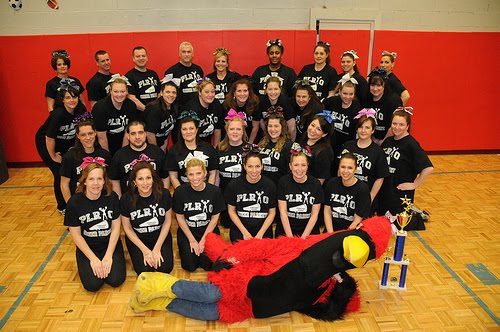 The lights dim, as a local gym’s newest squad takes the floor to show off their newly acquired tumbling skills, jumps and stunts. An MC introduces the group as AC/DC’s “Back in Black” begins to rail from the auditorium speakers. A crowd of teenage athletes holds up signs and begins to cheer wildly for individual members of the squad. Someone proudly yells out, “That’s my mom!” and a team of parent cheerleaders begins to perform.
These days, the above scenario isn’t an uncommon one at all-star gyms across the country. In addition to recruiting for their youth rosters, many gym owners have found themselves forming cheer teams comprised of athletes’ parents. Aside from giving cheer parents a means of getting to know one another, the main reason behind creating these teams is to provide parents with an appreciation for what their children do during a typical competitive cheer season.
“Having a parent team is awesome because they actually get a little taste of what their kids go through,” says Alisha Dunlap, owner of Sherwood, AR-based gym Cheer Time Revolution. “It gives them a taste of how much heart and soul their kids put into the sport.”
 While parent teams are certainly open to cheer amateurs looking to give their child’s sport a try, many are made up of adults who used to be all-stars and are longing to get back out on the floor. Scott Mizikar, who teamed up with his wife to coach several seasons of HotCheer’s parent team, explains that unlike adolescent cheer teams—which require extensive tryouts—parent teams are more of a laid-back experience. “We had an open sign-up and encouraged the parents to give it a try,” he shares. “While there are some teams that compete, we did it for the sake of doing it as an exhibition.” (This was also the case with Dunlap’s team, who channeled their competitive spirit into showing their stunts during gym-wide showcases.
Lisa Shaw, who owns Unique Sports Academy and directs the Maryland Twisters in Waldorf, was shocked when several of her cheer parents approached her and asked if they could form a parent team last year. “Most of them have full-time careers and children in the program, [so they are] busy,” shares Shaw. “Everybody had so much fun though that we’re going to do it again this year.”
The best part of hosting the team, says Shaw, is the enthusiasm that it adds to the program. “Their exhibition brought not just the Maryland Twisters to come and have a good time, but other gyms as well. Everyone was laughing and clapping and the parents took it very seriously. It takes a little edge off and adds some fun to the sport,” she says.
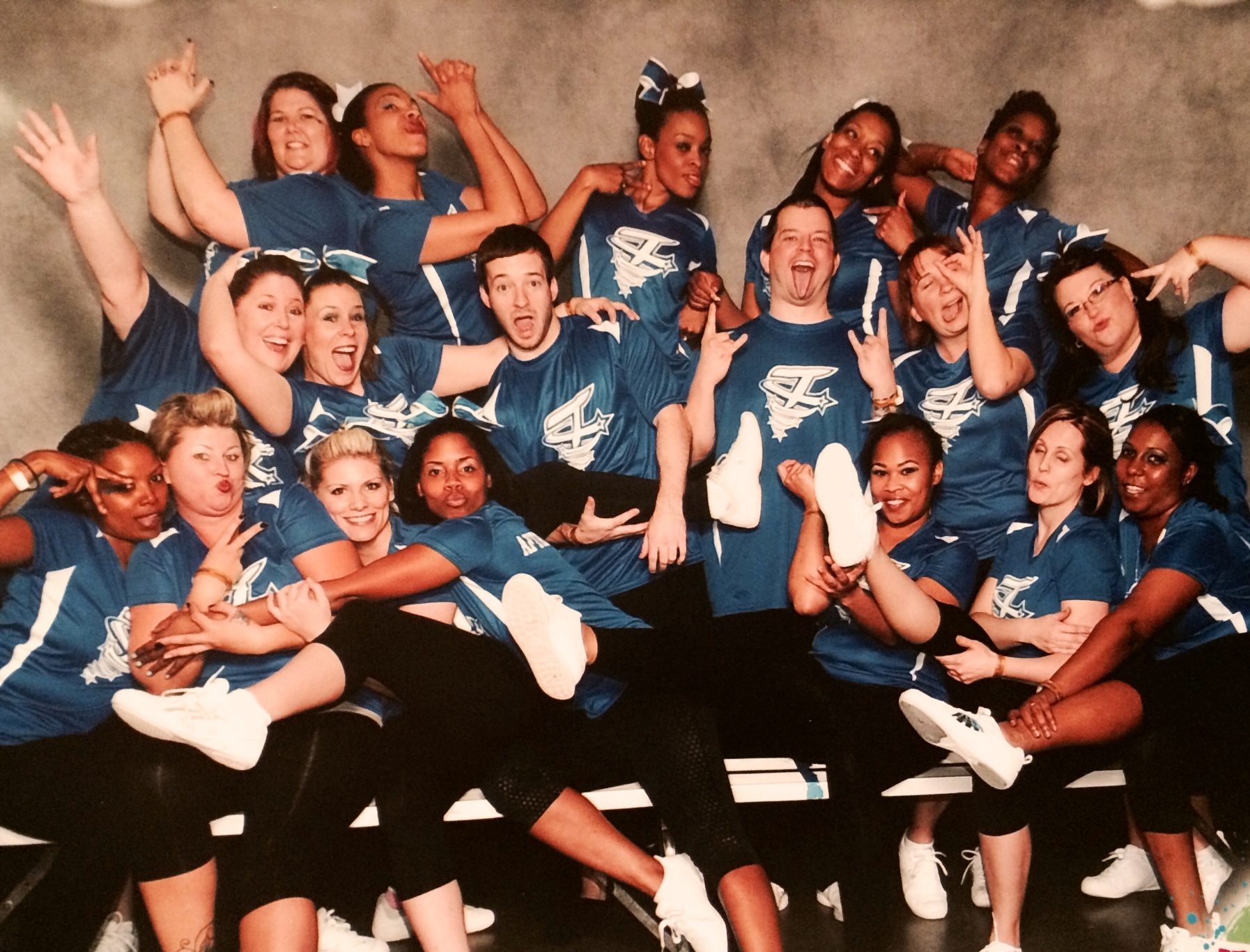
While some parent cheer teams refrain from competing, Shaw’s team, “Aftermath,” took their matching T-shirts and choreographed routines to last year’s Reach the Beach competition in Oceanside. “The team is asking to do more competitions this year, so we’re going to add another one in this season,” she adds.
 In terms of finances, most gyms tend to charge a nominal fee for their parents to participate on the teams, while others absorb the costs themselves. HotCheer co-owner Kelly Makay collected $10/month as tuition from the adults on her gym’s parent team; in addition, she tallied the total cost of purchasing music for their routines ($500 per mix) as well as the exhibition fees (which averaged $150) and divided those costs between the team’s existing members. Though she saw a huge emotional benefit from the team, especially through the bonding between cheer parents that occurred at her gym, she explains that there wasn’t a financial gain to hosting the team.
“The coaches were paid hourly to coach it, staff members were often wrangled into babysitting team members’ children, and it tied up floor space that I could have rented out to high school teams,” she says.
For Shaw’s Maryland Twisters program, she charges her parent teams a small fee for uniforms ($30), competitions ($40) and music ($30), but unlike the HotCheer team, her coaches volunteer their time to coach the parents. “Our parent team doesn’t affect our bottom line,” she adds. “The goal of the parent team is to have fun and get the parents involved in sports.” Such was the case with Cheer Time Revolution’s Dunlap, who didn’t charge her last roster of parent team members. “It was more about giving the parents a means of bonding and to open their eyes to see how much time and effort these kids really put into the sport,” she explains.
While parent teams have proven to enhance a cheer program, gym owners note that they are often difficult to keep running. One of the biggest challenges can be scheduling, according to Mizikar. “These parents are busy with their lives, their families and their jobs, so being able to count on them for weekly practices isn’t easy,” he explains. “When they can’t show up for 3-4 weeks at a time, it makes it hard to put a routine together.”
Recruiting is also difficult, says Dunlap, who saw her team’s roster dwindle just weeks into the season. To combat the attendance issue, Shaw suggests that coaches schedule practices on Sundays or coordinate rehearsals when their children are also practicing at the gym. And, of course, there is the issue of what athletes think about their parents becoming cheerleaders. “Some of the kids loved it, and some are embarrassed to death,” states Mizikar, who suspects that certain HotCheer parents enrolled on his team just to embarrass their kids.
Shaw has found that her Maryland Twisters kids have embraced their parents cheering so much that they’ve jumped at the chance to coach them: “The kids often stay around for the parent practices and you see them going, ‘Get tighter. Lift your legs up higher. Point your toes on your jumps!’ It’s really rewarding for them to see their parents learning the skills that they themselves have already mastered.”
–Nicole Pajer
Our First Year: TNT Cheer
jen : October 20, 2014 11:36 am : Down to Business| Web Exclusives| webexclusive2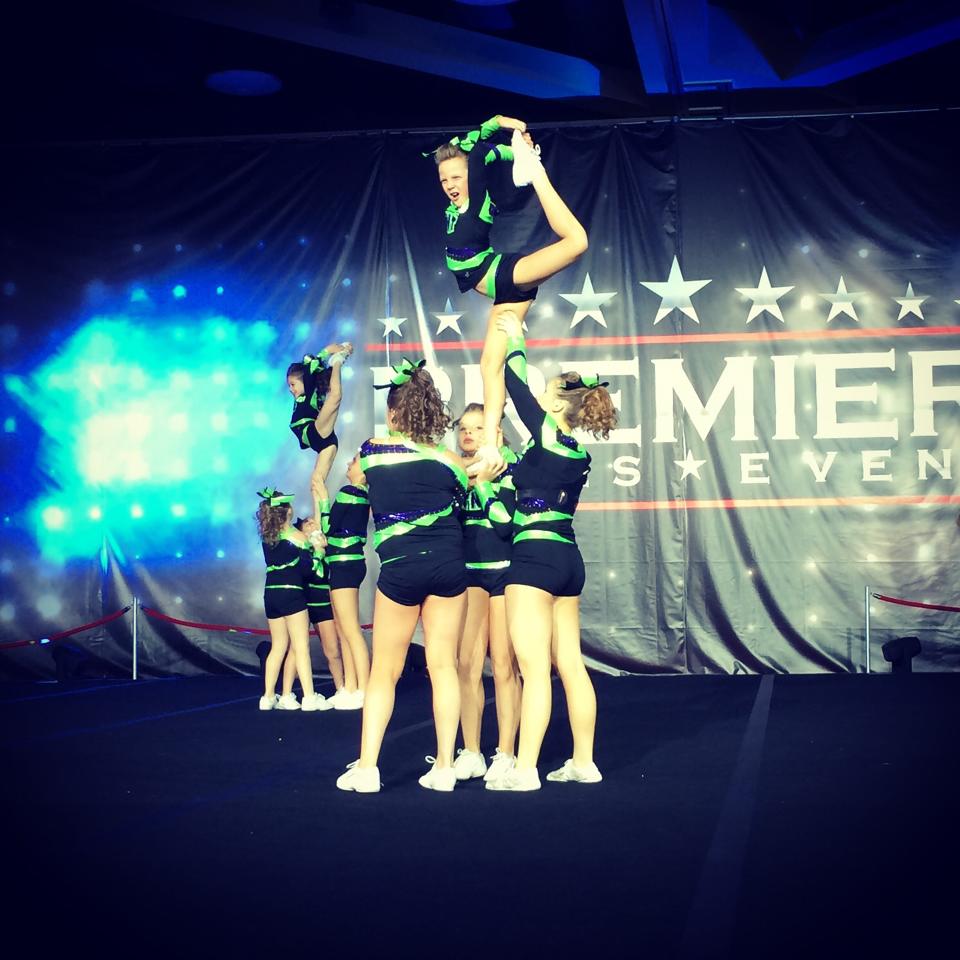 Anyone who’s read our “Starting a Gym 101” series on theCheerProfessional website knows that launching a new all-star program can be a massive undertaking—from setting up the logistics to securing the right insurance to attracting clients. To find out what it really takes for a successful start-up, we spoke with three cheer professionals who’ve just completed their first year at the helm. See how TNT Cheer’s first season went…and what they learned.
First Year Case Study #3: TNT Cheer
Location: Waterloo, Iowa
# of athletes: 125
Inspired by her daughter’s involvement, Amanda Freet took over the TNT Cheer all-star program from a trampoline and tumbling gym, because she wanted to take the program to a new level.
CP: What inspired you to open the gym?
Freet: My daughter. She had been doing competitive cheer at a local trampoline and tumbling center here for a couple of years. As a parent, I sat by the sidelines every day at practice, and I didn’t see the program growing, so I asked the owner what I could do to help move it forward. That’s where it started, and from there, I took the three coaches to a USASF regional meeting. We came home so excited and full of ideas.
CP: What were some of the challenges you faced this year?
Freet: First of all, trying to balance being a parent and owning a gym, especially one that your child cheers in. I want to be there to support her, but I also have to do what’s in the best interest of the gym. We were trying to put together a stunt team, and in my heart of hearts, I wanted my daughter to be one of the flyers on the stunt team, but it wasn’t the best decision for her program, so she didn’t fly in it.
CP: Any special goals for the future?
Freet: It’s all about getting people into the gym and getting people exposed to the gym. Especially here in the Midwest where we’re at, nobody knows about competitive cheer, so right now it’s getting the word out about competitive cheer.
 CP: Do you do anything special to get new clients into the gym?
Freet: Where the competitive program was previously, they just had competitive cheer. We’ve started up a recreational cheer program, and we’ve got almost 100 kids in the recreational program since we opened the doors in October. That gives them an opportunity to come in and try cheer at more of a recreational level, without having the financial and the time commitment that the competitive program has. So that’s been very helpful.
CP: What advice would you give someone who’s thinking about starting a gym?
Freet: Do your research. Attending the regional meeting through USASF was very eye-opening. It was a great chance to meet different people, and to hear how different gyms started and how they got to where they were. The camaraderie has been amazing for us. I mean, yes, we may be competing against each other [at events], but outside of that competition, you’re calling each other. You’re getting helpful hints from each other, talking about problems and issues that you’ve had within your gym, how you’ve changed things and how you’ve overcome it.
–Lisa Beebe
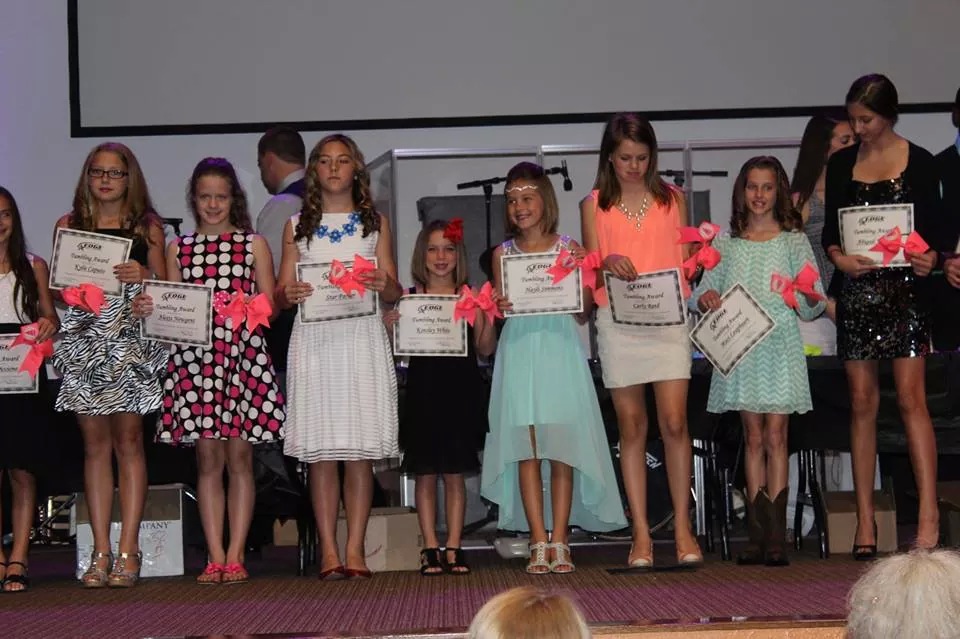
 At Sebring, FL-based Edge Cheer, athletes and their families end the year with a formal banquet full of awards, trophies and certificates. Owner Jenny Rowe says, “In this particular industry where it’s all about the team—and sacrificing and doing what’s best for the team—it’s a really big deal to get to individually recognize the strengths of these kids. We give them an opportunity to stand up in front of their parents and peers, [so they can have] their own particular moment of glory.”
Edge Cheer’s awards include funny categories, like “Most Likely to Get Injured,” as well as superlative awards like “Class Clown.” Rowe says they’re easy to prepare, as many of the awards are simple certificates: “I go to Office Depot and get pre-done certificates and we print them out ourselves.”
The formal banquet takes almost a year to plan, because of the size of the gym (200 athletes, 140 of those all-star). The cost of catering and trophies is funded mainly by ticket sales from an end-of-season recital. Every kid also gets to take home a DVD slideshow of photos taken throughout the season. If organizing a banquet for the first time, Rowe suggests thinking of it as a wedding reception and considering what type of atmosphere you’d like to create. “Do you want something formal? Or do you want something more like a team picnic?”
Karen Brenner of Egg Harbor Township, NJ-based All Star One knows the right answer to that question for her gym. Though this year’s banquet was held at a country club, she plans to borrow an idea from ACX’s Randy Dickey next year and throw All Star One a tailgate banquet with things like a chili cook-off, live DJ and a dunk tank. “We have a huge parking lot, and I know we could make that a great event for our kids, more like a carnival. [Something as formal as a country club] is just not ‘us,’” says Brenner. “The tailgating party is so much more up our alley.”
One of Brenner’s biggest honors she awards is “Team of The Year,” for which she selects the team she was most worried about at the start of the season that has come the furthest by its conclusion. “They get little tiaras with stars on them, like a little crown. They all love that,” shares Brenner. At the banquet, she also distributes branded candy bars with a picture of the team and each athlete’s name, as well as small individual banners that she describes as a “mini-version of a vinyl banner that you’d get when you win a competition.”
Moving Forward
 Wrapping up the year doesn’t just mean acknowledging the accomplishments of the year past—it also means planning ahead for the future. One effective way to do that is by conducting a survey to get feedback from athletes and parents on how the season went.
Gerry Richardson, president of Glen Burnie, MD-based East Coast Majestic, uses Survey Monkey to conduct an online survey. She recommends open-ended questions, like: “What do you like best about the gym?” and “If you could change one thing, what would it be?” For Richardson, no question is off-limits, and she advocates other gym owners take the same approach: “If people have thick skin, there’s nothing they shouldn’t ask.”
Richardson asks survey respondents to rank each of the year’s competitions in order of how much they liked them. (“If you get 90 percent of people saying they hated this one competition, you probably should not go to that competition again.”) Richardson also suggests asking athletes, “What level do you belong on?” because it lets her know whether they understand their placement level or not.
Michele Hasson, owner of Pride Cheer & Tumble in Collinsville, IL, conducts prefers in-person and paper surveys to the digital variety. At the end of the season, parents come to a roundtable, during which they are given an option to pick up an additional survey at the front desk. Hasson says, “It’s anonymous except by team, so we can see if there’s a pattern. This team didn’t like this event, or didn’t like this practice day.”
Hasson’s survey is fairly simple. She advises picking five or six things that are important to you as a gym and asking “Yes/No” questions like “Do you feel that the amount of practice time for this team is enough? Do you want weekend practices? Do you feel our attendance policy is fair?”
When conducting a survey for the first time, Hasson recommends including anything you’re thinking of changing for the next season. “For example, if you’re thinking of requiring certain practice clothes for the following season, I think it’s a good idea to get some feedback on that, which is what we did when we started [following that policy],” she shares.
Richardson and Hasson both find an annual survey to be a valuable communication tool between gym owners, parents and athletes. Opening those lines of communication—even when they’re telling you something you may not want to hear—can help make your gym even more successful moving forward.
–Lisa Beebe


