

In addition to all the great content we bring cheer professionals in our quarterly print issue, you’ll find plenty of original exclusive content right here at TheCheerProfessional.com.
Keep checking back for all the latest and greatest news, updates, debates and more!
Reinventing Your Gym: Victory Elite Athletics
jen : November 3, 2015 11:24 pm : Down to Business| Web Exclusives Considering a new name, new space or new approach? These changes can shake up your gym and open up new possibilities. We spoke with Allyson Moore, owner of Okemah, OK-based Victory Elite Athletics, about her decision to move to a new city and focus only on tiny/junior teams rather than offering senior teams.
What changes have you been making? We started out in Shawnee, about an hour west from where we are right now. I knew in my heart what I wanted for my program and the values that I wanted my kids to learn—but, for some reason, the area that we were in didn’t seem to share those things with me. I had a lot of trouble keeping parents committed and getting them to respect my rules and my philosophy itself, so that became really challenging, especially since I was so young.
We ended up opening a second location 45 minutes east in Okemah, which is blossoming. When we were in Shawnee, we added power tumbling and ended up having a really bad experience with the group that came into my gym. I was at the point where I just wanted to close that gym and just deal with Okemah, but I had a lot of good families, and I didn’t want to give up on their kids. But then we ended up having an issue where someone stole a little bit of money, and I just thought, “This is not for me. I’m done.” It made the decision so much easier to close my business there and really focus on the one where the people shared the same values as I did.
We outgrew Okemah so fast that we could not find a building to accommodate us. We finally found a 17,000 square-foot facility that was absolutely perfect, where we can do cheer camps and things like that. Now that we’re here, I’ve stuck to my philosophy that this is a faith-based program; I don’t let people run over me. I have to be very firm even though it is so difficult sometimes.
How has focusing on a faith-based philosophy affected your business? I ended up gaining so many people because they love those values. Once we moved, I was a lot more vocal about it; I wasn’t afraid to turn people away because they weren’t being honest or they were sitting in our parent room and bullying kids. A lot of people have said to me, “We love coming to your gym because you don’t care about politics. I know that my child is going to be treated fairly by you, regardless of whoever else’s child comes in here.” And that’s what I try to do: I want every child to be treated equally. When kids come into the program, they respect each other. I guess I’m just old-fashioned in my discipline, but that has really seemed to be the difference. I think once you stick to your values, your kind of people come to you, and that’s how you blossom. Looking back, that’s exactly what’s happened with us.
Why did you decide to focus on tiny and junior teams? When we were in Shawnee, it was very difficult to get younger athletes—it just happened to be a lot of older kids. Here in Okemah, it’s all younger kids. If I had a great junior/senior team walk through my door, I would work incredibly hard with them, but with our younger kids, I’ve had the ability to truly train them up under our values and philosophy, and then they’re more coachable as they get older. In just three years, they’ve really grown as a family and that’s exciting to watch.
What advice would you give another gym owner who’s making changes? You have to find your kind of people. You would think that everybody would share the same values as far as work ethic and respect, but unfortunately, there are a lot of people out there that don’t do that anymore. [Be a gym] that’s loyal and abides by the rules, doesn’t cheat, doesn’t recruit—to me, that’s what has made us successful.
Do you have any advice for someone who’s moving to a new gym? Make absolutely sure that before you open the doors, you figure out your philosophy, your long-term goals, and your mission statement, and stick to them no matter what. It doesn’t matter who comes through those doors or what political influence they have on others—stick to who you truly are, and I truly believe that God will bring you the right people. Our move has been a complete life-changing experience for my husband and me. I enjoy it more than I could’ve ever imagined.
Owner’s Manual: Nicki Baker of Nebraska Cheer Center
jen : October 20, 2015 1:54 pm : Down to Business| Web ExclusivesVital Stats:
 Name: Nicki Baker, Founder and Co-Owner
Gym: Nebraska Cheer Center
Location: Lincoln, NE
Founded: 2010
Size: 11 teams, 225 all-star athletes and 400 athletes total
Gym size: 11,000 square feet
The Debrief: One year ago, Nebraska Cheer Center relocated to a brand-new facility, and co-owners Dusty and Nicki Baker decided to incorporated a pro shop within the space. Says Nicki, “Having the space to do it really motivated us to open the shop and get things started.”
The Dish: Keeping the shop stocked is a lot of work—making sure it is filled with the right merchandise and keeping new merchandise coming in. For merchandise, we use several vendors, and we also stay active in various groups and organizations [that help us find new vendors to use]. We also just watch what the kids are wearing and try to follow the trends.
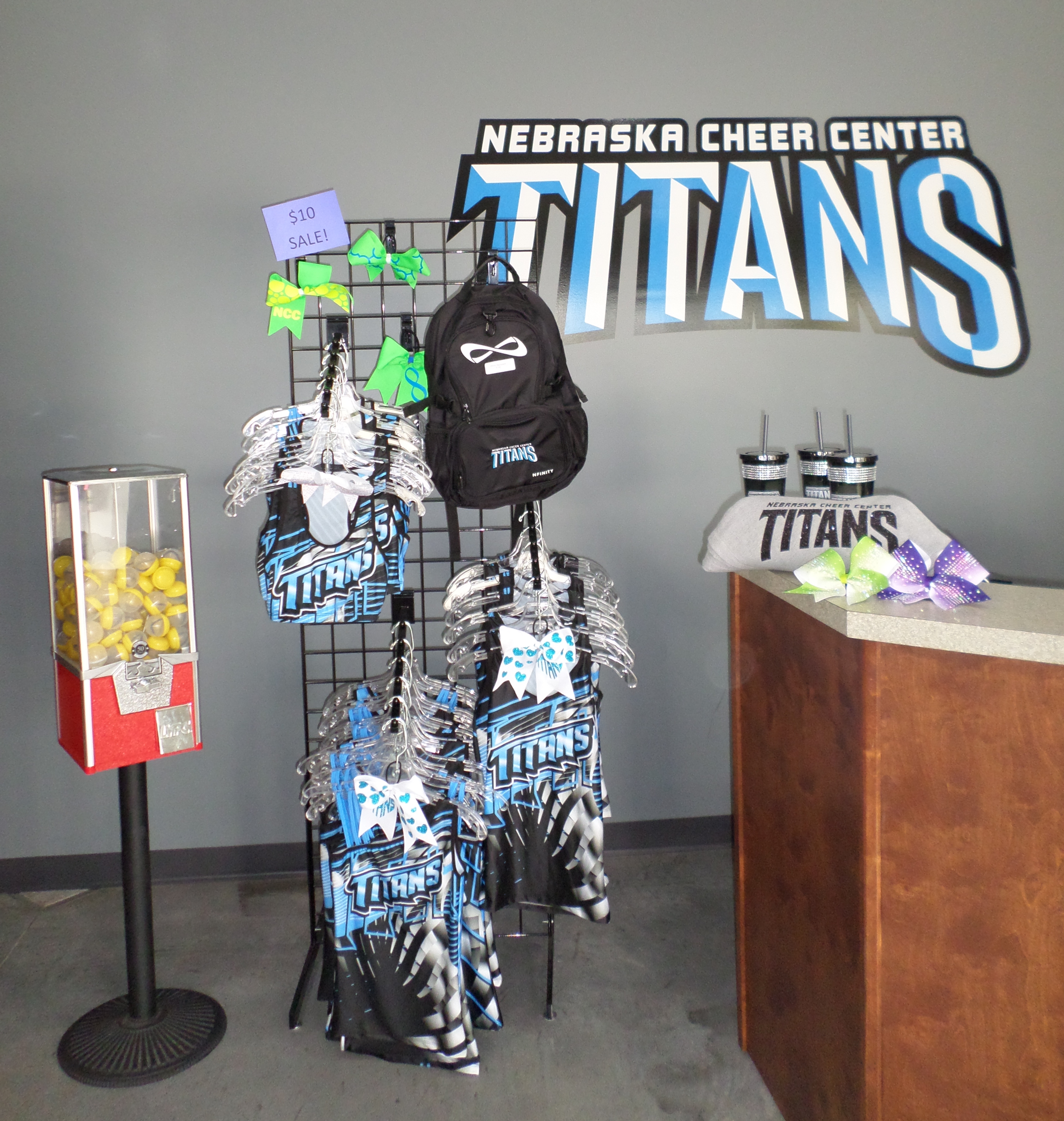 I have an office assistant who helps to run the shop, and we run sales and specials at Christmas, Valentine’s Day and other holidays. For example, during Christmas, if you spend a certain amount, you get a discount, and the more you spend, the higher the discount will be. I also have an in-house graphic designer who makes cute little ads that we can send out through email and Facebook when we’re doing our advertising.
For marketing, we use social media like Twitter, Instagram and Facebook to let people know about new items. Facebook hits your adult market so they know what’s new at the gym for the kids. If you share it on Instagram, the kids are on there so they see it, and Twitter hits a little bit older group of kids. We share photos of new things right as the kids are getting out of school so it hits [our target] market right away.
[As far as stocking,] we have learned that bringing in just 40 of an item when you have 225 athletes makes it just fly off the shelves. We also recently bought our own heat press so that we can make some things in-house too. We do not have an online store, but we have thought about it. Everything is going out as fast as it is coming in, so we haven’t gotten to the point where we have enough stock to start an online store yet.
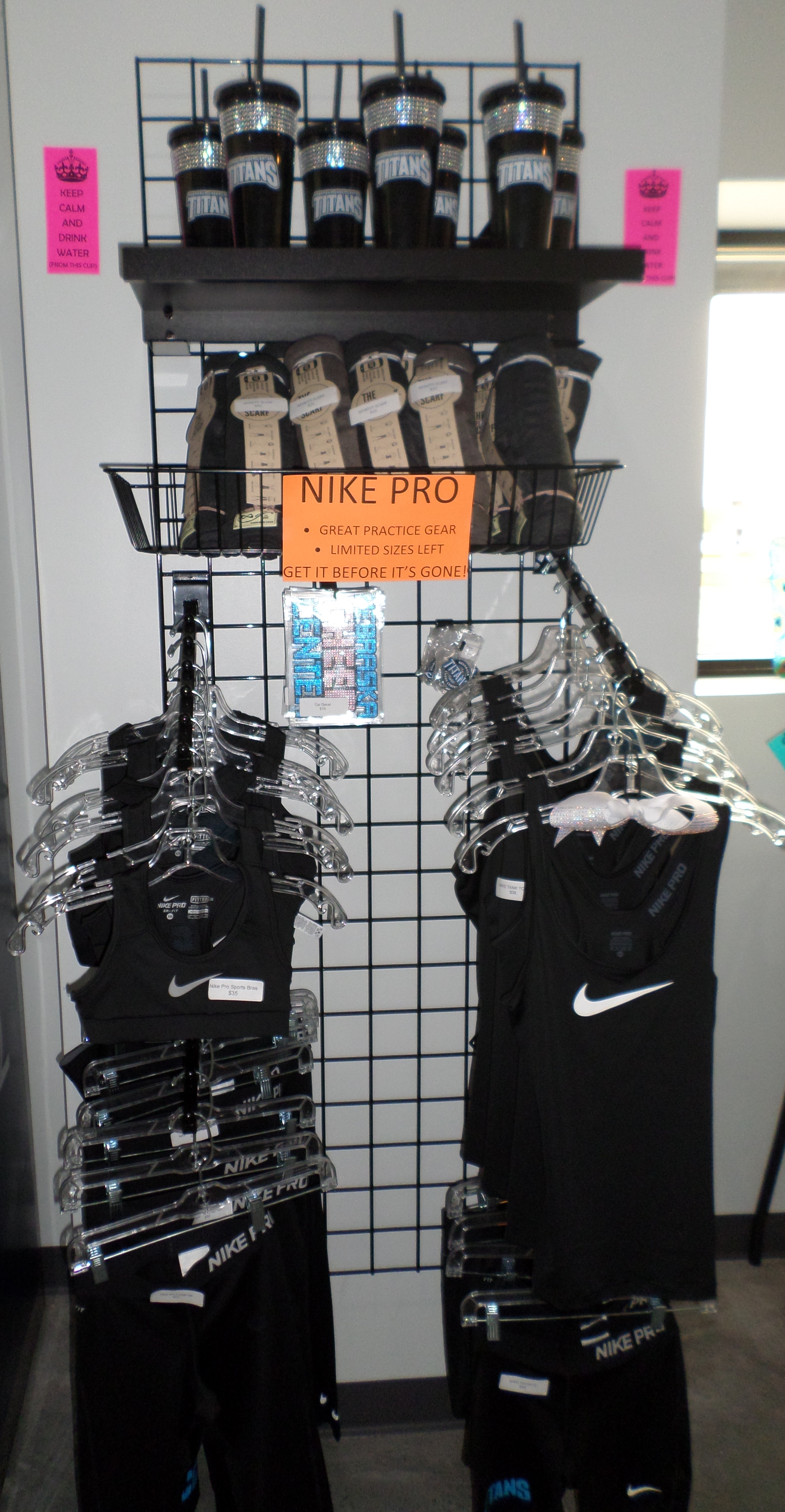 To date, I would say that about 15 to 20 percent of the gym’s income comes from sales at the pro shop. My husband and business partner would like us to get [that figure] to about 25 percent in the future. I would also like to bring in some new vendors and more athletic wear and practice gear in the future. We were approved to be an Infinity sponsor this year, so we get to carry Infinity shoes, backpacks, scarves and things like that in the pro shop—the athletes love that. And then Infinity gives your gym a little kickback, so it’s nice.
As for the physical space, we did a lot of research to figure out the best possible way to design the pro shop before we built it. We realized that when you go to Disneyland you have to walk through the shop to get to the rides, and our pro shop is the same idea as that concept. The shop is right as you walk in through the doors to the gym, so, like Disneyland, you have to walk through the pro shop to see the ride.
–Dina Gachman
What does it take to win our “Coach of the Year” competition? In Denise Ginocchi’s case, it was the heartfelt testimony of her athletes, who praised the Beloit, Ohio resident for pushing them to be their best and being generous with her time and effort—but also for having the ability to go from “laughing and hugging” her team to “conditioning with no mercy.”
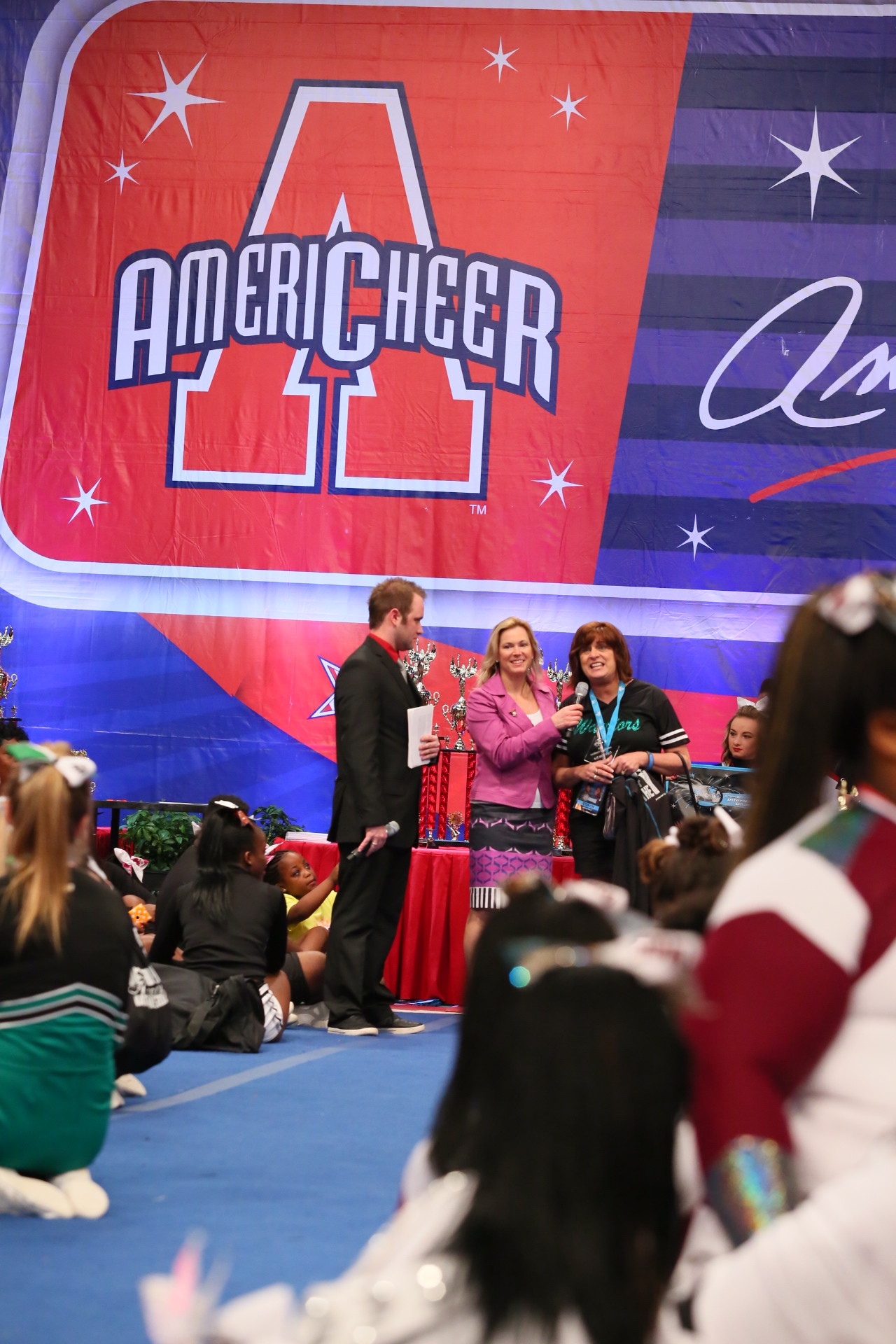 That determined work ethic is what spurred Ginocchi’s West Branch High School competitive cheer team on to kudos like third place at the 2015 AmeriCheer Internationals, seventh place at Ohio’s state competition, and series grand champion at their local CheerTime competition.
How did your coaching career start?
Ginocchi: I was hired as a teacher at West Branch Middle School 28 years ago, and was told the high school cheerleading coach had just resigned. Having been a competitive cheerleader since I was young and recently cheered for Youngstown State University, I knew I wanted to coach once I started teaching and have been doing it ever since. Cheerleading was in my blood—and I didn’t want to give it up!
As our 2015 Coach of the Year, you received nominations from your athletes; tell us more about your coaching style and why you think it works.
Ginocchi: I have to look at the individual athlete and the team’s chemistry and change my structure every year depending on those factors. We have a conditioning program and belong to a local gym with a gymnastics coach; she’s tougher than me and plays “bad cop” a lot. Conditioning is very important, and that’s the first thing I stress to the kids: “If you want to compete you’ve got to be in shape.” It’s something the athletes don’t like, but when they have success, they buy into it. This year we had great results and fewer injuries.
We also have team bonding time. I invite the seniors to my house for dinner and we talk about how we can improve team chemistry and camaraderie. We also do community service activities, like raising money for breast cancer charities. I always say, “If you work hard and do what’s right, good things will come your way.”
Do you do any work with all-star gyms?
Ginocchi: We’re at Competitive Edge Fitness & Dance in Alliance, Ohio, about two days a week as a team. We also practice two days in the school gym on the mat. My athletes are required to take some individual lessons from the gym coach at Competitive Edge. The gym owner is a graduate of West Branch High School and lets us use the gym free of charge when we’re there as a team. Then, the athletes are there for individual lessons two to five days a week, for which she charges a minimal fee.
It’s a very unique situation that I have—not all coaches have that and I take full advantage of it. I’ve been working with this gym owner for about two years. I think it’s great because the athletes are getting critiqued from someone who’s an expert in tumbling and jumps, [while] getting dance and choreography feedback from me.
Are any of your high school cheerleaders also on all-star teams?
Ginocchi: No, but I’ve had many of them pursue at the collegiate level, some at Division 1 schools. I have no problem with my athletes being on an all-star team as long as they’re true to our team and can balance both.
What aspect of your coaching cheer are you most proud of?
Ginocchi: I’ve had up years and down years, and being true to myself and my philosophy of coaching is what helps me. I thrive on adversity! When you’re winning, the coach is the greatest thing in the world, and when you lose, not so much. You have to stay focused and know what the right thing to do is—regardless of what people are saying. After 28 years, I very easily could have thrown the hat in, but…if you are true to yourself, you can weather the storms. Then, when you reap those benefits, there’s nothing better!
–Diana Kelly
The Price is Right: Presenting Pricing to Parents
jen : October 9, 2015 3:51 pm : Down to Business| Web ExclusivesRaise your hand if this scenario sounds familiar: a parent pulls you aside after practice and says, “According to my research, your competition fees are too high.” Chances are, if you’re a gym owner, you’ve been there—more than once. With so much information readily available online, many parents are doing their own due diligence to find out what competitions really cost, but they may not always understand the bigger picture. So what’s the best way to handle concerned parents who research fees online and compare them to the fees charged by your gym?
 In an attempt to solve that dilemma, Joshua Kennedy, owner of Horseheads, NY-based Intensity Cheer Elite, is trying something new at his gym. To date, he’s always charged parents an annual “comp pack” fee that covers things like competition fees, choreography, makeup, bows and cheer shoes (spread out over eight months), but next season, he’s introducing an auto-payment plan with more options for installments. “We’ll have both a quarterly payment plan and a monthly one to give parents the flexibility to choose which plan works best for them,” says Kennedy. “We’re also moving to an auto-pay system.”
As a seasoned gym owner, Kennedy realizes that getting all of the payments together to cover competition costs can be a lengthy process, so he’s also planning to cover all bases within the total amount for each family: “We always include the late fee of whatever competition we’re attending—nine times of 10, we end up having to pay the late fee anyway, so rather than having to ask for more money later, we just assume that we’re going to pay the fee.”
Despite his efforts to make his parents’ lives easier, Kennedy has received a number of emails from parents questioning his pricing over the years. He says, “I try to be as polite as possible, but it gets to the point where I tell them ‘Look, we’re a business, and we need to be able to operate and pay our coaches, pay our bills, pay our rent.’”
Leslie Pledger-Griffin, owner of Calhoun-GA, based Renegade Athletics, says she hasn’t gotten quite as much pushback from parents at her gym: “I’ve only ever had one parent who actually went online and looked up all the pricing and broke it down and asked me where the extra money was, to which I said, travel, food for the competitions, our hotels, per diems, things like that.”
To keep any drama at bay, Pledger-Griffin charges a lump sum for “competition and coaching fees” and breaks it down into four equal payments, due in August, September, October and November. By November 15th, everything has been paid in full.
Pledger-Griffin says that front-loading fees at the top of the season helps keep everything running smoothly: “It solves a lot of problems that other gyms have [where] they try to make the fees due a week or two before they actually have to pay them, and then they have a hard time collecting that money for whatever reason. In our situation, we don’t start competing until mid-December or even January, so I’ve had this money for over a month, sometimes two months, paid in full, before the competitions even start.”
At High Voltage All Stars in Salisbury, Maryland, co-owner Justine Lathbury tried all-inclusive pricing for the first time this year, and says “it’s the best decision we’ve made.” In the past, the gym charged a bulk amount for competition fees, split over five or six payments, but it was still a figure sitting out there. “This year, there’s nothing that says ‘X amount of dollars is going toward your competition fees.’ It’s just, ‘Here’s your monthly rate if you’re on XYZ team,’ and that’s what you pay. We haven’t had one question this season about any issues with money.” What’s included? Tuition, competition fees, makeup, practice wear and “anything else we want the kids to have.”
However, no matter what measures gym owners take to make pricing more clear, some feel the root of the problem is the fact that event producers put the pricing out in the open—where anyone can see them. Should EPs cave to the pressure and mask their fees? It’s a topic that stirs debate. Pledger-Griffin appreciates having the information at her fingertips, saying, “It’s convenient for me to just look it up when I’m considering a new competition—I can just go to the website and figure it out. I enjoy just being able to go look up the dates and pricing myself; you don’t have to contact anybody or get a secret login.”
Lathbury makes the opposite point, saying, “It’s almost like we’re buying from a wholesaler and then reselling a product or service. I feel like those numbers shouldn’t be available to the whole world. I’m not sure exactly what the right solution is, but maybe having a registration system, kind of like what the dance companies do.“
She adds, “It’s hard when a parent can just go on a website. They look at a price and it says $50, but that’s not always exactly how much it’s going to be. I think it would be better not to have that as public information.”
Kennedy sees both sides of the equation, calling it both a blessing and a curse. “Sometimes with our new parents, I’ll use the information to try to give them a feel. These nationals that we go to charge us from $100 to $150 a kid, [so when] parents challenge us, I can just pull up the company’s website, and they’re like ‘Oh, okay. You weren’t kidding,’” he says. “So it’s come in handy in that regard, but for the most part, I feel it should be private and marketed to coaches and owners, not necessarily the parents.” It’s an issue that will undoubtedly continue to come up, but it’s good to have a sense of how gym owners can approach the discussion.
–Lisa Beebe
Reinventing Your Gym Case Study: Central Community Athletics
jen : September 29, 2015 1:59 pm : Down to Business| Web Exclusives Considering a new name, new space or new approach? These changes can shake up your gym and open up new possibilities. We spoke with Kristin Perrin, owner of Central, LA-based Central Community Athletics, about her experience taking on a new gym name and two new co-owners. See what she has to say about the changes and how she’s reinvented her gym.
Why did you change your name? We were Central Cheer Athletics, but a lot of people were not aware that we also taught tumble and things like that, so we changed the name of our gym to Central Community Athletics. We wanted to let people know that we do more than just cheerleading.
You recently added two new co-owners. How did that come about? Laura and Stewart Messer were UCA staff members, one for seven years and one nine years; they were both also college cheerleaders. Stewart was on the LSU gold team when they won nationals, and Laura was with ULL. They recently moved back to our small town, and we were able to reconnect with them and bring them in to the gym.
Why did you decide to bring in new owners? For their experience. Mindy Callendar and I started [the program] just based on our experience, which wasn’t much as far as competitive or anything beyond high school cheerleading. We had about 70 girls that we were coaching at the time, but it was through the Little League Football Association. We had a lot of people telling us that they wished there was something else they could do cheerleading-wise in their small town, and there just wasn’t anything at the time, so we thought, ‘We’ll just go ahead and start something.’ We had minimal experience, and we thought adding the Messers would really help a lot—and it did. They sat down with us, and we revamped everything based on their experience and their knowledge.
How did it change your overall financial arrangement? We were a partnership. We brought them in as one entity—not two—because they’re a married couple. We’ve split it three ways as far as ownership goes, but it did increase our revenue, so it definitely was a good thing. It’s been a tremendous blessing for us.
When you renamed the gym, how did that affect things? As far as social media goes, we didn’t eliminate our current Facebook; we just put in a request for a name change so that we could keep our followers. We didn’t lose business because of it—if anything, we gained business, because when ‘cheer’ was in our title, it turned people away who were looking for gymnastics. Half of our business is dedicated to floor gymnastics, so we had to let it be known that we weren’t just cheerleading.
What advice would you give someone else who’s reinventing their gym? Send out press releases to all the newspapers and magazines and news stations around your area, saying, “Some big changes are being made.” There are lots of ways you can get free advertisement through that [approach]. Also, do a big open house with the new owners and a meet-and-greet. We joined the chamber with our new name and did another ribbon cutting, because we did become a new gym with new owners and everything. We just really made the most of it and talked it up the best that we could. We had another Grand Opening and all that good stuff, just to get the word out that we were still in Central—just with a new name.
–Lisa Beebe


