

In addition to all the great content we bring cheer professionals in our quarterly print issue, you’ll find plenty of original exclusive content right here at TheCheerProfessional.com.
Keep checking back for all the latest and greatest news, updates, debates and more!
 What it is: Want a cloud-based gym management solution? You should know Jack. Used by gyms like East Coast Nitros, All Star Legacy and Cheer Force One, Jackrabbit provides a web-based way to easily manage registrations, as well as automate payment and other processes. The program can also collect other types of data and connect to other programs like QuickBooks and Payroll Express Plus. Pricing plans range from $45/month (for up to 100 students) up to $245/month (for up to 3000 students); a free trial is available.
Why it matters: Say goodbye to bulky paperwork and hello to an entirely cloud-based gym management system that can be accessed from anywhere (a plus for gyms with multiple locations). Along with online registration and accounting, Jackrabbit also offers other features such the ability to send mass emails, view customer data, track employee hours and store new leads. Parents like it, too—for the added convenience factor of being able to register, pay and view their accounts online.
Quick tip: Cut down on collections and save your customers late fees by implementing the auto-pay feature.
Similar services: iClassPro (http://www.iclasspro.com); eSoftPlanner (http://www.esoftplanner.com/cheerleading_facility_scheduling_software.php)
 Many cheer professionals have been asking for an update about the GrowCheer.org proposal and whether the USASF has responded. The companies affiliated with GrowCheer.org have sent us the following update to share with the community:
GrowCheer.org would like to thank all of those in our industry that have voiced their support for our efforts, both publicly and privately. We would also like to thank Jim Chadwick and the USASF BOD for recognizing GrowCheer.org and agreeing to an initial dialogue after receiving our formal proposal. It is out of respect for the USASF, and an earnest desire to make all of the changes that we have proposed, that we will not be commenting publicly while discussions are ongoing.
Since the creation of GrowCheer.org, we’ve all noticed an increase in discussions about additional changes that should be made in the future with the USASF and our sport in general. While it is this kind of creativity and “what if?” thinking that will eventually make our industry better and growing again, we emphasize that the primary mission of GrowCheer.org is simply to create an independent and transparent USASF that can tackle these issues in the best interest of all of our members.
We also reiterate that while we are prepared to financially help the USASF gain independence, our only expectation in return is a truly independent and transparent USASF. To repeat, NONE OF THE FOUNDING COMPANIES OF GROWCHEER.ORG HAVE A DESIRE TO REPLACE VARSITY AS THE CONTROLLING ENTITY OF THE USASF. No sport or industry should ever be controlled by special interests within that organization if it truly wants to grow and get better.
 Whether an athlete wants a leg up on the competition or extra tumbling training to perfect that standing back tuck, many do double-duty on both high school cheer squads and as all-star gym athletes. Having kids involved in both is a balancing act—one that gym owners deal with all season long. It’s a process that involves patience, communication and one heckuva big calendar.
In many cases, the key is careful cooperation with high school cheer coaches. Kate Brahney learned that the hard way after she opened Ireland’s Xtreme Gymnastics and Cheer in Auburn, New York, last February. Of her 19 seniors, six also cheered for the local high school team. Brahney attempted to find a happy medium by creating a flexible tumbling class schedule and reducing practices to once a week; however, that practice still overlapped by a half-hour with the school squad—and the coach wasn’t willing to budge.
After several unsuccessful attempts to appease the high school coach, Brahney ultimately decided the best solution was having her athletes choose between the two teams. “The problem was that these girls were my bases, so I ended up with no full stunt groups during high school practice, and by the time they got to us, our practice was half over,” she explains. “The girls and their families pay a lot of money for this training, and it wasn’t fair to those who were there.”
Ultimately, only one of her students chose the high school team, so Brahney retained 18 of her 19 athletes. However, she’d have preferred a different outcome. “If all-star coaches and high school coaches could collaborate, wow, what an experience these athletes could have,” she says. “If [schools] are the cheer experts and we’re the tumbling and stunting experts, the cheerleaders get a complete package and it benefits everyone.”
Making It Work
Though Brahney wasn’t able to make it work for her gym this season, there are many gyms bringing her vision to life. At Cheergyms.com in Concord, California, kids can do both, and many do. Owner Morton Bergue believes forging alliances with school coaches has been critical to his own program’s longevity: “We embrace the schools. We want their business.”
His facility serves roughly 20 high school squads in the area on a regular basis, primarily in the areas of choreography and tumbling practice. For athletes that do double-duty, Bergue puts a heavy emphasis on scheduling, carving out a hefty chunk of time at the beginning of every year to go over upcoming competitions, training camps, etc. Athletes can then review their options and make sure it will be feasible to participate in both activities.
“We sit down with high school coaches and advisors with a big old calendar and work it out. It’s about plugging in dates and times,” shares Bergue. “You get them on your side, they like you, and you’re gaining their trust.”
When it comes to getting athletes to make all-star cheer a priority, Bergue says requiring kids to sign on the dotted line is key to reinforcing their commitment. “We make them fill out a contract, and we have lots of parent meetings. We have the upper hand and we don’t fool around,” he says.
Other factors also play a role—all-star cheerleading costs upwards of $4,000 a year, he says, so many parents make their kids make it a priority. Hiring a stellar cadre of instructors also makes a huge difference: “The coaching staff has to be good for the kids to want to come to practice; we make it so you don’t want to miss out.”
Cutting Through Red Tape
Of course, coach relations and scheduling aren’t the only obstacles. In some cases, state law can make the balancing act difficult. In Oregon, where Thunder Elite is based, the Oregon School Activities Association (OSAA) decrees that a child can’t compete twice in the same venue on the same day—making it difficult to attend any local or state competition that caters to both all-star and school cheer squads.
“The OSAA ruling hurts everyone involved and makes it more difficult for kids to do both,” says co-owner David Skaw. “Not impossible, but certainly challenging.”
Eric Contreras of Scottsdale, AZ-based Desert Storm Elite has dealt with similar setbacks. In 2009, the Arizona Intercollegiate Association (AIA) disallowed high school squads from competing or practicing with all-star teams. (AIA classifies cheerleading as a sport, whereas in most states, it’s considered an activity.) Contreras considers it a shame, as prior to the AIA ruling, he enjoyed a great, stress-free relationship with the school coaches. “We helped each other coordinate schedules so that wherever they were going [to compete], we didn’t interfere with that,” he remembers.
The Problem with Poaching
One of the most important ways to get school coaches on your side is to squash any fears of poaching athletes. At Thunder Elite, Skaw says “it’s a non-issue because it’s something with deal with upfront.” He enforces a strict-no poaching rule with his staff when it comes to high school athletes.
“I’m a firm believe that if a kid wanted to do all-stars, they’d be in the gym already. Coaches are trusting us to train their kids, not to pilfer their squad while they’re under our roof,” he says. “I feel it’s not only immoral, but also just dumb business.”
Bergue agrees. He says his program has been accused in the past of poaching high school kids, but he attributes his overall solid relationship with local schools to his focus on creating a peaceful co-existence. “It’s hard, but in the long run, it’s best to keep the high schools happy,” says Bergue. “We want them to like us enough for them to use us for many different things.”
Keeping the athletes in check is also important. Contreras says he was always quick to tell athletes that if they wanted to ditch their school squad for all-star, that wouldn’t fly with his gym: “We’re big on commitment and follow-through. I would tell them, ‘You tried it, so stay with it. Whatever it is in your life that you’re doing, stick with it.’”
–Lindsay Martell
Owner’s Manual: Darlene Fanning of ICE All-Stars
jen : March 11, 2013 1:56 am : Down to Business| Web Exclusives| webexclusive1 In our “Owner’s Manual” column, we ask gym owners to take us “under the hood” and give us their secrets to what keeps their gyms running so smoothly. Find out how Darlene Fanning finds her balance by keeping high schools happy below:
Vital Stats
Name: Darlene Fanning
Gym: ICE
Locations: Aurora IL, Fort Wayne, IN and Mishawaka, IN
Founded: 1998
Size: 350 athletes; 18 teams (cheer and special needs)
The Dish
I really like to work with the high schools. I encourage [our athletes] to cheer for their high schools because that’s something that others outside our gym can see and say, “Wow, this child has these skills and that’s great.” Sometimes high school coaches are worried that we will try to pull them away from high school cheerleading, but that’s not my intent at all. It’s to make them better so that they can do something for their school. Both of my daughters who cheered all-star also cheered at school and we made it work. There were a few weekends where they missed games for competitions, but there were also times when they missed my practices to cheer at games.
Coaches working together is the key—as long as high school and all-star coaches are willing to do that, I think it can be a win-win situation for both. That’s what I really try to push for. I like to talk to the high school coaches and say, “Is there a camp coming up? Is there something you’ve got that I need to change my practices?” It’s all about letting your ego and everything go and saying, “Okay, what’s best for the kids?”
Sometimes high schools practice right after school, so we start our practices later so that they can get to the other one first. Obviously, as an all-star coach, I have to work around their schedule; however, high school coaches have to understand that they need to do the same in order to allow the kid to do both. Otherwise what can end up happening is that high schools lose their most talented kids—and that’s a shame. Many times when athletes are made to choose between competing and cheering at games, those more talented kids will choose all-star. They understand that’s where they’re challenged cheer-wise. A lot of high schools don’t compete, so [that style of cheer] is more just supporting the team and your school.
As far as recruiting, you don’t want to get a bad reputation as a gym owner who steals athletes or takes them away from high school programs. That’s not good for the kids or for either program. Even when high school cheerleaders are training in my gym and taking classes, no coach is allowed to approach them. Only when a kid comes to us and says, “I think I’m not going to do high school cheerleading next year, I’m going to do all-star,” will we talk to them. High school coaches need to know that their athletes can go to ICE for training and not have to worry about the kids being recruited.
I haven’t had a problem with high school coaches because of that rule. I’m a smart enough business owner to know that you don’t shoot yourself in the foot by trying to recruit a few of those kids and making the high school coach mad. That’s why we’re so diligent about that, and that’s how we strike a happy balance.
It All Counts: Scoresheet Breakdown
jen : March 6, 2013 12:31 pm : In the Industry| Web Exclusives| webexclusive2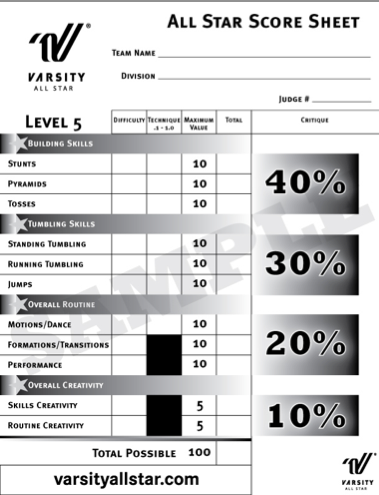 In the cheer world, it comes down to knowing the score. With a variety of complex scoring systems in competitions, it can be a challenge making sense of it all. Here are some things you need to know about how some of the major players in the business add it all up.
Many companies and event producers use Varsity’s All Star Scoring system, which was introduced three seasons ago. Its scoresheet is primarily composed of four main categories: Building Skills (which accounts for 40 percent); Tumbling Skills (30 percent); Overall Routine (20 percent); and Overall Creativity (10 percent). Depending on the level, those categories are then broken down into further subsets such as pyramids, jumps, motions/dance and performance.
This year, the scoresheet was further refined with a new scoring rubric, according to Justin Carrier of Varsity Brands. “We took every one-point range for difficulty and broke it down even further into low, medium and high ranges, setting black-and-white expectations for those teams trying to ‘max out’ their difficulty score,” says Carrier. For instance, 8.0-8.2 would be considered “low,” 8.3-8.6 “medium” and 8.7-8.9 “high.” Adds Carrier, “It makes it less of a guessing game as to where you’ll fall.”
Another significant update is the list of new elite building skills required to reach the highest level-appropriate range for stunts. “We re-categorized elite building skills because the teams have gotten so talented,” Carrier says. “The teams have pushed the envelope with difficulty, so it forced us to reevaluate.” In addition, Levels 3, 4 and 5 of the senior co-ed stunting teams (with some select exclusions) must now perform single-based, unassisted stunts.
Also of note is that coaches and judges receive the same information. “Our process is totally transparent,” says Carrier. “The presentation we give the judges is the same presentation we give the coaches as to how the system works.”
Along with all Varsity brands, companies like Cheer America, Universal Spirit, CheerSport and Americheer have adopted the Varsity scoring system. According to Americheer’s Jeannine Kranchick, the company relied on feedback from coaches, judges and industry leaders to determine which scoring system to use. “We felt this was a great fit for our customers,” says Kranchick, who acts as Americheer’s Marketing and Public Relations Coordinator. “It is easy for judges to calculate and easy for coaches to understand the scores.”
At Jam Brands, category judging is utilized. This scoring system consists of three panel judges in the areas of 1) tumbling 2) stunts and pyramids and 3) jumps, tosses and dance. Along with objective points earned for difficulty, judges also give subjective scores on technique, execution and overall impression. For instance, a score of 7-8 is “fair,” 8-9 “good” and 9-10 “excellent.”
“Difficulty scores are based on required elements that are allowed in different levels per the USASF,” says Jeremi Sanders, the company’s scoring director. “We use a rubric for all of our objective scores. We give a separate technique score, because we encourage teams to execute elements in their routine that promote safe skill progression.”
Each year, Jam Brands updates its scoring system to meet the needs of coaches and teams nationwide, according Sanders. “All of our judges are vetted and trained,” says Sanders. “They are required to take and pass a test based on our scoring system. We continue training throughout the year with weekly conference calls and event-specific clarifications.”
Sanders says Jam Brands was the first in the industry to introduce a unified scoring system back in 2009. Other strides include the creation of a department solely dedicated to judging and scoring and the introduction of co-ed specific scoring and quantity scores for whole team participation. Last year, the company also designated its own scoring representatives at events who can answer questions asked by coaches and oversee the judging panel.
Regardless of the scoring system in use, there may be a bigger picture to keep in mind. “A successful system is usually a consistent one, so coaches and judges don’t have to relearn it every year,” Carrier says. “A lot of emphasis is put on the scoring system, but it’s really the judges and the judges’ training that ultimately affects the outcome.”
[sidebar] Universal Scoresheet—Will It Ever Happen?
Talk of a universal scoresheet has permeated the industry for years. In 2010, the Independent Event Producers (IEP) made an official recommendation to the USASF stating that its 22 independent companies felt a universal scoresheet would be in the industry’s best interest. “We have made great strides toward legitimizing our sport and scoring is one area where we have not achieved legitimacy,” says Cheer America’s Colleen Little, who sits on the board for IEP. “The IEP recognized that our sport had reached the point where a universal scoresheet was the next logical step.”
Though the initiative stalled, talk resurfaced at the NACCC meeting in Doral last May, and in October, the NACCC released a position statement from its Universal All-Star Judging System Summit. “In order to enhance the integrity of the industry, the NACCC along with event producers have implemented a plan to develop a Universal Scoring System for All Star Cheerleading competitions,” the statement reads. “To ensure quality, fairness and consistency, a committee made up of judges, coaches and event producers will utilize their expertise and experience to create a structured scoring system to benefit the athletes, coaches, spectators and event producers. The development process for the system is scheduled to take up to 24 months which will include careful analysis of available systems, assessment and editing.”
As development and discussion continue over this 24-month timeline, the debate continues among some circles about whether it will truly be beneficial. Karlette Fettig of Indiana Elite sees both sides. “From the gym’s perspective, it would be easier not to have to worry about the differences between competitions; once you put a routine together, you know you won’t have any nuances from competition to competition,” she says. “However, I do understand from an event producer’s perspective that it takes away a piece of their individuality. I’m not sure it’s fair to them.”
Spirit Celebration’s Billy Smith is one event producer who’s all for it. “I am so excited to see the coaches getting organized and taking control of their industry,” says Smith. “This idea has been presented for years and shot down by the USASF without the support of the larger event producers. Now that the coaches are leading the crusade, I think it can really happen.”


