

In addition to all the great content we bring cheer professionals in our quarterly print issue, you’ll find plenty of original exclusive content right here at TheCheerProfessional.com.
Keep checking back for all the latest and greatest news, updates, debates and more!
Meet Our Young Entrepreneur Competition Winners!
jen : September 4, 2013 12:35 pm : Web Exclusives| webexclusive2Thanks so much to all who entered our Young Entrepreneur contest sponsored by Nfinity, and congratulations to our winner Madelyn Mize and finalists Cheer 360 and Muddy Cheer Challenge! Get to know these enterprising young cheer professionals and find out what’s coming down the pike.
 Meet Our Winner: Madelyn Mize
I’m a 17-year-old, current competitive Level 5 cheerleader with aspirations of cheering in college. As I learned about the process of cheering in college, I quickly realized how inefficient the process is. Colleges do not have the budgets to promote their programs. Often aspiring collegiate cheerleaders lack the time and money to participate in more than one or two camps. I told myself that there has to be a better way! That’s where Traelo Sports comes in. It exists to link not only the cheerleading and dance world with each other, but with colleges and their programs.
Meet Our Finalists: Cheer 360 and Muddy Cheer Challenge
 Cheer 360
Cheer360 is a sport specific strength training, nutrition and mental fitness program developed and run by certified, accomplished and enthusiastic fitness, nutrition and cheer professionals. Cheer360’s goal is to build better cheer athletes by empowering them to achieve, maintain and perform at their highest personal, physical, nutritional and mental level possible. Cheer360 understands that cheerleading is in fact, 100% a sport. Cheer athletes must be as strong as a football player, as coordinated as a dancer and as flexible as a gymnast. Located in Long Island, NY, the Cheer360 program teaches skills that transcend sport and enrich one’s personal life.
Cheer strong! Cheer Smart!
 Morgan Fairley: Muddy Cheer Challenge
I created the Muddy Cheer Challenge fundraising company to put the fun back into fundraising and remove all the work and worry. As a former cheerleader and coach, I know how important it is to find NEW team bonding activities and teaching the athletes how important giving back is. I also know how important fundraising is to teams and gyms. Selling cookie dough and tumbling clinics are good, but this is so much more fun, different and unique and what more perfect way than to combine all of these things that cheerleaders need into one company? These runs will have something for everyone and will be a family event everyone can enjoy. I want to encourage this to become an annual event for gyms and schools nationwide.
Q&A: “Cheer Perfection” star Alisha Dunlap
cheerpro : September 2, 2013 11:47 pm : Web Exclusives| webexclusive1If you love TLC’s “Cheer Perfection,” get ready for more of fiery Alisha Dunlap and her cast of characters at Cheer Time Revolution. Season Two has hit the airwaves! Get to know this opinionated gym owner and find out how “Cheer Perfection” has changed her life:

CP: Share a bit about your cheerleading background.
Alisha: We opened Cheer Time Revolution in 1999, and then I sold the gym in 2004. I had already started a family and wanted more babies. But as time went on, I absolutely missed it—couldn’t stand it. Also, my oldest daughter was awfully talented, and I couldn’t find a gym anywhere in the state that I liked. We were driving 2.5 hours to take her to cheer. In 2007, we re-opened, and today we have 16 teams ranging from Tiny Tots to an open Level 6 team.
As for my own cheer experience, I was on the very first all-star co-ed team in the state of Arkansas, the Cheer Central Braves. I cheered for six years.
CP: How did the opportunity with TLC come about?
Alisha: My daughter used to do pageants, and they had been asking me for several years to do Toddlers and Tiaras. They wanted to show just the pageant life, but I told them, “Our life is truly cheer, so come into the gym for a few days.” They came in and saw what we had to offer. After T and T aired, we got great hits, and they said, “We want to do this cheer thing selling you guys.”
At the time, I was so busy running two businesses (Pageant Perfection Studios and Cheer Time Revolution), plus a family with three kids. I wasn’t sure what more I could take on my plate. But all of the kids had so much fun on Toddlers and Tiaras; they thought they were superstars. They had a blast! I talked with the parents and kids at the gym, and they said, “Give it a try.” I thought to myself, “I’m going to do this more for the kids than anything.” Since when does a little itty-bitty gym in Arkansas and these kinds of kids get an opportunity like this? So I went for it.
CP: What are the benefits and drawbacks of such large-scale exposure? Have you seen a demonstrable change in interest or prestige since the pilot aired in July?
Alisha: The show isn’t just about cheer—it’s about our lives and interactions. The gym is a “set” for us; it shows how we all work together and get our kids to this point. We have not had any drawbacks. I haven’t lost one kid. In fact, we have doubled in size. When the show aired in July, we went from having small teams to large teams. Our junior team now has 32 [athletes]; we’ve probably gained 60 kids total since the show aired. Our tumbling classes are full, and new kids are coming out of the woodwork wanting to be cheerleaders. It’s generated a ton of hits on our website and Facebook pages.
CP: What advice would you give to cheer professionals who have the opp to put their gym in the spotlight?
Alisha: Pray about it. Go with the flow. Reality shows are reality shows, and editors are editors. Just do what you do best, and hope for the best.
CP: Parental expectations are a big part of the show. How do you strike a balance between keeping parents satisfied and doing what’s best for your gym?
Alisha: We have to set a line. It has to be our way, and that applies to both parents and athletes. We’re always open to suggestions, but our staff as a whole decides on what’s best for the gym. We’re okay with the fact that we might not always be the best fit for all parents or how they want to see a program run. We still have to do what’s best for our gym.
CP: You co-own the gym with your husband RD—any advice on running a business with your spouse?
Alisha: Without the two of us, it wouldn’t work. We love to disagree, but we always have to meet in the middle. We are night and day: I’m very firm, and my coaching style is very different than his. I want to see the overall routine hit and overall athlete to excel. I want their skills to improve and advance quickly, whereas my husband wants to see perfection before progression.
[As a compromise], we start our routines early in June. We have a lot of kids, so it’s about muscle memory. My husband helps them learn the early stunts before we advance. This approach gives us more lead time to accommodate both of our coaching styles. By the end, our kids can do the whole routine backward and forward, with or without music. Then he comes back in before competition season to get the skills absolutely perfect.
CP: The show emphasizes a heavy focus on winning. What’s your philosophy as a coach?
Alisha: Winning is important, but it’s not always about actually winning the trophy. They’re winners if they hit what they’re supposed to hit and do their absolute best. And 99 percent of the time, when the kids give all their effort and execute like they should, they’re going to win. It goes hand-in-hand.
CP: Any response to criticisms that you’re too hard on the cheerleaders?
Alisha: That’s from the outside world. [On TV], I come across as a hard coach, but what they don’t see is that, behind closed doors, I am very rewarding. I expect my kids to be a certain way in practice and I will push them until they get the skill they want to learn. In return, they are rewarded for everything they do. If they go out and have an awesome performance, we have sleepovers and ice cream parties, so it makes them want to work and give 100 percent. It’s all about working toward the skills they want to achieve.
CP: How do you think reality shows about cheer can further the sport as a whole?
Alisha: If all the cheerleading shows can show a positive side of cheer, I think it will be great and can only pick up the numbers. The new show on CMT [“Cheer”] shows a very high-level of kids. My feeling is that maybe the newer kids watching will say, “I couldn’t ever do that,” but with our show, they’ll see that everyone starts form the bottom and has to learn Level One first, so they have a chance. It’s great to have a wide representation across the spectrum.
Can’t get enough Alisha Dunlap? Check out our new “Candid Coach” Q&A with the Cheer Perfection star!
A Day in the Life: Les Stella
jen : August 19, 2013 2:57 am : A day in the Life| Web Exclusives| webexclusive1 Get a glimpse into the day-to-day life of USASF’s Les Stella (when he’s not on the road, that is).
5:00 am: Up and at ‘em! I usually start my day with prayer and quiet time, and then it’s off for a barefoot run.
7:00 am: Time for a breakfast—usually eggs and fruit, or sometimes a smoothie. We use a Vitamix blender for all types of great smoothies. We also try to eat breakfast as a family and can pull this off pretty often.
7:30 am: I bring my two sons to school and head into traffic for the 45-minute commute. This is another good time to listen to some podcasts on ministries. It keeps me from getting frustrated with other drivers (most of the time) and helps start the day on a good foot.
8:15 am: I usually start by preparing for the day. I know when I open up my emails that I usually get stuck there, so I review my calendar, meetings, video reviews and other important priorities for the day. My day can consist of everything from conference calls on scoring or rules, to Board or Committee meetings, to answering questions from lawyers or parents, to updating the rules website or handling any “drama” that may have occurred overnight! I try to also check the major social media outlets for any news that I should know about. THEN IT’S EMAIL TIME!!!
12:30 pm: Off to lunch. I try to get my mind out of “cheer” at this time and focus on coaching my boys at soccer, talk to my parents or just read local and national news websites. Then, back to work!
1:30 pm: More emails, meetings and conference calls. After lunch is when I usually do a calendar check to see if I need to book any upcoming flights, hotel rooms or rental cars.
5:00 pm: Traffic is a nightmare! I rush to pick up my boys from after school care, get changed, have a quick snack and run out the door to coach a soccer practice (soon to be football for my youngest son).
5:45 pm: I have learned to love coaching soccer. People always ask if I miss the coaching side of things. The answer is “ABSOLUTELY!” Now I get my coaching “fix” by coaching my sons. When you can train a group of individuals to lean on each other and trust one another to make a cohesive unit, the sky is the limit. I enjoy challenging them mentally and physically, and they are a great group of athletes. I usually get two to four rules phone calls while running practice (and games). I don’t mind as long as the cheer coach on the other end is patient while I call out instructions to my soccer athletes. My soccer parents think I’m a lunatic as I’m on the phone marking cheer stunts or watching stunt videos sent via text while coaching a game.
7:30 pm: This is my favorite time of day. We have a family dinner every night and take turns talking about the highlights of the day. We laugh, play and just enjoy our family time. If we have time after dinner, we may go for a family walk or bike ride. When my wife, Katie, travels to judge at cheer competitions, she is often asked about the latest USASF drama. People are always amazed that she has no idea what they are talking about. We never talk about cheerleading at home, especially in front of the boys. If my sons wanted to cheer, I would let them. However, I don’t want them to feel like they “have” to cheer because that’s what Mom and Dad are involved in all of the time.
9:00 pm: Time to put the boys to bed (if they have finished their homework) and relax with my wife for a bit before bed (and check emails one more time which usually gets me in trouble with Katie).
10:00 pm: Lights out! See you in the morning.
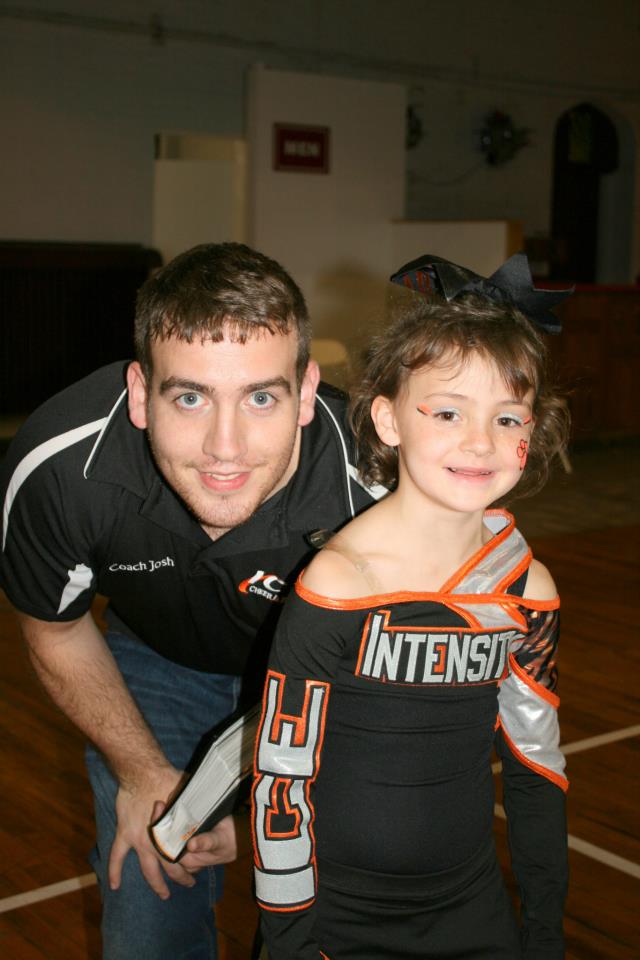 Want to secure juicy sponsorships for your gym? Joshua Kennedy shares the inside scoop.
Vital Stats:
Name: Joshua Kennedy, founder, owner and coach
Gym: Intensity Cheer Elite
Location: Horseheads, New York
Size: Six cheer teams and three dance teams
Gym size: 16,500 square feet
Debrief: As founder, owner, and coach at Horseheads, New York-based Intensity Cheer Elite, Joshua Kennedy has his hands full managing this rapidly growing gym. Now in its fourth year, Intensity has been successfully seeking out creative sponsorships and partnerships to help offset some of the costs and expenses that come with running a gym with 75 cheerleaders. Kennedy took the time to share his experiences and give some tips about seeking out – and securing – local and corporate sponsorships.
The Dish: When getting started, it’s important to evaluate the perception of cheerleading in your area. When I first I opened four years ago and asked this same question, I would say it would have been unrealistic to get a business sponsor without an “insider.” Since then, my program has helped to change the community’s outlook on competitive cheer and they are much more supportive now.
In addition, people are seeing that we are not just about training athletes but also about building character, which provides a greater attraction for support. Give a business reasons they should support the program, showing how it will in turn provide something worthwhile to their business. Also, make sure your gym is showing support for the community. Our program goes caroling during Christmas, conducts food drives for the local food bank and raises cancer awareness.
For this season, my gym offers a few different tiers of sponsorship: Bronze, Silver, Gold and Platinum. In the lowest tier (Bronze), I start a low bottom offer of a sponsorship of $25, which gets their business email recognized on our website. As you go up the tiers, the sponsorship commitment increases. Platinum requires a sponsorship of more than $1,000, for which I offer the business a window advertisement (and space for) their marketing material inside my gym. They also get a plaque with a program photo for them to display in their place of business; I am also offering sponsors of this tier [a photo op in which] they may hold a placement trophy from one of our events.
Overall, the bottom line of the gym is greatly impacted by sponsorships. I’ve received not just monetary support, but also material support such as wood supplies, paint and food for fundraising dinners. We’ve turned $400 in food donations from businesses and local supporters and had the fundraiser bring in over $3,000. These fundraisers, donations and sponsorships enable me to assure my clients that I have community support to help them offset the costs of the season.
Ultimately, sponsorships do enable us to travel more with our teams. However, the ownership of the gym has the ability to direct sponsorships to where they need them to be. Since my program has been growing so fast, many of my sponsorships have been focusing on new facilities, facility improvement and equipment investments. If the owner can show the community and businesses that their sponsorships are benefiting the kids (and not the bottom line), the possibilities can be endless.
Visit our “Biz Docs” section to see the letter Kennedy uses to secure sponsorships!

Business experts and Gym Kix owners Carrie Harris and Stephanie Beveridge
Number seven on our list is pricing your services! Pricing your service (tuition) is extremely important. “How much is it?” is usually the first question a customer will ask and—while you don’t want them to gasp for air at your answer—you want to be profitable and competitive with your market.
Your tuition cannot out-price your target market, yet a profit for your company must be made in order to keep your lights on. There are several approaches to pricing; ours is just one version for making pricing decisions that take into account your costs, the effects of competition and the customer’s perception of value.
Definitions:
- Cost is the total of the fixed and variable expenses (costs to you) to provide your service. (Rent, payroll, utilities, etc…)
- Price is the selling price per unit (monthly, 6-week session, a year etc…) customers pay for your service.
Price has to be set higher than the cost in order to turn a profit. How the customer perceives the value of your service determines the maximum price customers will pay.
Perceived value is created by an established reputation, marketing messages and your facility’s environment/personality. What do parents want for their children? What do parents value? Students learn life lessons, goal setting, courage, the humbleness of defeat and the glory of winning, etc. Parents know that these traits are valuable to their children and will more likely pay for those skills in addition to their child learning a back handspring. How are you different and what does your gym do better than your competitor? This will play into perceived value as well because your customer will compare you to other gyms.
Use cost-based pricing along with value-based pricing to come up with a price that is fair to your customer and profitable for you!
–Carrie Harris & Stephanie Beveridge
Past posts:
Starting a Gym 101: Licenses, Permits & Insurance
Starting a Gym 101: All Things Legal
Starting a Gym 101: Making the Big Decisions
Starting a Gym 101: Writing a Business Plan
Starting a Gym 101: Legal Forms of Business Ownership


