

In addition to all the great content we bring cheer professionals in our quarterly print issue, you’ll find plenty of original exclusive content right here at TheCheerProfessional.com.
Keep checking back for all the latest and greatest news, updates, debates and more!
Pure Magic: Pacific Coast Magic
jen : August 26, 2014 1:02 pm : In the Industry| Web Exclusives| webexclusive2 Troy Hedgren landed in the all-star cheer world by chance, but he nailed it. Today he’s one of four co-owners of the rapidly growing Pacific Coast Magic program, but the former gymnastics coach first started his entrepreneurial career at age 19 with the Tumblebus, a mobile gymnastics school for pre-schoolers. In 1995, he sold the venture (which by that point had grown to three gym buses) to open his first gym, Gymnastics 4 Kids, with his wife Keri. While sponsoring the local Pop Warner cheer team at a competition, the Hedgrens ran into one of Keri’s former gymnastics students, whose parents clued them into the competitive all-star world of tumbling, stunting, dancing and flying.
“It looked like a lot of fun, so we started down the road to learning about cheer and what it is,” Troy says. “I wasn’t a cheerleader, but the elements and training of gymnastics are similar.”
The Hedgrens took the bait, adding their first cheer team in 1997. By 1999, it made sense to change the gym’s name to Magic All Stars, one of the first gyms of its kind in Orange County. By the time Jarrett and Kellie Elliott (the latter a former college cheerleader) opened their all-star gym Pacific Coast Cheer in Murrieta in 2005, the emerging all-star industry was already changing with some smaller gyms consolidating and gaining presence in the industry because of multiple locations.
Pacific Coast Magic emerged in 2008, combining the two gyms under one umbrella. Troy and Kellie had judged competitions together for years and felt confident about their joint prospects. “We knew we wanted to get bigger and stronger and felt like the best way to do that was to combine our strengths,” shares Troy.
With increased numbers came better buying power, which helped the gym with everything from cutting costs on uniform essentials to adding additional locations. Owners of smaller, independent gyms started contacting the PCM team about the possibility of partnering or just straight out asking them to buy their struggling gyms. As a result, the all-star cheer gym has grown to seven locations in seven years: seven in California (Anaheim, Corona, Irvine, High Desert, Murrietta and Vacaville) and the most recent in Scottsdale, Arizona.
The most obvious advantage of joining forces was the bigger talent pool for creating elite competition teams, as well as the ability to utilize all the coaches’ individual strengths company-wide. Since the merger, PCM teams have secured bids for Worlds yearly. With the added training centers, PCM anticipates training 1,000 or more athletes next year in anticipation of Worlds, nearly doubling their arsenal.
 Hedgren says the key to the merger’s success has been ensuring consistency throughout the organization in both training and business operations, procedures and centralized bookkeeping—while ensuring that they didn’t strip each individual brand of its personality. “We had to make sure we didn’t lose the gym’s individuality, but we wanted it all to identify with PCM and embrace the best of both of those things,” Troy says.
The Hedgrens and Elliotts stay hands-on at all locations by evaluating the different teams’ routines by video, providing feedback and quality control. “Kellie and I are coaches at heart,” Troy says. “We love this sport, so we are constantly trying to be on the cutting edge, the very forefront of what is happening—inventing new stunts and choreography or just making sure we’re pushing the envelope.”
Their enthusiasm is most evident when they are on the practice mat. “I love watching the growth of young athletes,” Troy says. “I love injecting in them the strength our sport provides of teamwork, hard work and dedication. I love taking them through the journey of a season—starting from scratch and learning a routine or building a new stunt and seeing the light in their eyes as they go through those procedures.”
However, it hasn’t all been pleasant turns of fate since opening PCM. In late 2012, one of their athletes, 17-year-old Danika Rae Tibayan from the Anaheim gym, died from a severe asthma attack. She had competed as an International All-Girl Level 5 All-Star in 2011 and 2012. “It was a very trying time because obviously losing any young athlete or child is never easy, but I think what it did for PCM is that it reminded us that while we are growing and we want to continue to grow and get stronger, we never want to lose that family feeling from our core values,” says Troy.
At a competition just days after Tibayan’s death at the Citizen’s Bank Arena in Ontario, Calif., the PCM family wanted to find a way to honor their fallen friend. They spoke to the event’s producer and organized a 10-minute break in the festivities for a prayer circle around the Tibayan family, who were in attendance. But what they thought would be a PCM moment of grief and healing turned into something much larger as the rest of the attendees joined them, forming a huge circle of support.
“The feeling that came from that was just overwhelming,” Troy says. “While it was tragic to lose Danika, it was definitely a reminder for us that no matter how big we get that we will always remain a humongous family.”
–Arrissia Owen
Private Lessons: A Primer
jen : August 21, 2014 12:30 pm : Down to Business| Web Exclusives| webexclusive1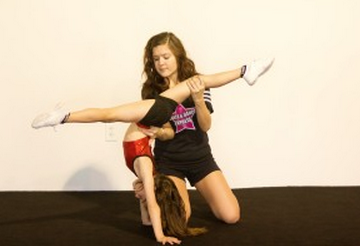 The good news: Private lessons can certainly add an extra layer of perceived value for gym clientele. The bad news: at times, offering privates can also add more hassle for gym owners between scheduling, pay structure, and other considerations. However, in the end, most gym owners, coaches and parents agree that private lessons offer an array of benefits that make it worth the effort. Find out how gyms around the country handle this popular revenue stream:
About Time
The trickiest aspect of offering private lessons in a gym, most say, is scheduling. Some gyms have set times at which the lessons can be offered, while others leave it up to coaches to handle their own schedule.
At the Wilson School of Gymnastics, Cheer and Dance in Chambersburg, Pa., coaches have freedom to schedule their own private lessons—within reason. According to team coordinator Rachel Roberts, privates can’t be scheduled during class times, so most coaches arrange them immediately before or after the student’s team practice.
At Virginia-based Cheer Extreme Roanoke, coaches also have liberty with scheduling, and several use business cards to help parents contact them for privates. Gym owner Bobby Lozano offers assistance with scheduling and pairing up people for privates. “Parents will come to me and say, ‘My daughter wants to work on her back handspring. Who does a really good job working with that age group and skill?’” Lozano says. “I figure out who would best suit that child [and his/her needs].”
Kristen Shimmel, a coach with Cleveland-based X-Cel Athletics, says scheduling is the responsibility of the coaches, but it’s not always easy. “At our gym, the space is always utilized by squads or tumbling classes, so private lessons use whatever free space is available at any one time,” she says. “Space is often an issue, but you just have to get creative!”
Private Benjamins
Where gyms vary more widely in handling private lessons is how coaches are paid. Some gyms allow coaches to keep 100 percent of the earnings as a means of supplemental income (and extra incentive), whereas other gyms take a cut of the cost or expect the coach to do privates as part of their existing salary.
For instance, X-Cel Athletics pays its coaches, including Shimmel, through the gym’s payroll. At Wilson and CEA Roanoke, coaches are paid directly by parents, although both Roberts and Lozano say there is a standard rate for the lessons. And at Georgia-based Renegade Athletics, private lessons are simply another way coaches earn their hourly salary.
“All of our privates are scheduled and paid through the gym,” explains owner Leslie Pledger-Griffin. “Instructors make their hourly pay regardless of what they are doing—office work, tumbling class, privates lessons, teams or whatever.
Lozano says payment for privates used to go through the gym, but the coaches now make 100 percent. “Coaches do the work for it and deserve the money,” he says. “The added incentive for coaches to work more privates is that they’re getting the full amount of money. In the end, it benefits the gym because the kids they are working with cheer for us.”
Why Privates Matter
Offering privates can help assure parents as to the one-on-one attention and education that their child is receiving—helping to ensure gym retention. For Wilson parent Beverly Musgrave, private lessons are a welcome aid to her daughter’s skill development. “The one-on-one time gives her the chance to really concentrate, and focus more on what the coaches are asking her to do,” Musgrave says.
Gym owners and coaches can also use private lessons to help the team at large—targeting needed areas of improvement. For instance, when Roberts was prepping her athletes for U.S. Finals this spring, she worked privately with one particular athlete to nail a key tumbling skill. “We had one athlete who was extremely inconsistent with her standing tuck,” says Roberts. “She wanted to be really sure she was going to hit.”
For Renegade Athletics, privates are about supply and demand. “Our office always tries to push classes over privates, but some parents and kids are insistent so we try to fulfill that demand,” shares Pledger-Griffin.
Regardless of the reasons, private lessons offer lasting benefits for both gyms and athletes. “At Cheer Extreme, we’ve done privates forever,” says Lozano. “It’s the best way, I think, to communicate with kids. You build bonds on a one-on-one basis.”
–Jennifer Deinlein
Avoiding the Lazy Coaching Trap
jen : August 19, 2014 6:15 pm : Mind, Body & Soul| Two Sides| Web Exclusives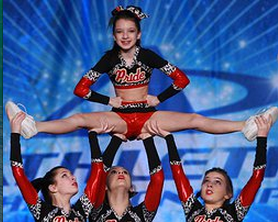 It’s Friday night at the Cheer Pride All-Stars gym in Whippany, NJ. Coach Erin Shane signals The Summit-bound Junior Level 1 team to enter the gym. Clad in fire-colored practice gear with bows neatly placed on their crowns, 15 female athletes quietly line up in four rows, hit a “T” and prepare to perform a timing drill for jumps.
Shane begins to clap to the rhythm of her counting to keep the team’s unified left kicks timed to her beat. The team doesn’t flinch as she pauses to hit a strong, poised “T” to demonstrate proper motion technique. The squad reaches 20 kicks smoothly and quickly, then Shane continues the process again on the opposite side.
No matter what activity her athletes participate in, Shane is highly engaged. She spots tumbling, fills in for missing stunters and works out with the team at the end of practice—all after an eight-hour workday as a special education teacher at a North Jersey high school.
Not all coaches are able to master the juggling act as easily as Shane; after all, all-star cheer coaches are faced with the challenge of managing a winning squad all while balancing multiple jobs, families and personal time. In the face of overwhelm, it can be difficult for coaches to avoid falling into a “lazy funk”—an attitude that affects both the team and the gym as a whole.
“It is important that people learn hard work gets results,” said Jodi Gerhartz, co-owner of East Brunswick, NJ-based All Star Athletic Center.
She adds that irresponsible habits, such as sitting down or answering phone calls during practice, also play a role in lazy coaching behaviors. “I had a coach who was always sitting down, talking on her cellphone and yelling at the athletes,” Gerhartz shares. “I have zero tolerance for that type of coaching. I explained to her that the athletes did not respect her because she was not respecting what they are doing.”
Shane also believes lazy coaches “inevitably hurt the team, and the business will suffer. Athletes will have poor technique and skills, resulting in an inability to grow or be successful at competition. [Eventually,] athletes will leave the program to go where their coaches are an active part of the experience.”
Lazy coaching behaviors can also lead to financial loss, poor reputation and lack of indispensable leadership skills cheerleaders can learn from experienced instructors to become successful athletes, students and professionals in the future.
So how can coaches avoid the lazy funk? Start off right by energetically implementing the following tips in their routine at practices:
Stand up. Coaches must lead by active example. Gerhartz believes that on the “first day of practice [and beyond], coaches need to set the precedent. Stand up to coach, and work as hard as the athletes do.”
Plan ahead. Making a blueprint for practice ahead of time can truly pay off, says Shane, who suggests creating practice plans that change in activity every 30 minutes. Pre-planning helps coaches become more aware of what needs to be accomplished in practice—keeping their focus narrowed.
Cater to individual training needs. Every athlete learns differently, whether it be visual, auditory or kinesthetically. Taking the time to teach skills in different ways can help coaches maximize effectiveness—and avoid lazy tendencies in their effort to meet each athlete’s needs.
Ditch the digital world. Coaches must put the cellphones down during the practice to effectively observe their cheerleaders. Consider practice an opportune time to evaluate their strengths and weaknesses rather than respond to parent emails or gym gossip.
-Christina Hernandez is the founder of Rah Rah Routines, a consulting firm specializing in choreography, tumble lessons and routine consultations for cheerleading organizations. She is a cheerleading and tumbling aficionado who has led senior-level All Star teams to multiple local, regional, and national titles. She has more than 23 years of experience as a Pop Warner, high school and all star cheerleader and is contracted to work as a tumble instructor at several cheer and dance organizations in New Jersey. She is a longstanding choreographer for reputable recreation, high school and all–star competitive teams throughout the Northeast region and is a member of the American Association of Cheerleading Coaches and Administrators (A.A.C.C.A.), USASF and NFHS. She believes perfecting the fundamentals of cheerleading and tumbling are the key to achieving excellence. To find out more about Christina and her business, visit rahrahroutines.com
Straight Talk with Maryland Twisters’ Tara Cain
jen : August 14, 2014 5:31 pm : In the Industry| Web Exclusives| webexclusive2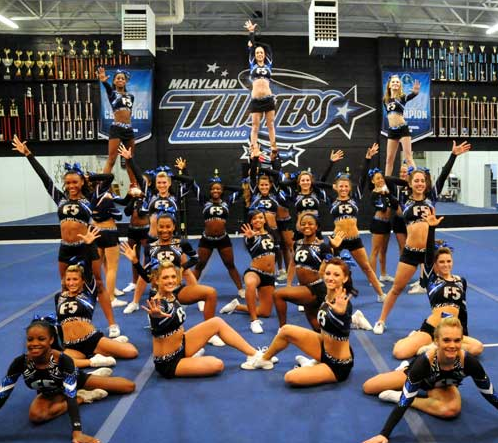 As home to the premier F5, the Maryland Twisters are no strangers to high expectations. Pressure from industry leaders, judges and fans to “keep delivering and over-delivering” can be intense, but gym owner Tara Cain insists that championship titles (of which they have many) are not the end goal for a Twister—it’s having fun.
“At the end of the day, the kids sacrifice two to three days a week at practices, all year long, because they love what they do,” says Cain. So when competition time arrives, she advises her athletes to “stop worrying about the judges” and simply enjoy the moment they’ve worked so hard to achieve.
Several such moments arrived this year at The Cheerleading Worlds, where the Twisters competed on five paid bids and saw their senior medium teams—the flagship F5 and Reign—nab Bronze medals.
It’s another stellar win in Twister history, one punctuated with the kind of success that grows a gym from 50 athletes in 1998 to more than 500 today. Yet Cain says their winning reputation isn’t what drives athletes to become a Twister. Instead, she credits a great staff, “families that believe in [the] system” and a commitment to having “hard conversations” about athlete progression and team placement “before they become an issue.”
Equally important to the big picture has been building brand recognition. In 2007, a parent opened Cain’s eyes to the tremendous value of brand investment. A logo and social media presence were developed and the phrase “repetition leads to retention” embraced, the cumulative effect launching Maryland Twisters into an international spotlight.
Of course, the Twisters are not without challenges. The biggest, Cain asserts, is one that the industry faces as a whole: talent retention. Minimal work hours (roughly six to nine per coach per week) plus limited pay scale (intended to keep athlete costs down) lead many top coaches to work multiple jobs or leave the industry entirely to pursue full-time careers or, as they grow older, start a family. “It’s hard to find that person who is dedicated, loyal and loves cheer, but is willing to put in the nine hours [weekly] for little pay,” says Cain.
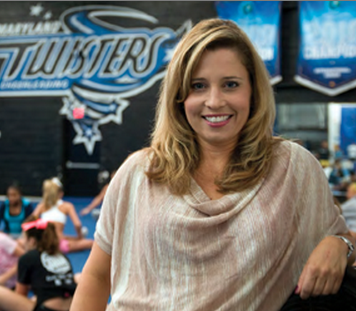 This is the type of straight talk Cain is known for, a quality that’s led her to question cheer status quo time and again. Questions like the one she posed to GK Elite in 2008: Why are cheerleaders still wearing polyester? The material, Cain said, proved so constricting that “the fabric was actually like rubber bands around certain parts of [the athletes’] biceps.” The conversation intrigued GK Elite, and the collaboration resulted in an innovative uniform made of “super-stretch fabric” that granted athletes a fuller range of motion while redefining industry standards in the process.
Last year, Cain was at the forefront of another industry leap—helming the NACCC judging committee and leading the charge towards a unified scoring system. The system, scheduled to see its first full implementation at The Cheerleading Worlds 2015, is, according to Cain, “a great change for the industry.”
So what’s next for the Maryland Twisters? Cain’s keeping her options open but admits more growth is on the horizon. “I would love to launch other sports programs. Maybe I’ll just get a bigger building and be more of a sports complex, but cheerleading will always be my first love,” Cain muses.
–Carmen Rodriguez
Two Sides: Too Many Nationals?
jen : July 14, 2014 2:50 am : In the Industry| Two Sides| Web ExclusivesShould event producers be permitted to hire judges who are currently (or were once) affiliated with a gym competing at that event? CheerProfessional looks at both sides of the issue.
It’s a question of objectivity—can judges “turn it off” when they take the stand? Some gym owners and coaches say “no,” taking issue with event producers who allow judges that have some form of past or current affiliation with programs on the competition roster. Others say that because of the prevalence of cheer gyms, it’s almost impossible to find a whole panel of judges that don’t have some sort of knowledge or background with at least one of the gyms involved; they also argue that judges should be trusted to be professional and impartial. So who’s right? We spoke with Ron Swanson of Kansas Gymnastics & Cheer and Becky Woodson of Daytona Xtreme to explore the issue.
Editor’s Note: Please note that the views expressed in this article are expressly those of our sources and not those of CheerProfessional.
 Swanson’s take: I’ve seen some bias on the judges’ stand every year, but this season, I was able to find some pretty significant facts. At a regional competition, two of the judges were high school coaches in the area, and I’ve discovered that they have a strong affiliation with one of the local gyms. That gym won just about everything with their 12 teams—they’re a quality gym with a few really good teams, but they’ve never dominated a competition. At another competition, I found out two of the tabulators worked at a local gym that was competing there; also, one of the people working the competition was wearing a jacket from that gym, so it was obvious the gym had strong ties to that event. I’ve noticed this type of issue across the board with a few different brands.
Swanson on objectivity: Many judges may think they can be unbiased, but when you work in a gym, you become strongly passionate about that gym’s style and stunting techniques. Regardless of how professional anyone tries to be, they’ll always have a personal bias to that gym. I judged for about five years in Texas, and I understand the relationship on the judges’ stand. You spend the entire weekend with that group, and you’ll have casual conversations that could possibly sway opinion.
Swanson on where the line should be drawn: It’s not acceptable for anyone who is currently (or was once) affiliated with a competing gym to judge that event. I know a lot of judges who are very professional and pulled themselves out of events for that reason; they make it a point not to judge in the areas where those teams compete.
Swanson on possible solutions: I believe strongly that there needs to be a federation or association for judges—and that they all need to belong to it. There should be a system in place to rank judges, and their names should be attached to that. As judges become more qualified, they should be known not only to the event producers, but also to the gyms who are getting judged by them. Right now, judges are completely hidden from the process; no one knows who they are or what their level of experience is. If they make a bad call, their name and credentials should be on the line, just like an NFL ref.
Also, I see companies giving out too many trophies and banners—I don’t need a third place banner or sixth place trophy. That’s a few thousand they could be using to pay judges better or fly in impartial judges. I’d rather see that money invested in judging than unnecessary paraphernalia.
 Woodson’s take: On most judging panels I’ve been on, there has been someone who has some sort of background or affiliation with one of the programs involved—whether through choreography, coaching or another capacity. I’ve actually been in that position myself multiple times at smaller competitions. For instance, I was the head coach of Bristol University for two years, and one year after I’d resigned from the position, I found myself judging their team (with athletes I’d coached) at the ICC University Nationals. I believe it is definitely possible to be objective when judging; the key is to look at things from an unbiased point of view and assume the mindset of someone who doesn’t know what that team is capable of doing.
Woodson on objectivity: I focus on how the routine plays to the scoresheet for that specific event producer. As a coach, I expect objectivity from the judges, so I conduct myself the same way when judging. I think most experienced people are able to do that. You have to stay strong and have strong morals to make it work.
Woodson on where the line should be drawn: Choreography or past affiliation may be one thing, but having someone judge who currently coaches in a competing gym is pushing the boundaries a little much. There are enough qualified judges out there where event producers shouldn’t have to pull from the same pool [of registrants]. Event producers should definitely make an effort not to hire judges who are involved with a program at that competition. If event producers want to grow their business, it makes a lot of sense to show that there is a sense of fairness and impartiality. Not everyone will always like the results, but if you provide the most professional experience for a client, they’ll keep returning to your event.
Woodson on possible solutions: Having a substitute judge for the division [where the team is competing] could be one idea—but if you’re going to hire a substitute judge anyway, you might as well just have that person judge the whole event [to ensure impartiality].
Looking at the big picture, judges need to be more qualified and a universal scoresheet should be implemented by USASF. At most of the competitions I’ve judged around the world as well as here in the U.S., the scoresheets have been completely different. This has caused some of the issues—coaches may blame their undesirable results on the fact that a judge used to work with a certain program, when that may not have been the case.


