

In addition to all the great content we bring cheer professionals in our quarterly print issue, you’ll find plenty of original exclusive content right here at TheCheerProfessional.com.
Keep checking back for all the latest and greatest news, updates, debates and more!
Making Headway: Handling the Rise in Concussions
jen : April 22, 2013 12:05 am : In the Industry| Web Exclusives| webexclusive2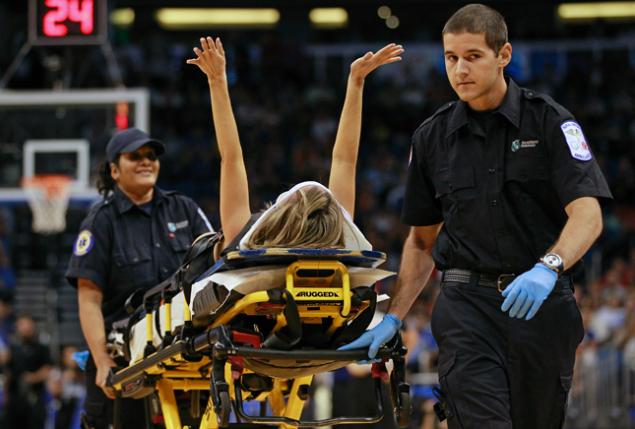
Jamie Woode raises her hands to show the crowd she’s okay.
When Orlando Magic cheerleader Jamie Woode fell on her head last November in front of a packed crowd at Amway Center, the accident caused shockwaves throughout not only the audience, but the cheer world at large. In light of Woode’s injuries (which included three fractured vertebrae and a broken rib), the University of Florida decided to ground-bound its own collegiate cheer squad—a decision that has since only been partially reversed to allow very basic stunting.
They’re not the only ones making headlines. In February, ABC News reported that the University of Georgia’s cheer squad had incurred a higher percentage of head injuries than its football team—with eight of 52 cheerleaders getting concussions, as opposed to nine of 152 football players.
The incidents coincided with a highly publicized American Academy of Pediatrics (AAP) report that urged classifying cheerleading as a sport. Its argument was that doing so would help provide better resources comparable to other sports, such as more qualified coaches, better facilities, access to athletic trainers and improved injury prevention methods.
AAP’s report also provided some eye-opening statistics culled from multiple studies. Among the findings: cheerleading has accounted for about 66 percent of all catastrophic injuries in female high school athletes over the last 25 years, and cheer injuries have steadily increased in both severity and number. College squads had the highest injury rate, followed by elementary school, high school, all-star, middle school and rec cheerleaders, respectively. Across the board, the most likely causes of injury were basing and spotting (23 percent), tumbling (14 to 26 percent) and falls from heights (14 to 25 percent).
Concussions accounted for between four and six percent of all cheer injuries—a number that, though lower than other sports, had increased by 26 percent every year from 1998 to 2008. The vast majority (96 percent) of those concussions happened during stunting, and pyramids were responsible for the majority of head and neck injuries.
Though the AAP study focused primarily on school-based cheerleading, experts say the issues are the same: safety must come first. “In order for cheerleading to continue in a form we all know it to be, I think safety has to be taken very seriously,” says The Spirit Consultants’ Dave Kirschner, citing the rising number of concussions and emergency room visits as chief concerns. “Coaches have to have a very close look at what they’re doing to keep their kids safe.”
Taking Action
Cheerleading isn’t the only activity experiencing a rash of concussions. “All of the sports we deal with [as athletic trainers] have seen an increase in head injury rates—it’s been our most pressing issue,” says Karen Lew, a University of Miami athletic trainer who often works at Varsity-branded events. “Our goal is to try and reverse these trends.”
Lew and her colleagues set out to do just that by creating a protocol that could help coaches and gym owners determine when an athlete was ready to resume competing. “There was no previous [formal] reintegration process for cheerleaders,” shares Lew. “Rather than recreating research that has already been done, we wanted to develop a guideline for medical management of concussion as it applies to cheerleading.”
The result? Step-by-step guidelines to help coaches implement various levels of rehabilitation—based on five stages of incremental activity. (The minimum criteria they set for returning an athlete to the mat was being symptom-free for at least 24 hours and having physician clearance.) “Coaches need to understand the inherent risk they face by not following the appropriate progression,” says Lew.
Jessica Funke, an athletic trainer with Adventist Health System, agrees. She says that when athletes are injured, there is often a natural inclination to return them to competition right away—but that may be a dangerous proposition. When consulting for gyms like Wauconda, IL-based Ultimate Athletics, Funke uses a baseline assessment test called ImPACT. The purpose of the computer-based test is to assess athletes after they suffer concussions, and Funke says it is used by doctors and psychologists around the country. “It’s a really great objective test for concussions, one of the best that I’ve seen on the market,” Funke says.
Funke uses the test as a preventive measure, typically testing athletes before they even face an injury. The screening takes about 20 minutes, during which it tests both verbal and visual memory; athletes are also tested on their reaction time after an injury, compared to their normal reaction time. “The baseline test is performed when they have no symptoms and no concussion, so that when they do have a concussion, we know what their ‘normal’ is,” Funke says. “It basically lets us know what their brain function is like before they become injured.”
If an athlete suffers a concussion, Funke tests him or her again using ImPACT. She also uses her own set of tests such as checking the reflexes, vision, cranial nerve and cognitive functioning. She then makes injured athletes perform jumping jacks, sit-ups and push-ups to test their physical exertion, all in an effort to keep them safe.
“When the parents or athletes get upset because I’m not letting them practice, I remind them that ‘Cheerleading is wonderful, and I want you to be able to do it for a very long time, but if you don’t listen to me now, this might be it,’” Funke says.
Along with advanced assessment and testing, new equipment is being introduced to help prevent concussions. Case in point: Cheercussion, a rubber foam safety headpiece currently in development that aims to prevent concussions and is designed for use mainly during practices. However, Lew says she believes that the main emphasis should be on proactive prevention. “I would rather train the industry’s focus on having higher quality coaching and development of action plans,” says Lew. “Injury prevention is the key to any sport, so we have to be smart about it.”
–Karen Jordan
 Tech tool: CheerLIVE! (www.cheerlive.net)
What it is: Obsessed with watching routines on YouTube? Take your viewing habit up a notch with CheerLIVE!. The website provides both live streaming and video on-demand of various gym showcases (such as Cheer Athletics, Spirit of Texas and Cheer Extreme) and competitions like The MAJORS. For free, guests can listen to the CheerLIVE! radio library and watch top videos, and for a subscription fee of $9.99/month, members get full access to all benefits including video in-demand and competition webcasts.
Why it matters: During competition season, it’s important to stay current on who’s getting bids, who’s wowing the crowd and who’s setting the trends. CheerLIVE! provides a central place to watch national competitions around the country and put your finger on the collective all-star pulse. If you’re interested in broadcasting your own gym’s showcase, it can be a viable option on that front as well.
Quick tip: Want to get the most bang for your buck? Sign up for a full-season pass for $49.99 (a savings of $70).
Similar services: Varsity TV (www.varsity.com/VarsityTV); IASF Video On Demand (http://iasfworlds.org/worlds/video/)
GTM Sportswear Spotlight on: Happy Hooper
jen : April 17, 2013 6:00 am : In the Industry| Web Exclusives| webexclusive1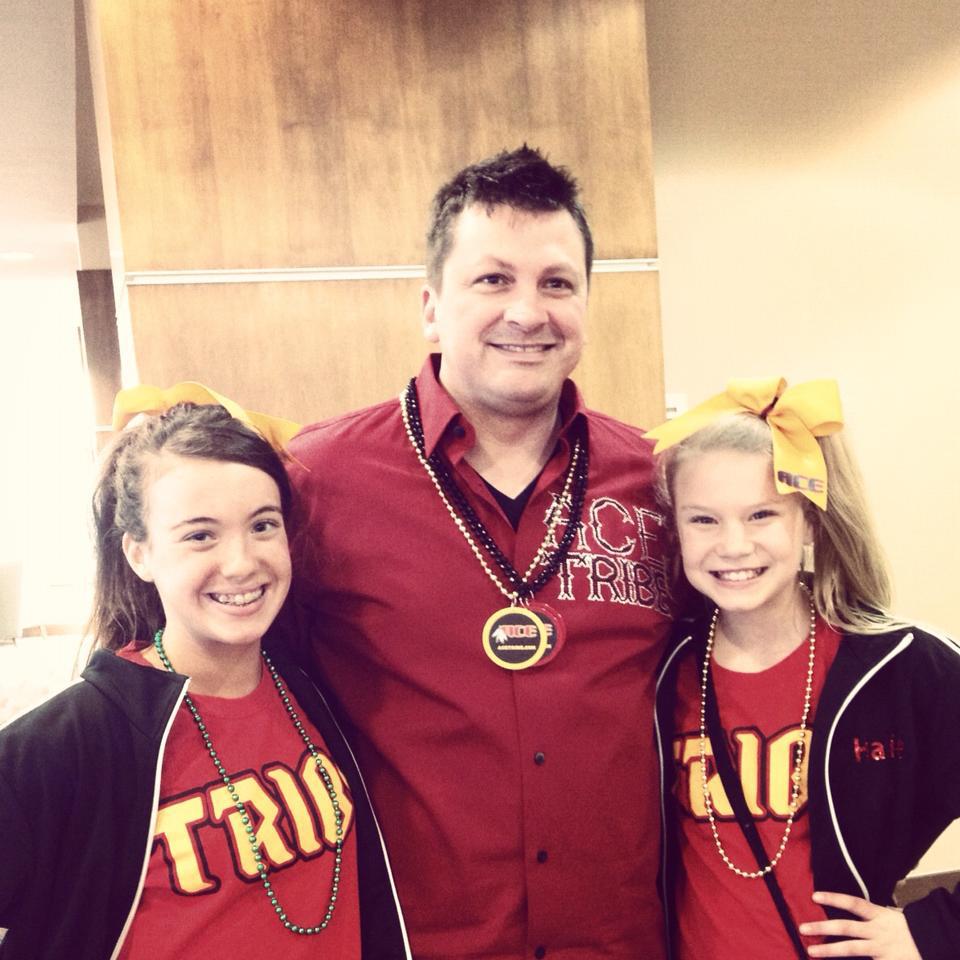 Watching cheerleading genius at work in Birmingham is as simple as buying a movie ticket. If the showing you choose happens to fall just right, you’ll see Claude Cornelius “Happy” Hooper III—Happy Hooper for short—in a dark theater, hunkered down at a commercial film like The Hobbit, watching the screen but not entirely focused on what’s playing. Instead, he’s mentally projecting images of perfect formations and flawless pyramids rising, spinning and flowing onto the screen. It all plays into the bigger picture back at the gym with his award-winning squads at ACE Cheer Company.
“A lot of times in the movies, I will zone out and use the screen as a way to kind of see what I want—different transitions, formations, pyramid pictures and transitions [that are] supposed to happen,” he says.
In fact, if it weren’t for entertainment media—TV, movies, music—Hooper says the cheerleading-themed ticker tape that’s constantly running in his brain would never stop spooling. “I have to sleep with the TV on, and if I’m ever [alone] in a room, I have to have music playing. Otherwise, I’m always just thinking about cheerleading,” he says.
Though it’s hard for Hooper to narrow down his favorite films, he’d probably go with The Goonies or Steel Magnolias (a pick he attributes to “the Southern woman in me!”). It’s hard not to notice that both have ensemble casts: ragtag individuals banding together to overcome assorted problems. In the truest sense of the word, they’re teams—or, in ACE-speak, “tribes.”
 So in-demand that he guest-starred on last year’s CMT reality show “Cheer” as the special guest consultant tasked with making over the Central Jersey All-Stars’ Worlds routine, Hooper is something of a legend in the cheerleading world. It’s not terribly hard to see why: watch that episode and you’ll see Happy—at first unassuming in a T-shirt, jeans and sneakers—go into full-on savant mode, giving the squad rapid-fire direction for a new pyramid, making tiny gestures and miming transitions in triple-time. It’s like watching John Nash scribble equations on the library windows in A Beautiful Mind. The girls look at him wide-eyed. You can’t blame them: it’s hard to keep up with a visionary like Hooper.
Hooper’s company, ACE All-Stars, has 58 squads in five states and employs more than 100 people. It’s a mini-empire in cheer world, one that requires constant attention. When the company was smaller, Hooper prided himself on personally coaching every team. Now that the company is more spread out, it’s impossible for him to shepherd all of them in person—though he wishes otherwise. (It’s clear that Hooper’s inability to be 58 places at once pains this perfectionist who admits point blank, “I like to win.”) So Hooper goes for the next best thing: viewing their routines via YouTube videos that his coaches are required to upload daily. They get his notes within 24 hours.
Credit Hooper’s steadfast work ethic to his upbringing—Hooper’s parents both coached high school sports, and his mom even has a gym named after her. “I was in the baby rocker, and I would either be at cheer practice, softball practice, football practice or basketball practice. I grew up not knowing any other way to live other than working hard,” he says. “Playtime was sports, so to me, life and play go hand-in-hand with what I’m blessed and fortunate enough to call my profession.”
 Hooper first realized cheerleading was his calling when he saw Alabama compete on-screen at UCA College Nationals, thanks to a rare glimpse of cable during a visit to his aunt and uncle back in the ’80s. “To this day, I remember their entire routine was to ‘Rockit’ by Herbie Hancock, and that was just the most amazing thing I’d ever seen in my life,” he says of the “a-ha” moment. “I knew I always loved cheerleading, but the competitive side, I’d not really seen.” There was no going back: Hooper was officially enamored with that slice of the sport.
He went on to cheer on scholarship at Sneed State Community College in Boaz, Alabama, for two years, then Columbus State in Georgia before coaching at University of Alabama and opening his first ACE gym in Alabama. He’s gone on to have incredibly high career highs, such as winning Coach of the Year and Worlds in 2011, and low professional lows, namely closing his Columbus, Georgia, gym four years ago. (Families from the area now drive three-plus hours to Birmingham or Atlanta in order to cheer at one of Hooper’s gyms.)
“Knowing when a gym isn’t making you money, when to call it a day, that’s very tough. As humans, we let our pride and ego get in the way,” he says. “You have to be a strong business person to know when to say when. You feel like you let everyone in the community down; you feel like you let down all the athletes. I took it very hard. But, financially, the company was much stronger after that.”
As for the state of cheer today, he has two major beefs: the idea of “cheerlebrities” (“After we got off the floor last year in Dallas, there were people pulling two of my athletes to take pictures with them… That’s not okay. This is a team sport; it is not about individuals”) and professionals’ desire to splinter off into disparate groups, which he says damages the industry as a whole rather than bettering the structure that already exists.
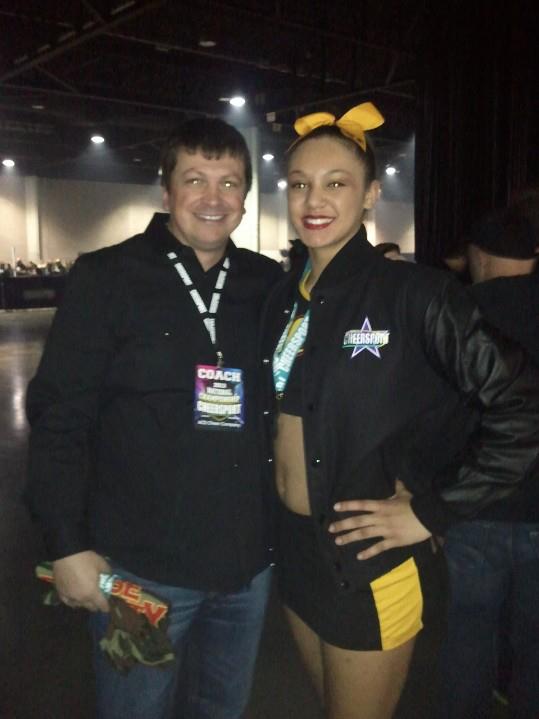 When it comes to giving advice to cheer professionals looking to replicate his success, he has dual keys to surviving and thriving: classes and communication. “Classes are going to make you money and afford you the luxury to hire who you need,” says Hooper. “[As far as] communication…even if you can’t answer an email right then, I stress to my staff and everyone in the industry to at least reply: ‘I have received your email, I don’t know the answer to this as of yet, but I will get back to you.’ And I try to put a little caveat in there, that if you haven’t heard back from me within a day, send me another email, call me.”
Though Hooper is the heart of the operation, he’s quick to share the success with those around him. “I get a lot of the—I don’t want to say ‘glory,’ but I don’t know a better word for it—but I would never be able to do what I do without everyone within the company,” says Hooper. “We have business directors, gym directors, and they all work their butt off for me and for the company. Our turnover is virtually none, which I find very warming to my heart that we must be doing something right. We retain staff, and we just get to add to our family.”
In the movie of Happy Hooper’s life, that sounds like a true happily-ever-after ending.
–Jamie Beckman
Open Letter from GrowCheer.org to USASF & the All-Star Cheer Community
jen : April 16, 2013 12:47 pm : In the Industry| Web Exclusives| webexclusive2
The purpose of this letter is to discuss the USASF’s letter dated April 10, 2013. Growcheer.org applauds the USASF for responding to our proposal and initiating a self-improvement process. We would also like to thank everyone who offered invaluable insight and suggestions into our proposal, provided ongoing support and raised issues on their own to the USASF that we hadn’t even considered.
YOU were the impetus for the USASF to begin addressing many of the important (and long overdue) issues that have been plaguing the all-star cheer for years. Now that you’ve “got the ball rolling,” we are hopeful that the USASF will run with it. To be sure, in these busy times, it is imperative that we collectively work with the USASF to ensure that these issues remain at the top of their agenda, so that meaningful, timely progress can occur in our sport.
With that, we respectfully submit the following comments to the Board of Directors of the USASF:
USASF: A 501c status is used primarily for organizations that receive donations, which the USASF does not.
Growcheer.org: While this is a factual statement, Internal Revenue Code Section 501(c)(3) provides for organizations that are “organized and operated to foster national or international amateur sports competition.” With rare exceptions, all other national governing bodies for US sports are organized as 501(c)(3) organizations and operate with full transparency to its members. Furthermore, the ability to accept donations is a positive aspect that could serve to generate additional revenue for the USASF, strengthening its financial position and reducing the cost of participating in Worlds for its members.
USASF: The corporate structure is controlled by the USASF Board of Directors and could be changed if the board decided it was in the best interest of the members.
Growcheer.org: We suggest that the Board conduct a third-party administered survey that objectively outlines the advantages and disadvantages of the existing structure and a 501(c)(3), and let the members decide what is in their best interest.
USASF: …it is obvious those bylaws could be improved upon. But remember, when written there was no reason for a formal set of complete statutes. The bylaws made all of the original board seats permanent in order to assure the organization stayed true to its mission. They also required a unanimous vote to change the bylaws. This stipulation is probably not ideal today.
Growcheer.org: We agree 100% with the USASF’s statements that their bylaws could be improved upon. Despite the USASF’s original intentions in establishing permanent Board seats, we believe the mission of the organization should be guided by its members, not a couple of for-profit companies. Successful organizations need to be able to adapt to change, and certainly all-star cheer has undergone significant change since the USASF’s inception nine years ago. Although not specifically addressed in their letter, we urge the Board to put aside their self-interests for the good of the sport and to eliminate permanent Board seats and the unanimous vote provision. We believe that making these changes are, by far, THE most important steps the USASF can take to ensure that the sport of all-star cheer continues to grow and meet the ever-evolving needs of its members.
USASF: This [the Varsity loan] has been an incredible benefit to our organization and members, and it would have been impossible for the USASF to survive without it.
Growcheer.org: While we acknowledge Varsity’s support has aided the USASF, the admission that without it the organization would have ceased to exist altogether is alarming, especially given the sport’s growing popularity over the past decade. This brings into question the validity of the USASF’s business model and/or the financial competence of the Board. Growcheer.org, comprised of management teams of diverse, complex business enterprises, would be willing to work with the USASF gratis in this area in an effort to improve the operating performance of the organization. The USASF’s pledge to publicly disclose their complete, audited financial statements in a few weeks will be an excellent starting point.
USASF: We look forward to working with our entire community to insure we continue to build an even stronger and more effective USASF.
Growcheer.org: Again, we congratulate the USASF for taking this historical step. Growcheer.org’s sole purpose is to do its part to effect positive change in all-star cheer. In this spirit, we offer our services to the USASF and pledge to keep members focused on these important issues by keeping the conversation at the forefront.
Sincerely,
Growcheer.org
Cheer Zone
GK Elite Sportswear, L.P.
GTM Sportswear, Inc.
Motionwear, LLC
Nfinity Athletic, LLC
Rebel Athletic
Team Cheer
Open Letter from USASF To Its Members
jen : April 15, 2013 6:18 pm : In the Industry| Web Exclusives| webexclusive1 The purpose of this letter is to inform our members about some questions which have been raised recently relating to our structure and operating procedures. We will address those questions below, but more importantly, we would also like to share with you our view for the future.
When the USASF was founded in 2004 the All Star community was much different than it is today. There were no rules, no safety guidelines and no competition standards. There was also no true recognized national championship. If we had had a crystal ball at that time and had been able to see how All Star would develop in the following 10 years, there is no question many things would have been set up differently. However, since we did not have the luxury of what is now hindsight, it is important to understand the history of the organization in order to better appreciate why USASF made some of the decisions that are now being questioned.
We accept some of the questions that have been raised as a legitimate attempt to strengthen the organization, and we welcome that dialogue. Like all organizations, ours is not perfect, but we remain committed to doing what is right for the athletes, coaches and organizations that make up All Star Cheer and Dance.
History of USASF
USASF was founded in 2004 by Varsity and CHEERSPORT. At that time, both companies believed that there needed to be an organization that could bring stability to the sport and serve the athletes and coaches by standardizing rules, promoting safety and providing sanctioning standards.
In evaluating how to legally establish this new organization, Varsity and CHEERSPORT determined that a non-profit entity was the preferred structure. Therefore, USASF was chartered as a non-profit corporation in Tennessee as this was viewed to be a cost effective ($100 fee) and a quick and efficient way to start the organization. There was never any serious discussion about setting it up as a 501c corporation because this would have added unnecessary complexity and delay. A 501c status is used primarily for organizations that receive charitable donations, which the USASF does not. The corporate charter for USASF is posted on our website. To be clear, USASF is a separate legal entity from, files taxes independently of, and is not a corporation owned by Varsity. The corporate structure is controlled by the USASF Board of Directors and could be changed if the board decided it was in the best interest of the members.
As the USASF was being formed, it wrote its bylaws and appointed its first Board of Directors. Viewed today, it is obvious those bylaws could be improved upon. But remember, when written there was no reason for a formal set of complete statutes. The bylaws made all of the original board seats permanent in order to assure the organization stayed true to its mission. They also required a unanimous vote to change the bylaws. This stipulation is probably not ideal today, but frankly it was originally proposed by CHEERSPORT as protection to insure that it could not be voted out at some point in the future. JAMfest was also granted a permanent seat when they joined based on similar concerns. The bylaws have been amended several times over the years to broaden membership and representation to include coaches, gym owners and other event producers. The bylaws and amendments can be seen on our website.
After USASF was formed, Varsity provided an interest free line of credit to the USASF. At its peak, the loan balance was $1.8M. As of December 31, 2012, the balance on the loan was $565K.Varsity has allowed the USASF to have complete flexibility with our repayment schedule. The loan has been completely interest free to the USASF. This has been an incredible benefit to our organization and members, and it would have been impossible for the USASF to survive without it. Varsity has also continued to guarantee a substantial “rainy day” fund to insure USASF could withstand any type of unforeseen natural or financial disaster such as having to cancel Worlds one year. There has been no “co-mingling of funds” or any other impropriety. Just as any lending institution would do, Varsity secures the loan by retaining certain rights to the USASF trademark and intellectual property.
Moving Forward
As previously stated, the USASF and its board recognize that change is needed within the organization. The board met via conference call on Wednesday, April 3, 2013 and agreed to initiate a process to systematically manage this change. We want to move promptly but do not want to make the mistake, which has occurred in the past, of making significant changes without taking the time to solicit input from all members and stakeholders.
The issues we have identified to address are as follows:
- Board Make Up: This will include, but will not be limited to, structure of the board, balance of representation and accountability within the USASF.
- Bylaw Revisions: Revise the bylaws to accurately reflect the current environment and govern USASF properly.
- Worlds: A comprehensive analysis of everything relating to Worlds including the pros and cons of utilizing Walt Disney World as a venue.
- Location of USASF Office.
As this process unfolds, there may be other areas we examine based on feedback from our membership. We will utilize our existing committees, the NACCC and our USASF Regional Meetings to insure our entire membership is heard and considered as we address these issues.
One area the board felt needed to be improved now was that of financial reporting. Though we have nothing to hide, we believe a more detailed financial report would eliminate some of the inaccurate statements from our critics. As always, an independent certified public accounting firm will review the books and records. In addition, moving forward into 2013, a report by that public accounting firm will be included in a calendar year annual report that will be provided to our members and available to the public. This new annual report will also address a general update of the status of the USASF, as well as its future plans. In about three weeks we will post the 2012 financial report for the USASF on the website, along with more detailed information than has been presented in the past.
The board also agreed to move forward aggressively on several programs that we feel are critical to serving our athletes and coaches. We will consider and investigate options for an enhanced athlete membership program with an outstanding and affordable individual insurance option component and provide information in the upcoming weeks. Our professional membership program will also be improved, including reviewing the option for background checks for everyone working with our athletes. Also, we have already asked Les Stella to develop a more dynamic and comprehensive FAQ section on our website to provide a better way to field and answer the most common questions. These are types of initiatives that only USASF is in a position to accomplish and we are committed to getting them done expeditiously.
In closing, we would like to thank all of the hundreds, if not thousands of people who have volunteered their time and efforts to create and build the USASF. The organization would not have accomplished what we have without their dedication to make our sport better. We look forward to working with our entire community to insure we continue to build an even stronger and more effective USASF.
Sincerely,
USASF Board of Directors
Morton Bergue
Mike Burgess, Vice President
Justin Carrier
Jim Chadwick, President
Brian Elza
Jeff Fowlkes
Tara Patton Harris
Happy Hooper, Secretary/Treasurer
Mack Hirshberg
Dan Kessler
Colleen Little
Catherine Morris
John Newby
Elaine Pascale
Kathy Penree
Steve Peterson
Kristen Rosario
Read the GrowCheer.org response to USASF’s open letter here.


