

In addition to all the great content we bring cheer professionals in our quarterly print issue, you’ll find plenty of original exclusive content right here at TheCheerProfessional.com.
Keep checking back for all the latest and greatest news, updates, debates and more!
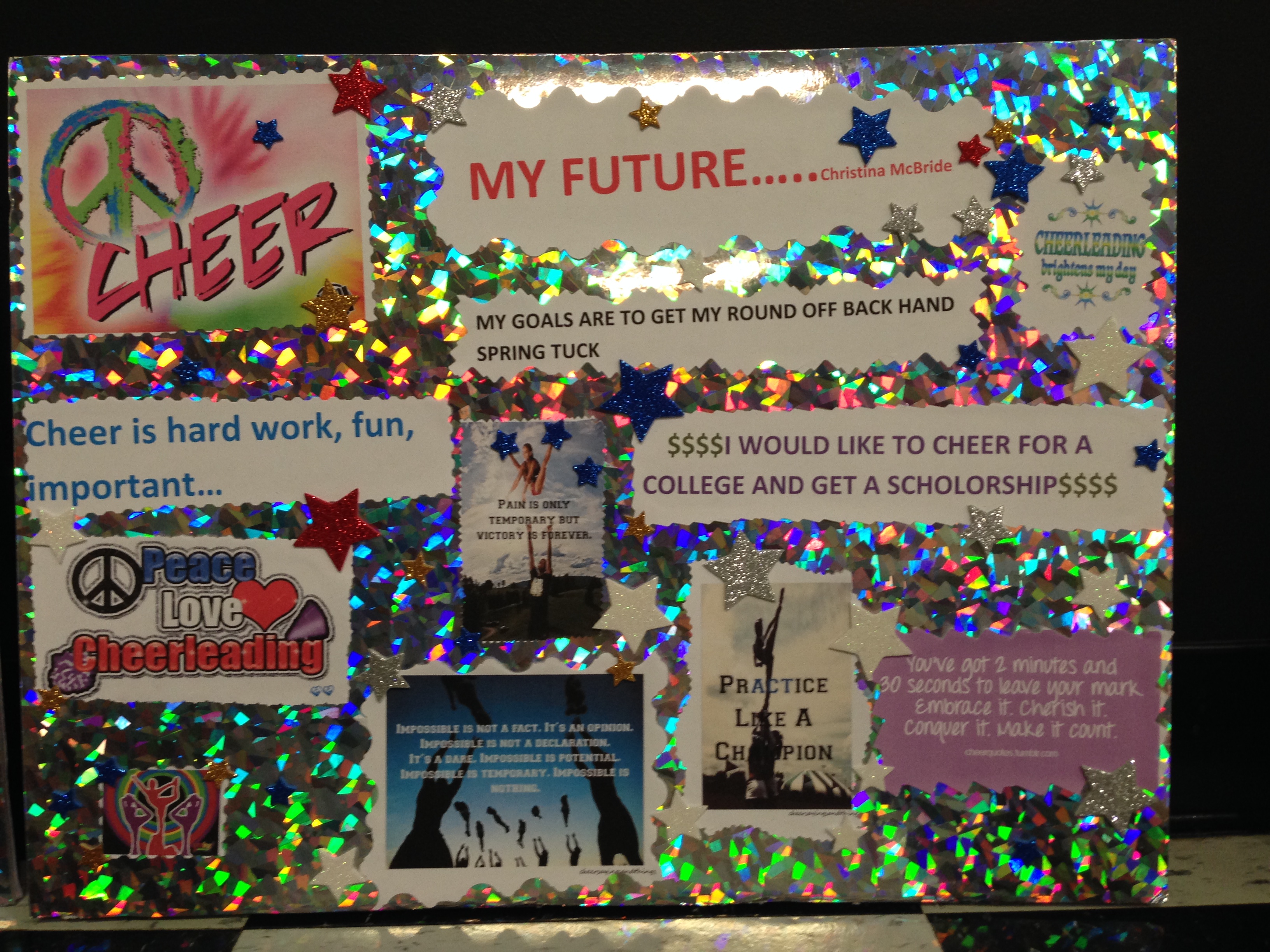
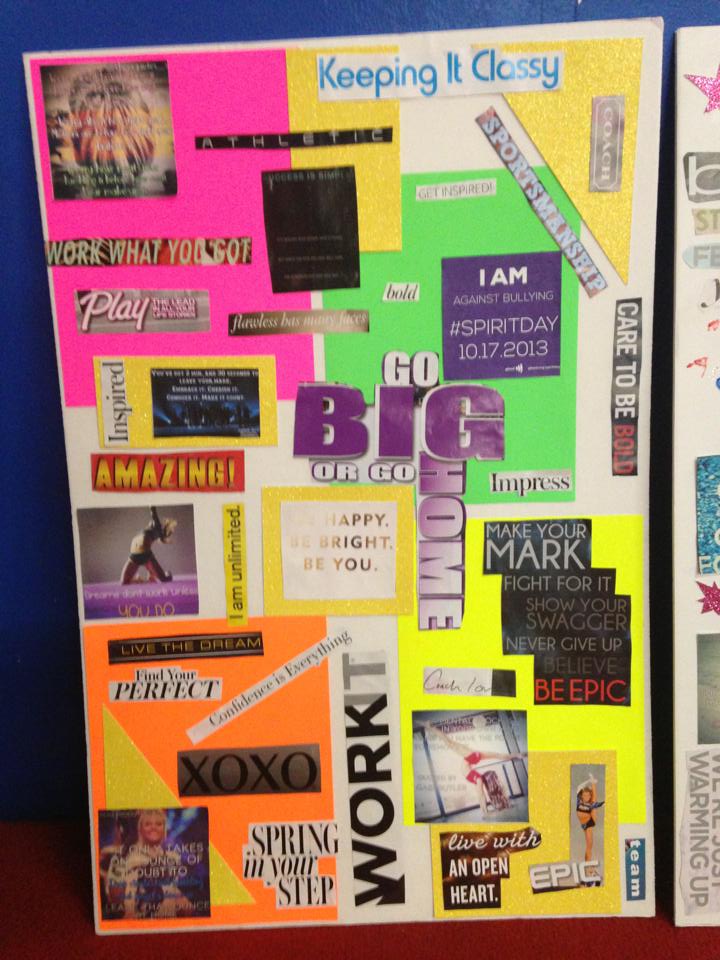 Walking into Cheer Fusion in Fredericksburg, Virginia, it’s hard to miss the colorful posters lined up above the mirrors. Filled with platitudes like “Practice Like a Champion” and goals like “I would like to cheer for college and get a scholarship,” these homemade vision boards provide a creative source of motivation for the gym’s teams—as well as a much-needed means of focus and direction.
Ever since Mandi Spina, program director at Cheer Fusion, first implemented the practice of making vision boards two years ago, she says they’ve had a big impact on her gym. “We ask the teams what they see in their future and [how they envision] the epitome of cheer,” says Spina. “We give them a month to work on the vision boards and then showcase them [in the gym]. The kids explain why they used the photos they did and talk about what’s special to them.”
Spina notes that the finished boards feature a variety of photos, many depicting complex moves or memories with fellow teammates. Many of the athletes get creative, making door hangers or even video recordings. Age often determines the content; for instance, the 5- to 8-year olds focus on big bows and trophies, but the older girls emphasize goals.
The practice effectively enhances performance, especially for youth cheerleaders. “A lot of the younger athletes amaze me with their visions. They post pictures of stunts they want to do,” she asserts. “They want to become those pictures on the boards. It pushes them toward their goals and provides a constant reminder.”
A Powerful Roadmap
 Joyce Schwarz, founder of The Vision Board Institute and author of The Vision Board Book, defines vision boards as visual maps comprised of pictures, power words and affirmations depicting changes you’d like to make in your life. “They represent the best of what’s to come. It’s really about living and appreciating what we bring to others,” says Schwarz.
Schwarz utilizes an acronym, GRABS (Gratitude, Receive, Acknowledge, Share), when teaching others about vision boards. “[Creating vision boards] should be coming from your heart, not your head. Work with the senses, do word association with colors,” she advises. For instance, an athlete who wants to go to Worlds might picture the experience of traveling to Disney World—and all the sights, sounds and emotions that would entail—while creating his or her vision board. Adds Schwarz,
“Envision what you want to accomplish and act as if it’s already happening.”
At Diamond Springs, CA-based All Star Elite Cheer, vision boards are an integral part of the gym’s annual Team Bonding Night. Each member of the team contributes to the creation of a group board, using supplies from its Vision Box. “The process itself was great because it led to some great conversations about the things that were important to them as a team,” says gym owner Karen Wilson. “We now have the boards in the gym, and at every practice, we go over to them and remind ourselves of the things we put on there. It has been a great tool.”
What’s Your Vision?
 Manifestation isn’t just for athletes—many business owners swear by the practice as well, even in corporate America. Three years ago, Kim Lawton, COO/Partner at the Inspira Marketing Group, heard about the concept at a leadership seminar and introduced the idea to her staff. “Every year, we incorporate the vision boards to kickstart discussions about our mission, core values, what clients we want and our revenue goals,” says Lawton. “It is a cultural thing and turns into a bonding moment.”
Lawton finds employees will depict personal dreams and goals, as well as professional aspirations. “People are creative. They start with a blank canvas and are totally open to making the vision board more impactful. It has meaning and purpose,” she says.
Vision Board Book author Schwarz points out that many people continually update their vision boards as a living work-in-progress, keeping the focus positive and productive. “This is more than creating a collage. It’s a GPS system that guides you to immediately take steps toward your vision every day,” she says.
Want a step-by-step guide to creating your vision board? Check back on our blog this Thursday for some trusty tips!
Go, Go Gadget! Review: KONTAQ
jen : February 19, 2014 6:14 pm : In the Industry| Web Exclusives| webexclusive2 For our new “Go, Go Gadget!” review feature, we asked the team at North Florida Elite to road test the new KONTAQ sportsbra.
What It Is: Touted as a “revolutionary sports bra,” Kontaq is designed to prevent breast pain and injuries caused by sports contact. The bra utilizes special removable inserts made from StuntShield (a special contact-absorbing material that is flexible, breathable and antimicrobial). Estimated to reduce 90% of the energy of impact, Kontaq supports athletes’ chests and holds them in position to reduce impact, bounce and movement during routines.
Our Testers: Two athletes on the Senior Sapphire team at North Florida Elite
What they loved: Abby Darty, a senior back spot/baser/tumbler, confirmed that KONTAQ greatly reduced impact and made her less “scared to catch [her] flyer when they were falling on [her] chest.” Brooke Hygema, one of the main bases on the team, was a big fan of the padding, as well as the ample support. “I could catch however I wanted to and not worry about the rough impact,” shares Hygema.
What they thought could be improved: Both of our testers felt that the bra trapped heat and could be a lot more sweat-resistant; one suggested adding air holes or making the bra lighter. Overheard: “I wish it didn’t get so sweaty” and “Maybe y’all could make [the bra] where it doesn’t hold so much sweat.”
The verdict: Two thumbs up. Coach Stefanie Nelson says, “Both athletes told their teammates that they have to get one and that they’re legit!”
How to get it: www.kontaq.com
Spotlight: Randy Dickey
jen : February 17, 2014 1:13 am : In the Industry| Web Exclusives| webexclusive1 Professionalism, the importance of checks and balances and family are three of the moral tenets that ACX Cheer owner Randy Dickey lives by. Actually, if it were up to him to reorder those terms, family would come first, specifically Dickey’s wife Amie (whom he met in college at an Atlanta honky-tonk) and his 9-year-old daughter Macie.
“I honestly think that, in cheerleading, the way you treat your family will show through in your character in the industry,” he says. “[When] people treat their family bad, disrespect their marriages or do things like that, [that behavior] says a lot about who they are in the industry. I believe that your family comes first.”
A proponent of honesty and accountability in cheer, Dickey started the All-Star Gym Owners Association in 2008 as a free resource group for gym owners to share knowledge and obtain group discounts through volume buying. However, it soon turned into a respected outlet to vent concerns about the industry and, eventually, somewhat of a renegade watchdog group.
Specifically, in 2012, after new rules were handed down two weeks before Worlds—including one limiting the tumbling skills allowed (thereby reducing a revenue stream for gyms)—owners took to the ASGA Facebook page in droves. The complaints culminated in a giant conference call beyond anything Dickey could have imagined: “We anticipated having 50 people on the phone call, and we had over 1,000 show up,” he says. “Everyone was listening, and people were taking turns talking. It was refreshing to see that much interest and passion in the sport and our rules.”
As the number of ASGA members grew, the grassroots group began to sway the industry’s governing bodies and apparel companies. “If something is not right for the industry, truly just not right or not fair, they’re going to listen to 1,500 people a lot more than they would just one gym…so it’s kind of like checks and balances,” Dickey says.
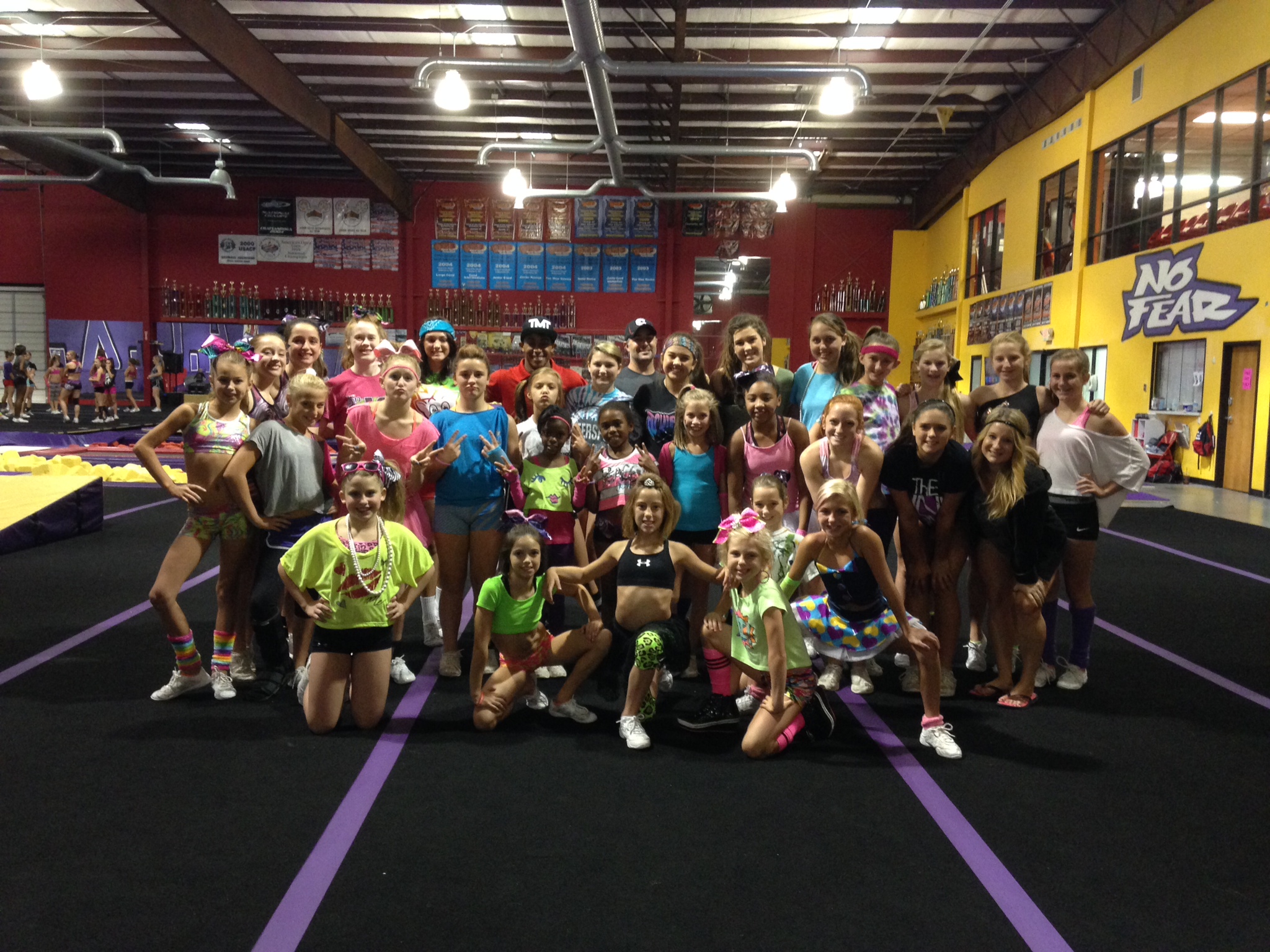 Despite the organization’s efforts to influence rules, vendors and event producers, Dickey still considers the knowledge shared among gym owners the group’s biggest achievement. At retreats and on the ASGA Facebook page, they discuss everything from how to deal with irate parents to how help athletes push past tumbling plateaus to how to organize fundraisers.
The collective goal? Longevity. “[Fellow ASGA leader] Courtney [Smith-Pope] and I want to make sure the industry is still around when our kids take over the gym,” Dickey says. “There’s an astounding rate of gyms going out of business, and we like to think we’re reducing that.”
Dickey’s own road to cheerleading was an unconventional one—he was on both the football and the wrestling teams at his high school until he injured his arm during junior year right before state championships. (He still competed, with his arm taped to his body.) The next year, everything changed for Dickey. He intended to play football as planned, but an athletic director dissuaded him because he wasn’t getting a scholarship in the sport. “Well, what am I supposed to do to stay in shape?” Dickey remembers asking him. As far as Dickey was concerned, cross-country was definitely out. “[I considered] running a punishment,” Dickey says. “I just figured that something similar to wrestling would be gymnastics.”
After he saw a VCR tape of a UCA summer camp, where the guys were stunting with women, Dickey was sold on cheerleading. He joined the squad his senior year of high school and scored both a wrestling and cheer scholarship to Georgia State. Post-college, he worked at Pro Cheer and later opened locations for industry veteran Tate Chalk.
Now Dickey not only owns ACX Cheer Gyms with two locations, but also produces his own cheer music—taking inspiration from his saxophonist father (who played with acts such as Aretha Franklin and The Drifters) and sometimes using his daughter’s voice on tracks. Next up: he’s planning to franchise ACX, a brand he’s worked hard to perfect.
“I don’t want to own any more facilities, per se,” he says. “However, if people want to take the business model that I have, use our name and have weekly meetings via Skype, [I’m willing to] just have my own private kind of gang, so to speak, of ACX gyms. They would own them and do their thing and just pay a monthly fee to run it like we do, and they can reap the benefits. I think that [approach] is a good, safe place to go for me, one that will help secure my future and basically help me enable gyms to stay successful that may have struggled.”
That hard-won reputation in the industry and desire to help other gyms grow is especially important to Dickey for personal reasons. “The reason I’m so passionate about cheerleading is because of everything that it’s given my family,” he says. “I’ve really never had any other job, so…without cheerleading, I wouldn’t be where I am right now, with the family that I have or the home [that we own]. That’s why I’m so passionate about giving back—because of what it’s done for me.”
–Jamie Beckman
Money Talks: Explaining Fees to Parents
jen : February 13, 2014 2:29 pm : Down to Business| Web Exclusives It’s a common gym owner conundrum: “My parents are researching event costs on their own and questioning my fees!” After all, it’s easier than ever for parents to get online and do their own legwork—since event producers are utilizing the same strategies that gym owners use to market their businesses, from informative websites to robust social media platforms like Facebook and Twitter. But what does that mean for gym owners who get caught in the crossfire? We asked Julie Hallam, co-owner of New Freedom, PA-based Titanium Athletics, and Tara Wieland, program director for Midland, MI-based Michigan Storm Cheer & Dance, for their take.
The Transparency Dilemma
The bottom line: parents want to know where their money is going. Hallam first started to notice a spike in this trend during the country’s economic downturn in 2008. “Parents started using the Internet to research fees,” she says. “They wondered where their money was going.”
Like many gyms, Titanium Athletics operates in a rural area. The majority of Hallam’s athletes come from single-income homes. “[The families] are cost-conscious,” she says. Parents review competition websites, look at posted entry fees, run the numbers—but from their perspective, they don’t add up. While Hallam can’t blame parents for being thrifty, she maintains that they’re not taking into account what gyms actually pay to attend competitions: “There is much more to it than that.”
It’s the nuances to the business of all-star cheer and gym pricing, Hallam says, that parents don’t understand. She acknowledges marking up competition fees, but asserts that the approach is essential for gym owners to continue to operate. “It covers additional costs,” she adds, “like my coaching staff’s travel expenses to attend competitions and extras such as credit card or registered check fees.”
Tara Wieland with Michigan Storm Cheer and Dance agrees, adding that parents “don’t realize that event producers often alter their posted pricing at the last minute” due to unexpected schedule changes or cancellations. She, too, has noticed an increase in parents doing their own legwork. “10 years ago, it was different,” Wieland says. “Parents weren’t scrutinizing fees.”
This perceived discrepancy has created confusion (and sometimes anger) on the part of parents, prompting some gym owners to call for event producers to stop posting their prices publicly. However, Hallam and Wieland both believe that demanding competition websites remove pricing from public view is not the solution—rather, strategic parental communication is.
Smart Strategies
Hallam’s solution is to bundle her program membership dues for the entire season and then spread the costs out over 11 months, starting in June. Her membership includes competition fees but also incorporates coaching, tuition, tumbling, uniforms and competition travel costs for her staff. Internally, she uses a budget and bases her competition schedule on what they can afford to attend without charging more.
She admits she has cut out the smaller events. “They tend to eat up our budget, and our parents are looking for value,” says Hallam. She strives to balance parent expectations (such as competing on the national stage versus locally) with the quantity and quality of competitions they can realistically manage. “We also look at attending events where the awards add value to the cost of competing,” she notes.
Hallam’s intent is not to hide costs from parents. But she believes charging a flat fee—where costs aren’t necessarily allocated to a specific competition—over a period of time allows her to cover all expenses without having to defend her fee structure to parents.
Wieland employs a somewhat different strategy, providing parents with an exhaustive list of where their membership dues are going. “[We tell them], ‘This is how much for coaches, this is how much for travel,’” she says. “Parents know competition costs aren’t the only thing they are paying for.” She too looks for value when it comes to choosing events, putting an emphasis on those that offer a family atmosphere and a superior experience for both the kids and parents.
While Hallam and Wieland approach the issue of presenting fees differently, they agree that, now more than ever, it’s essential to effectively manage the parent-gym relationship. “Our industry has to be sensitive to parents wanting to know where their money is going,” Hallam says. “But there also has to be a certain level of trust [by parents], too.”
An EP’s Perspective
Billy Smith knows both sides of this situation all too well—after all, he was a coach and gym owner before he began producing events at the helm of Spirit Celebration and Amazing! Championships. “[When I owned a gym], I did not hide anything from my parents,” he shares. “The best thing you can do is be upfront and let them know flat out what the costs are—travel expenses, per diem, hotel, coaching—so they know the deal. I don’t think coaches have the right to gouge parents, just like EPs don’t have the right to gouge coaches.”
On that note, Smith also maintains that posting competition fees promotes consistency and fairness across the board on the part of event producers. “If we didn’t post our prices, I could in theory make up different prices for different gyms,” he points out.
The bottom line? Gym owners must stand their ground when it comes to dealing with parents. “You’ve got to be really careful of how much power you give up when you’re the owner,” cautions Smith. “The gyms that have the most discipline will succeed.”
Pinterest & Instagram: A Crash Course
jen : February 10, 2014 12:51 pm : Down to Business| Web Exclusives| webexclusive2 If Thunder Elite All-Stars coach Cher Fuller has her phone out while her Junior Level 3’s are running a routine, it’s not because she’s texting. She’s boosting the gym’s brand—and bonding with her athletes—by snapping a quick picture or video of their progress to share on Instagram. When she’s not coaching, Fuller works at an ad agency, and she understands how social media can help a business grow. By now, many cheer gyms now have active Facebook and Twitter accounts and know the benefits of connecting with athletes, parents and potential customers on those platforms—but Instagram and Pinterest can develop that connection even further.
“From a business perspective, Instagram is probably a little more lucrative as far as a marketing tool, but Pinterest can be great for building community,” says Kate Boyd, a cheer coach, choreographer and corporate communications expert. Intrigued? We asked Boyd, Fuller and other experts for their tips on how to pump up your gym’s online presence with these powerful tools.
Instagram: Snap a pic that offers a peek inside your gym.
Got a smartphone? Get Instagram. It’s a quick, easy and free way to get your message across. Once you install the app, all you have to do is take a picture, add a short caption and upload it. (FYI: Instagram is primarily for use on mobile devices. You can view photos on a computer, but you won’t have access to your full account.)
Boyd recommends using Instagram to offer a glimpse behind the scenes. “If you’re mixing your own music, take a picture of your computer. If you do your own choreography, take a picture of yourself in the mirror dancing. It gives the people looking at your account a sneak peek at what’s going on,” shares Boyd. Posting fun, candid photos on your Instagram feed will also give followers a strong sense of your gym’s culture. “Everyone wants to win and everyone wants to work hard, but the values embedded in your programs are either a good fit for a family or they’re not,” adds Fuller.
Once you get the hang of it, you can also start employing “hashtags” to get your photos maximum exposure. Adding a simple hashtag like #cheerleading or #Worlds to your post can attract hundreds of eyes to your page and help propel your gym’s name into the social stratosphere.
Pinterest: Pin your way to community connections.
Setting up a Pinterest account can help strengthen your gym’s relationships with athletes and their parents. Pinterest offers community boards where different people can contribute images; Boyd recommends using these to gather T-shirt and bow ideas, as well as a way to solicit suggestions from parents when your gym is planning an event.
If you want your account to attract people to your gym, Boyd suggests creating and pinning your own content as well. She says that the platform can be a good forum for “educating parents regarding behavior, nutrition and sportsmanship. You’re showing parents that you have their cheerleader’s best interest at heart.” A few great examples: the Pinterest pages for North Canton, OH-based NEO All-Stars (which has more than 25 boards on topics like “Conditioning,” “Muscle-Building Smoothies,” “Cheer Moms,” “Cheerleading Worlds,” and “Travel Ideas”) and Marietta, GA-based Legends Elite All-Star Cheerleading (which has boards on topics like “The Summit,” “Cheer Bows,” and “Legends Elite”).
If you’re new to Pinterest, Fuller advises planning ahead. “Sit down with your coaches and your owners and figure out what exactly it is that you’re trying to accomplish. If you want to talk about different stunts that are out there, different bows, different outfits or different teams that you idolize, bucket those into different categories, so it’s not just a chaotic mess.” Creating a Pinterest board for each category (ala NEO All-Stars or Legends Elite) will help keep your account organized as you add more and more pins in the future.
Getting Started
Before you set up a profile, think about how you want to brand your gym. “What kind of message are you trying to get across? What kind of picture are you trying to paint?” asks Sarah Gosnell, owner of Legends Elite All-Star Cheerleading, who keeps those questions in mind as she manages the gym’s Pinterest page.
When you first set up a new account, don’t rush into promoting it. Fuller recommends posting at least 10 pictures before you share the link publicly, so that you aren’t directing people to an empty page. “The best way to populate an account is when you don’t have followers. Get a few pictures up there, so that when you start driving traffic to your account, you actually have something to keep people there. It gives them a reason to come back,” she suggests.
As you build your account, always keep your gym’s goals and desired image in mind. Gosnell advises, “Be sure that whatever you’re putting out there, you’d be okay with your competitors seeing and kids who cheer for a rival gym seeing.” Once it’s set up and you’re ready to spread the word, share the link on your official website and on your Facebook or Twitter pages. If your gym’s athletes, parents and coaches are using Instagram or Pinterest, follow them and encourage them to tag you in posts. And, finally, don’t feel pressured to set up more accounts than you can handle—choose what feels right for your gym and master that platform. As Fuller points out, “There are a lot of great social platforms out there, but if you try to get onto all of them, you’re [likely] to neglect something. Pick what you’re interested in, and focus on those.”
-Lisa Beebe


